

Why Christ Came (Hebrews 2.5-18)
You all know that Christmas is almost here, and most of you probably know that Christmas is the day that Christians celebrate the birth of Jesus Christ. We all know the scene: the baby in the manger, the parents watching (usually way more peacefully than new parents are, ever), maybe the shepherds and the animals gathered around. The baby is always clean and sleeping and looks just perfect.
It can seem like something out of a fairy tale, rather than something that really happened—much less something that actually makes a difference in our lives today.
But it did, and it does.
We’ve been preparing for Christmas by looking at the first couple chapters of the book of Hebrews, in the New Testament, the second part of the Bible. So far we’ve seen that the baby Jesus in the manger wasn’t just a baby who would grow up to be a good teacher or an influential leader. The author tells us that Jesus, that baby born in Bethlehem, is God himself. When God took on a human nature and came into this world as a human being, he has made himself visible to us. Jesus is the perfect expression of who God is, because he is God.
And then last week we saw that because of what Christ did, he has taken up his place of supreme authority over all things. So we are called to listen to him, to hold tight to the good news he has given us.
All that is important. But if you’re coming to this fresh, those may not be the first questions in your mind. You come to church for a Christmas service, and you’re expecting we’re going to tell the nice story we were talking about—the story of baby Jesus. That’s not what we’re going to do this morning, at least not exactly.
Instead, we’re going to continue in chapter 2 of Hebrews, to answer the question, as clearly as possible: Why did Jesus come?
The text gives us four different answers to the question. It tells us that:
1. Jesus came to rule;
2. Jesus came to make a family;
3. Jesus came to defeat sin and death; and
4. Jesus came to be our faithful High Priest.
Jesus Came to Rule (v. 5-9)
The first thing we see here is that Christ came to rule. Not over a country, or a city, but over everything. And if you look at what the author says here, this isn’t a future goal Christ has established for himself—this is something that has already happened. V. 5:
5 For it was not to angels that God subjected the world to come, of which we are speaking. 6 It has been testified somewhere,
“What is man, that you are mindful of him,
or the son of man, that you care for him?
7 You made him for a little while lower than the angels;
you have crowned him with glory and honor,
8 putting everything in subjection under his feet.”
Now in putting everything in subjection to him, he left nothing outside his control. At present, we do not yet see everything in subjection to him. 9 But we see him who for a little while was made lower than the angels, namely Jesus, crowned with glory and honor because of the suffering of death, so that by the grace of God he might taste death for everyone.
So you notice that every time the author talks about the world—both this world and “the world to come,” that is, heaven—being put “in subjection to” Jesus, he doesn’t put it in the future, but in the past. Jesus is already ruling over all things.
The thing is, though, if you look around at the world, it’s pretty hard to see that. It doesn’t look like Jesus is ruling. And the author told us this was the case. At the end of v. 8, he says, At present, we do not yet see everything in subjection to him. That is, at this point, he is ruling over a world that doesn’t know its King. A world that doesn’t recognize its King.
I’ll never forget the first time I read Psalm 8, which is quoted in v. 6-8, and realized that it’s not actually about us. I’d grown up in church, and I’d always heard that psalm being used as a way to reassure us, that God actually cares for us.
God does care for us, but Psalm 8 isn’t about us, and the author makes that connection here.
When he came to rule, the Son of God could have come down, guns blazing, to make the world get into line and do what he wants. But he didn’t do that. We don’t see everything in subjection to him yet; what do we see instead?
We see a King who was for a little while made “lower than the angels.” We see a King who, instead of waiting for us to reach him, came down to us. We see a King who went to live in the slums with his people. We see a King who made himself small.
That sounds like an unusual way to put something “in subjection” to you. But it’s not—you might fear someone who was powerful and huge and domineering, but you won’t love them. You won’t trust them. You won’t be drawn to them. Jesus is not a King who strong-arms people into following him. He is a King who is so humble, once we know him we love to follow him.
He came to rule in that way, for all eternity.
Jesus Came to Make a Family (v. 9-13)
The second reason Jesus came was to make a family. Let’s read v. 9 again:
But we see him who for a little while was made lower than the angels, namely Jesus, crowned with glory and honor because of the suffering of death, so that by the grace of God he might taste death for everyone.
10 For it was fitting that he, for whom and by whom all things exist, in bringing many sons to glory, should make the founder of their salvation perfect through suffering. 11 For he who sanctifies and those who are sanctified all have one source. That is why he is not ashamed to call them brothers, 12 saying,
“I will tell of your name to my brothers;
in the midst of the congregation I will sing your praise.”
13 And again,
“I will put my trust in him.”
And again,
“Behold, I and the children God has given me.”
Do you see it? It’s Jesus talking in v. 13, when he says, “Look—I and the children God has given me.”
This is the incredible truth of the gospel of Jesus Christ: through what Jesus did for us, God has adopted all those who placed their faith in Christ as his sons and daughters.
It’s hard for most of us to feel the incredible weight of the grace that is adoption.
My younger brother Jared got married last weekend to a wonderful woman named Desiree. The wedding began as all weddings do—the groom was up front, the bridal party came in and took their places. Next would be the moment where everyone would stand up to watch the bride make her entrance.
But instead, the pastor (who happens to be our dad) asked everyone to stay in their seats. He said that normally at a wedding, the bride would be walked down the aisle with her father—but that today, Desiree would be walking down the aisle alone. He explained that when Desiree was little, her mother died suddenly, and seven years later, Desiree’s father abandoned her and her sisters. They grew up in foster care and benefited from the support of some wonderful caregivers, who were present at the wedding. But Desiree was never adopted; she’s been without parents for most of her life.
My father pointed out her former caregivers in the seats, had them stand so that everyone could see them. Then this happened:
I have heard very few stories in the last several years that illustrate this point better. Desirée, who was abandoned by her only living parent, feels the weight of her adoption by God so keenly that it wasn’t sad for her to walk down the aisle unescorted. It was a privilege—because God is her Father, and he was faithful to her. She is no longer an orphan.
This is what the author means when he says we have become “children” of God, “brothers” of Christ. This is how we are brought into Psalm 8, that we talked about earlier. We have been adopted by God, brought into his family by the finished work of Jesus. The Son of God took on humanity, in order that “he who sanctifies” (that is, Jesus, who makes people holy) and “those who are sanctified” all have one source. We share humanity with him—and that is why he is not ashamed to call us brothers. He made us his family, and he brought us along with him, into his heavenly reign.
Jesus came to make a family.
Jesus Came to Defeat Death (v. 14-15)
Third—Jesus came to defeat death. V. 14:
14 Since therefore the children share in flesh and blood, he himself likewise partook of the same things, that through death he might destroy the one who has the power of death, that is, the devil, 15 and deliver all those who through fear of death were subject to lifelong slavery.
We need to realize that the fear of death drives so much of what we do on a day-to-day basis. We want to live, but we know our time is limited. So what do we do?
We either ignore the reality of our death, and waste our time on unimportant things until it’s too late; or we try to amass as much happiness for ourselves as we can, to make the most of the time that we have, because we know it’s limited. That’s not necessarily a bad thing, trying to be as happy as we can, but we try to find it in a million different things—in marriage, or kids, or our career, or our hobbies, or our friends—a million things that will ultimately disappoint us, because none of it will last.
It’s no accident that the author calls this a kind of slavery. It’s a vicious cycle that we follow because we don’t see any other way.
But Jesus did.
Because human beings had sinned against God, we are all separated from him. God himself is the source of our life—so separation from God means a slow and steady death, and then condemnation for our rebellion against him.
But if a human being could live a perfect life, then he wouldn’t be separated from God. And if that human being could die, actually pas through death, and then come back from the dead better than he was before… Well, that human being could make it possible for any of us to do the same. It would neutralize the threat.
That’s what Jesus did. He lived a perfect life, the life we should have lived; he took our sins on himself and was punished for those sins in our place; he died, a real, human death, after suffering all the wrath of God against our sin; and then he came back, glorified and made perfect.
And the wonderful thing is, he did it for us. He went through that for us. He actually preceded us in death, and came out the other side, so he can say to us, “Don’t worry. Trust me, and it will be okay.” If we lay hold of Christ, we can live without the fear of dying—without this fear that dictates everything we do. We can live, for the first time, and forever, absolutely free.
Christ came to defeat death.
Jesus Came to Be Our Faithful High Priest (v. 16-18)
Lastly: Jesus came to be our faithful high priest. V. 16:
16 For surely it is not angels that he helps, but he helps the offspring of Abraham.
(That is, all those who belong to his family.)
17 Therefore he had to be made like his brothers in every respect, so that he might become a merciful and faithful high priest in the service of God, to make propitiation for the sins of the people. 18 For because he himself has suffered when tempted, he is able to help those who are being tempted.
Why is this such good news? We saw that sin leads to death; sin also leads to fear and guilt. Because we can hear that at least theoretically, Christ saved us… But now I’m tempted to sin again. I’m trying to fight, but it’s really hard. That struggle makes me feel ashamed, and afraid, because I’m terrified that I can’t resist the temptation, and if I fail, how could God still love me?
When we feel that way—and all of us will, at some point—we need someone in our corner.
When you are going through a hard time, nothing is more reassuring, more calming, more helpful, than talking to someone who knows exactly what you’re going through. Even if they don’t have any real advice to give you, it’s just wonderful to know that someone understands, that they’re not looking down on you, and they have your back.
This is what Christ does for us now. He was made like us in every respect: when he was born, it was in a real human body, subject to the same weaknesses and temptations as we are. He resisted those temptations until the end, so he knows how hard it is. He gets it.
You see, Christ didn’t just come to die; he came to live.
He died so that our sin might be done away with, paid for, once and for all. And he lived so that he might understand why living as a weak human being is difficult—that he might be “a merciful and faithful high priest.”
The high priest, for the Israelites, was the intermediary between God and man. He was the person who would come to make sacrifices before God. Those sacrifices would temporarily cleanse the people of their sin, so they could keep on being the people of God. Every time the high priest would go into the temple to offer sacrifices, he would essentially say to God, “You see? Their sin is taken care of. They are still your people.”
But the high priest for the Israelites wasn’t a perfect priest, because he was a sinner too, and every high priest would eventually die—it wasn’t a permanent solution.
But now, Jesus Christ stands as a perfect high priest. A high priest who permanently stands before God and says, “You see? Your wrath has already been poured out on this person’s sin.” (That’s what the word “propitiation” means in v. 17—it’s a sacrifice that satisfies the wrath of God and his demand for justice.) Jesus is a high priest who understands what it’s like to be tempted. For because he himself has suffered when tempted, he is able to help those who are being tempted.
Conclusion
So think back to the story you know—the baby, lying in a manger. At that point in time, it would have been hard to anticipate what that baby would grow up to be. Even Mary, who had heard from the angel that the child would be miraculously conceived of the Holy Spirit, and that he would be “holy, the Son of the Most High” (Luke 1.30-35), didn’t really know exactly what he would be like.
What would you expect of a baby who was also the Son of God? What would you expect him to be like when he grew up? You might expect him to grow up to be incredibly handsome, very strong—a great warrior who would free his people from Roman occupation and after, rule over them.
But that’s not exactly what ended up happening.
He did come to rule—but his reign would be totally different from what you’d expect of the Son of God. It wasn’t earned through military victory or through might, but through humility and sacrifice.
He did come to rule—but he came to rule over a family, not subjects. He came to bring a great many brothers and sisters by his side, that he might share the benefits of his reign with them.
He did come to rule—but it was unacceptable that his rule be temporary, over subjects who will one day be separated from him. And it was unacceptable that his rule be forever contested and rebelled against. So he took on the sin that separated us from him, the sin that brought death, and he defeated them on the cross.
He did come to rule—but he didn’t ask his subjects to do anything that he hadn’t already done himself. So he lived the life we live: a hard life, a life of suffering, a life of struggle with temptation and weakness. He is a ruler who knows what it’s like not to be strong, so he is a compassionate advocate for us.
He did come to rule—but he came to rule over an eternal family, an eternal kingdom. He tasted death for all of us, and came out on the other side, alive and well, so that we might know we don’t have to fear death—which means we don’t have to be enslaved by fear.
Chapter 2 of this book begins with these words:
The first chapter of this book spoke of the superiority of Christ—his power and his greatness and his glory. The resounding message is, You’d better not resist him. Don’t neglect such a great salvation.
But then following that, in tchapter 2, we see the author speaking of the kind of authority Christ wields: his authority is humble, and loving, and sacrificial, and compassionate.
That changes the message a good deal, doesn’t it? Instead of simply saying, Don’t neglect such a great salvation, the author says, Why would you WANT to? It’s hard to follow and obey a dictator… But a loving, gracious, caring King? Why wouldn’t we want a King like that?
Christ is a good King, who gave himself for his people, who loves us and who is trustworthy and compassionate. So I would invite you, this Christmas season, to follow him. Do not neglect such a great salvation.
Every time you see a manger scene, every time you see a Christmas tree, every time you see a gift or a decoration, realize that all of these superficial things are actually calling you to a much higher joy than anything this world can offer. Come to your King.
Christ Superior to Angels (Hebrews 1.5-2.4)
There’s a story almost everyone has heard, sometimes without even realizing it. The story involves a group of shepherds who are out in the fields, watching over their sheep. All of a sudden, out of nowhere, an angel appears in the sky, shining with the glory of God.
The shepherds are, quite understandably, terrified.
That story is told in Luke 2, and we’ll come back to it in a minute. But it’s not the only story in the Bible like this. Almost every time we see an angel appear in the Bible, the people who see them are terrified.
Why were they so afraid? The Bible isn’t super explicit about what angels look like—and certain angels are described in different ways, often in ways that don’t even make a lot of sense, as if the author was struggling to find words to describe what he had seen.
We know a few things about them from the Bible, though. Angels exist, for one: they are real beings. Angels are spiritual beings created by God—so they’re not physical, or at least rarely take on physical form. Angels are servants of God. Lastly, angels are incredibly powerful: and not only are they powerful, but when an angel is sent by God, they often shine with God’s glory, like we see in Luke.
It would be hard for a first-century believer to imagine any being more powerful than an angel.
That being said, let’s go back to the story in Luke 2.
The shepherds see the angel; they are terrified. The angel tells them not to be afraid, and then he tells them that in the nearby town of Bethlehem, a Savior has been born. He is the Christ, the Messiah that the Jewish people have so long been waiting for, the one who would save them.
Then all of a sudden there’s not only one angel, but a multitude of angels praising God.
So the shepherds run to Bethlehem, to find this Messiah baby the angel had announced to them.
Now, if you were one of the shepherds, what could you reasonably expect to find in this place you’re going? Something amazing, right? The person who makes the announcements at a wedding—the one who tells everyone where to sit, where to park their cars, what time drinks will be served—is not more important than the bride. That person won’t be dressed as beautifully as the bride.
So if a multitude of angels were the ones announcing the birth of this Savior, what must this child be like?!
I don’t know what they were expecting, but we do know what they found.
They found…a baby.
A very ordinary-looking baby, with two ordinary-looking parents. The shepherds weren’t terrified of the baby like they were the angels. Even more, they found this baby lying in a manger, a feeding trough for animals. Hardly what one could call glorious—certainly not more glorious than the angels.
And yet, this baby was more glorious than the angels, and still is.
This is what the author of the letter to the Hebrews insists upon in the second part of chapter 1.
Last week, in v. 1-3, we saw that God has revealed himself perfectly in his Son—Jesus Christ, this baby born in the manger, who grew up, lived a sinless life, died to make purification for our sins, and is now seated at the right hand of God. Now, beginning in v. 4, we see the author deepening his argument even further by making one contrast after another, between these two incredible categories: the Son on one side, and angels on the other.
Jesus is the Son (v. 4-7)
The author lays it on thick right out of the gate. The first reason Christ is superior to the angels is his relationship with the Father. V. 4:
[The Son has] become as much superior to angels as the name he has inherited is more excellent than theirs.
5 For to which of the angels did God ever say,
“You are my Son,
today I have begotten you”?
Or again,
“I will be to him a father,
and he shall be to me a son”?
6 And again, when he brings the firstborn into the world, he says,
“Let all God’s angels worship him.”
7 Of the angels he says,
“He makes his angels winds,
and his ministers a flame of fire.”
If you’re looking in your Bibles and you see certain verses put in a different format (for example, italicized or with regular line breaks), that’s the translator’s way of telling you that these are quotes from the Old Testament. In these quotes (mostly from the psalms) we see God speaking of the Messiah.
Which of the angels can say they have been called “sons” of God? None of them.
In addition, he says, the angels worship this Son, this firstborn that God brings into the world. They are naturally subservient to him.
The angels are powerful beings who serve God, but they are not worthy of worship. The Son, however, is. He commands the angels, and gives them the power to fulfill his commands.
Now this may all seem fairly obvious to us today; but remember the time in which the author is writing. The people to whom he is writing were contemporaries of Christ. They may not have all seen him (though some of them had), but this is being written only about thirty years after Christ’s death and resurrection. It would be like someone writing to us about Princess Diana. They have accepted Christ and they believe in him, but they still remember when he was around. It would have been hard to grasp just how glorious Jesus is.
That’s why he compares Christ with the angels: these are beings his readers also believe in, and which inspired awe and wonder and fear. And these incredible beings, he says, are subservient to Christ, because Christ is the Son. He has a filial relationship with God the Father that none of the angels have.
Jesus is Eternal (v. 8-12)
The second reason Christ is superior to the angels is because he is eternal and unchanging. V. 7 again:
7 Of the angels he says,
“He makes his angels winds,
and his ministers a flame of fire.”
8 But of the Son he says,
“Your throne, O God, is forever and ever,
the scepter of uprightness is the scepter of your kingdom.
9 You have loved righteousness and hated wickedness;
therefore God, your God, has anointed you
with the oil of gladness beyond your companions.”
10 And,
“You, Lord, laid the foundation of the earth in the beginning,
and the heavens are the work of your hands;
11 they will perish, but you remain;
they will all wear out like a garment,
12 like a robe you will roll them up,
like a garment they will be changed.
But you are the same,
and your years will have no end.”
Remember what we read last week, in v. 2? Through the Son, God created the world—that is, everything that exists that is not God himself. He created everything—including the angels.
It’s important to remember that in order to be eternal, it has to go in both directions. We have received eternal life if we have faith in Christ, but we ourselves are not eternal, because we had a beginning. The same thing applies to the angels. They are not gods; the one God created them.
God the Father, God the Son, God the Holy Spirit—the one true God—is the only being in existence who is truly eternal: he has no beginning and he has no end.
How is this possible if we just said that the Son was born? It’s a tricky question. He was born as a human being at a certain point in time, yes; but he existed an eternity before that. That’s why theologians like to use the word “incarnate” to describe Jesus Christ. He is God, and he always has been, but at just the right time he took on human flesh.
Think about that. For as long as angels have existed, there is an eternity before that, that they never saw. But that baby in the manger… He had seen it.
Not only is Christ eternal, he is unchanging. V. 12:
…like a robe you will roll them [the earth and the heavens] up,
like a garment they will be changed.
But you are the same,
and your years will have no end.”
Saying that Christ is “unchanging” is also an incredible thing to say about someone who lived an eternity as God, and then became something else. But that word “became” is a bit misleading; Christ didn’t stop being God just because he took on human flesh. When he took on our human nature, he did something he had never done before, but he was still the same God he had always been, and he still is that God today.
Christ never changes. He is still the same powerful, wise, sovereign, joyful God he has always been. And he’s the one holding us.
Jesus is Victorious (v. 13-14)
Lastly, Christ is superior to the angels because of the victory he has purchased. V. 13:
13 And to which of the angels has he ever said,
“Sit at my right hand
until I make your enemies a footstool for your feet”?
14 Are they not all ministering spirits sent out to serve for the sake of those who are to inherit salvation?
V. 13 quotes Psalm 110:1, a prophecy in which we see God speaking to the Messiah, the Christ. Christ is seated at the right hand of God, the position of ultimate authority. All things are under His feet, and He is waiting for the time when His enemies will be fully defeated.
The angels, though we do see them fight battles in the Bible, can claim no such victory for themselves. Their victory is not their own, but God’s, because he gives them the power and means to fight for him. They are not the champions; rather, they are “ministering spirits”. They serve God, yes; but the author mentions a surprising thing when he says that they also minister to us—to all those who have inherited salvation, as he says in v. 14.
Now we need to take a second here. In modern Christianity, we have been conditioned to feel like everything we’re doing on this earth is for us. It sneaks in, in subtle ways, in the words to the songs we sing together, in the prayers we hear one another pray. We’ve been conditioned to think of ourselves as precious to God. And while that is true, it’s possible that we have become desensitized to the wonder of that truth.
So it’s worthwhile, when we read this, to remember what we’re talking about. When people encountered angels in the Bible, they were petrified. That level of power and glory and beauty was just too much to handle. If we had to stand next to an angel today, and answer the question, “Who is more important? You or the angel?”, not a single person here would say, “Me. I’m more important.” We’d be struggling just to stay on our feet.
That’s why v. 14 should hit us hard. Since v. 4, the author has been comparing Christ to the angels, saying, “Christ is way up here, and the angels, for all their power, are far below him.” Where do we fit on that scale? If you just look at what we bring to the table, we’re far below the angels. We have no supernatural power of our own. We bring with us our weakness, our failures, our sin.
And yet, God has sent the angels to serve us. He has given us a place of honor even above the angels, adopted us as his sons and daughters. I think that is why he talks about our “inheriting salvation”, and not simply “receiving” it; I think it’s a deliberate callback to v. 2 and 4, when he talks about the Son inheriting all things, inheriting the greatest of all names, because of his filial relationship to the Father. Strangers are not heirs; sons and daughters are heirs.
Christ has inherited all things because he is the Son of the Father, and we have inherited salvation because we have been adopted as God’s sons and daughters.
The angels, for all of their beauty and power, have not received this; they have not “inherited salvation.” The apostle Peter tells us that the grace we have received from God is something “into which angels long to look” (1 Peter 1.12). It might be easy to look at angels and think, How amazing would it be to be one of them? To serve in the presence of God, to be given this incredible power?
But the angels look at us and say, How amazing would it be to be one of them? To be able to experience the unmerited grace and the mercy of God, to receive the gift of the Son who died for them and the Spirit who lives in them?
The Son of God, who is infinitely greater than the most amazing beings in creation, made purification for our sins. He gave us a perfect revelation of who God is. He lived, died and was raised to apply his work to us.
I hope you can see what the author is doing with this masterful exposition of the greatness of the Son of God—all these descriptions and comparisons are there to fire up our imaginations, to shock us with just how great Christ is. And we need to be shocked—we need to be wide awake—or we will never respond to these truths as we should.
Do Not Neglect Your Salvation (2.1-4)
So what is the appropriate response to these truths?
The author gives us a clear answer at the beginning of chapter 2—since we have received such grace from God, since the Son has taken up his rightful place of victory and authority, and since he has made us heirs of the salvation he built for us:
Therefore we must pay much closer attention to what we have heard, lest we drift away from it. 2 For since the message declared by angels proved to be reliable, and every transgression or disobedience received a just retribution, 3 how shall we escape if we neglect such a great salvation? It was declared at first by the Lord, and it was attested to us by those who heard, 4 while God also bore witness by signs and wonders and various miracles and by gifts of the Holy Spirit distributed according to his will.
This is an argument from lesser to greater: Christ is clearly greater than the angels. When the author talks about “the message declared by angels,” he’s talking about the law; it is the Old Testament. This is a little mysterious, but we see in a number of places—namely, Deuteronomy 33.2, Acts 7.53 and Galatians 3.19—that angels were involved in the transmission of the law to God’s people.
What exactly was their involvement? I’m not sure, but that’s not the author’s point. His point is that everything we see in the Old Testament proved to be true. When God said he would do something, he did it. When God said that every transgression or disobedience would receive a just retribution, he was telling the truth. And if this message, declared by the angels, was reliable, how much more is the good news that the Son of God himself has declared to us, that was passed on by those who heard him firsthand, and which God proved through the signs and wonders he performed in the church?
If what the angels said proved to be true, how much more trustworthy is what the Son of God has said?
He says all of this to hammer one point home: We must pay even closer attention to what we have heard, lest we drift away from it… How shall we escape if we neglect such a great salvation?
Now of course this can make some people uneasy, because the author is writing to Christians here. Is he saying that Christians who have been genuinely and truly saved by faith in Jesus Christ today can suddenly be not saved tomorrow?
No, he’s not saying that. He’s doing two things here that we see over and over again in the Bible.
First, he’s using a warning to protect us. God often does this in the Bible; he speaks to us like a parent speaks to a child. A parent of a toddler will constantly say things like, “Don’t put your hand in the fire. If you put your hand in the fire, you’ll get burned.” On the one hand, that’s true—if the kid puts his hand in the fire, he’ll get burned. But the reason we say that isn’t because it’s going to happen. We say it to keep that from happening. Loanne and I said it to Jack and Zadie when they were little—and thank the Lord, neither of them have ever stuck their hand into an open flame. They’ve never been burned.
God constantly uses warnings, not to paralyze us with fear of failure, but to protect us from failure. He’s giving us this warning to help us realize that maybe there are areas of our lives where we’ve started to drift, where we’ve started to neglect our salvation. And he’s telling us, “Watch out. Don’t do that. Pay attention to what you’ve heard. Be alert.”
But that’s not all he’s doing. He’s also saying these things to wake us up. The author of this book is also aware that whenever you’re addressing a church, you’ll have people in the crowd who are genuine believers, who have placed their faith in Christ and are committed to following him.
But you also have people who aren’t there yet. You have some who are present, but who don’t yet believe; and you have some who are pretending to believe, but who aren’t actually disciples of Christ. They’re not following him, they’re not living for him. They know how to pretend because they’ve been in the church for long enough. They know the lingo, they understand how to wear that mask.
But they’re still wearing a mask.
To these people, he’s saying the same thing: he wants to wake them up. You know what you need to know; you’ve heard what you need to hear. But since the message declared by angels proved to be reliable, and every transgression or disobedience received a just retribution, how shall we escape if we neglect such a great salvation?
Our Lord and Savior is infinitely high above every power, every authority, every servant of God in the heavenly places. He reigns over all things, he has authority over all things, and he is coming back to judge the living and the dead. He lived, died and was raised to save his people—and if you neglect this salvation, you will not escape.
To all of these different types of people who might be reading this book—to every person in this room—he’s saying the same thing: don’t neglect your salvation. Pay even closer attention to what you have heard. If there’s any area of drift, stop drifting—come back. If you have neglected salvation so far, stop. If you keep going down that road, you will not escape.
This may seem like a strange tone for an Advent service, but this is what Advent is about.
We will never feel the immediacy of that call until we have understood the beauty and the power and the greatness of the Son of God. Every time we see Jesus do anything in the gospels, every time we see a Christmas tree and remember what we actually celebrate at this time of year, our minds should be blown. We will never fully enjoy Christmas until we realize that this is what we are celebrating. This incredible, glorious Son of God, who is infinitely high above the angels, is the little baby born in Bethlehem—this little baby whom the angels worshiped, and who was given for us.
This season is anything but light; it is anything but simply festive. This season is a reminder of the greatest power in the universe, whom we are allowed to know. So all of the things that come with this holiday—every decoration, every meal, every present—should bring to the front of our mind this simple call: Don’t stop listening to him. Pay attention to what you have heard. Don’t neglect your salvation. Follow him.
A Concrete God (Hebrews 1.1-3)
My godfather’s name was Bill. He was a single man almost all of his life, and then in his seventies he met a woman named Nancy. He met Nancy, of all places, online. They chatted on Facebook for months. They had long conversations, but it was always through chat. (They lived far away from each other, and couldn’t afford all the long-distance phone calls.) After almost a year of chatting online, Bill and Nancy decided to get married.
They had never met in person, but they felt they had known each other for years. The first time they met was the day before their wedding.
I got the opportunity to see them both a couple of times before Bill died a few years ago. It was strange for me, because I had always only known him as a single man. But he was happier than I had ever seen him, now that he had found Nancy. I was asking about their experience, seeing each other for the first time in person, getting to know one another in person, and said it must have been strange.
But both of them agreed that it was exactly as they had expected, only better. They already knew enough about one another to know they loved each other and wanted to be together. And everything they saw when they finally met only confirmed and deepened that love, and made it even more real.
Now here’s why I’m saying this. I just spent the last three weeks in the U.S. And already, when I landed in the States three weeks ago, people had already put up Christmas decorations. My parents already had a Christmas tree in their living room. A lot of people expect a lot of things this time of year, and it’s easy to get distracted with the decorations and the gifts and the meals, especially if Christmas was a big deal in your home when you were young, like it was in my home.
But the real reason we celebrate this whole season isn’t because of all of these things, no matter how fun they may be. We celebrate this season because of the dynamic we saw between Bill and Nancy.
In the Old Testament, at least to a certain extent, we see God in the abstract. He made himself known through his laws, through the miraculous things he did, through his people, and through the prophets who spoke for him.
But no one ever got to see God himself. Even Moses only got the briefest glimpse of him, and even then, only in part.
And for the longest time, it seemed like that would be the way it would always be. The prophets had promised that a day would come when God would send the Messiah, this warrior-like figure who would conquer sin and free his people. But even then, no one quite understood what that would look like. They waited for hundreds of years for the arrival of this Messiah, but when he finally came, most of them didn’t recognize him, because he’s not at all what they expected.
But that fact—the unexpected nature of who Christ is—does not change this simple reality: Christ is how God has revealed himself. Not just his law, not just his will—himself. God is no longer abstract. He is concrete—visible and tangible and present.
So for this Advent season, that’s all we’re going to be seeing. We’re going to be looking at the first three chapters of the letters to the Hebrews. In these chapters, the author goes into great detail about this one main idea: in Christ, God has made himself fully known.
Context
Before we get started though, let’s give ourselves some context for what we’ll be seeing.
The book of Hebrews is sort of unusual. We don’t know exactly who the author is (I’m partial to Paul, but several people think it’s Apollos or Barnabas); it was finally decided it should be in the canon of the Bible because it is perfectly coherent with the other books. What makes it even more interesting is its structure: it’s structured more like a sermon than a letter, so a lot of people consider it a “sermonic letter”—a sermon that was written down and then sent out in letter form.
As far as the first audience goes, the traditional title “to the Hebrews” lets us know only that the original recipients were Jewish Christians. (Which makes perfect sense as you read the letter, because it is constantly drawing from the Old Testament; everything we just saw in the book of Exodus will be extremely helpful here.)
So let’s just read the text together—we’ll just be in the first three verses of chapter 1 today—and this will serve as a brief introduction to what we’ll be seeing these coming weeks.
Then and Now (v. 1-2a)
Long ago, at many times and in many ways, God spoke to our fathers by the prophets, 2 but in these last days he has spoken to us by his Son…
There is a lot to see here. First of all, we need to see that the author is intentionally making several distinctions.
First, there’s a distinction of time. It begins with “Long ago, at many times and in many ways”. But in v. 2, he says, “but in these last days”. Jewish Christians grew up with a profound attachment to the past, to their history. The author wants them to know that God’s revelation is not just a thing of the past; it is present, it is actual, it is here.
Second, there’s a distinction of to whom God is making his revelation known. V. 1: Long ago, God spoke to our fathers (our ancestors). But in v. 2: In these last days, he has spoken TO US. The Jewish Christians revered their ancestors—it’s easy to believe God would have spoken to them, because they were these incredible, outsized figures. But no, the author says—God hasn’t only spoken to them; he’s spoken to us.
Third, there’s a distinction of through whom this revelation has come. V. 1: God spoke to our fathers by the prophets. (In biblical thought, whenever you talked about “the prophets,” you weren’t just talking about the prophets mentioned in the stories, but the actual authors of all of the Old Testament books.) The prophets were God’s spokesmen, his ambassadors to the world, making known God’s will and God’s Word.
But now, he says in v. 2, in these last days, he has spoken to us by his Son.
We don’t ever see Christ’s name in this passage, but it will become clear later on that Jesus Christ is the “Son” the author is referring to. A long time ago, God spoke to our fathers by the prophets. But now, in these last days, he has spoken to us by his Son.
So there are a couple of questions that immediately spring to mind. The first is simple: Did God change his plans? He spoke for centuries through the prophets, then the prophets went silent for four hundred years. So it’s easy to assume that God’s revelation is finished, it’s all done. And if God was going to speak again, it would be reasonable to assume that he would do so through more prophets, since he had spoken through the prophets in the past.
So did God change his plan? If we keep reading, we’ll see that no, the Son isn’t a change of plan. Rather, he is the fulfillment of everything the prophets were pointing to.
Now this may have been a bit disconcerting for Jewish Christians. I just got back from a three-week trip to the U.S. for fundraising. We planned that trip, and the events that we did there, for several weeks. And I won’t lie, when I finally got there, and arrived at these events that were the culmination of these plans, it was a little nerve-wracking. What if it doesn’t succeed the way we hoped it would? What if the right people don’t hear the message we’re trying to send? What if the right people don’t respond? When you talk about the culmination of a plan, it can be scary, because if the plan doesn’t succeed…what’s left?
So the second question the author implicitly asks—the question he’ll spend the rest of this letter answering—is a simple one. If God spoke to our fathers in the past through the prophets, and now he’s spoken to us by the Son… How is the Son better? How is Jesus Christ better than everything that came before him? How is he better than the prophets? than angels? than Moses?
That is what we see in the following verses.
The Son: Revelation of God (v. 2-3)
V. 2 again:
…but in these last days he has spoken to us by his Son, whom he appointed the heir of all things, through whom also he created the world. 3 He is the radiance of the glory of God and the exact imprint of his nature, and he upholds the universe by the word of his power. After making purification for sins, he sat down at the right hand of the Majesty on high…
So let’s just work our way through this real quickly. What does the author say about the Son, by way of introduction?
First, he says that he is “the Son”. Whose Son? Well, he is God’s Son. That isn’t to suggest that God was there before the Son, or that he made the Son. This is tricky, and we won’t go into great detail, but this is the way the Bible talks about God: that there is one God, who has always existed in three distinct persons, the Father, the Son and the Holy Spirit. One God, three persons. The Son, the second person of the Trinity, became a human being and lived as a man named Jesus at the beginning of the first century A.D. He lived a perfect, sinless life, died and was raised again, and is now seated at the right hand of God. That’s who we’re talking about when we talk about the Son.
Second, the Son was appointed by God to be “the heir of all things.” When we think of an “heir,” we don’t usually think of someone who’s inheriting something small. It wouldn’t be worth mentioning that someone would be the heir of 30€ in a checking account and a mountain of debt. If you say, “He’s the heir of his father’s media empire,” that means something different.
The Son, we see, is “the heir of all things.” Not a few things, not even a vast fortune—ALL THINGS. Things in heaven and things on earth. Every corner of creation, every person, place or thing that exists, has ever existed or will ever exist… All of it belongs to him.
And that makes sense, because we see thirdly that the Son is the agent of the creation of all things: through [him God] also created the world. You remember, back in Genesis 1, when God said, “Let there be light,” and there was light? When God said, “Let there be light,” the Son is the one who flipped the switch. When God said, Let there be animals and plants and mountains and rivers and stars and, finally, people, Christ is the one who made those things.
Next, we see in v. 3 that he is “the radiance of the glory of God.” The glory of God is everything that God is, all of his attributes, made visible. It’s often metaphorically described as light.
It’s a little hard to picture this, but we can see it if we read the gospels. Jesus looked like an ordinary man, he talked like other men do. He learned a trade, he had skin and hair, in every respect he looked and sounded like us. And yet, during his ministry, what do we see? People gravitated toward him—even those who didn’t like him. They couldn’t help but be drawn to him. When they looked at him—not necessarily what he looked like, but what he was like—they could immediately tell that he was different from other men.
Why? Because, as we see next, the Son is “the exact imprint of [God’s] nature”. All of God’s character, all of his attributes, everything God is, was perfectly represented in Christ. People were drawn to Christ because he showed them what God was like. God’s nature was perfectly displayed in this man’s actions, in his words, in his character.
Now here’s where it gets crazy. Up until now we could say that what the author has said about Christ is relegated to the past. These are the things people saw when they looked at Jesus during his earthly ministry. But now we start to see Christ as he is now.
The author tells us that he “upholds the universe by the word of his power”. Think about this for a minute. Everybody, put your hand on your heart; do it until you can feel your heartbeat. (And if you can’t feel your heartbeat, we do have medical professionals here who can help.) Take a minute.
Now think about this. Every time your heart takes a beat, it’s because the Son is telling your heart to take a beat. Every time you take a breath, it’s because the Son is telling your lungs to keep breathing. Every time the wind blows, every time the sun rises and sets, every time a wave lands on the short, every time a bird manages to stay in the sky, it is because the Son is upholding all of those things by his powerful word. If he chose to do so, with a single word he could cause all of creation to stop. To just not be anymore.
Remember when Paul talked about rejoicing in the Lord always, about giving thanks in every circumstance? We just celebrated Thanksgiving together as a church. Some of you may feel like you don’t have a lot to be thankful for. But if your heart is still beating, if your lungs are still breathing, it is because Christ is making it happen. We always have reason to be thankful. We always have reasons to rejoice.
Next, we see that the Son made purification for sins. If you were paying attention during our series on Exodus, you know what this means. Humanity has rebelled against God; every individual person alive has rebelled against God. Humanity is totally and completely infected by sin. Our sin means that we can’t live with God; but the fact that we were created in his image means we can’t live without him either.
So God gave the Israelites a system of purification, a means of paying for the sin they’ve committed, at least for a little while. The priest would figuratively place their sin on an animal, and they would sacrifice the animal, who would essentially receive the punishment for that sin.
The problem, of course, is that for every sin that is paid for, there’s a whole lot more waiting just around the corner, so they had to offer those sacrifices again, and again, and again.
But the Son “made purification for sins” once and for all. He took all of the sin of all of God’s people throughout all history on himself, and he was crucified, and on the cross he absorbed all of God’s wrath against our sin. He acted as our priest, and our sacrifice—something no other human being was ever able to do. Only a perfectly sinless man could be the sacrifice for sinful people, and only God himself could absorb God’s wrath against sin. That is what the Son did.
And consequently, lastly, “he sat down at the right hand of the Majesty on high”. This means two things. First of all, it means that his purification for sin actually worked. The work of salvation has been completed, and there is nothing else for him to do to save his people—the work is done. And secondly, it means that since he has taken care of sin, the Son has now taken his rightful place, the place of supreme authority over all things.
Now obviously, that is a lot to digest in just two short verses.
1. Christ owns everything (even if we can’t see it yet).
2. Christ is at the origin of everything.
3. Christ is a perfect picture of God’s attributes.
4. Christ is a perfect picture of God’s character.
5. Christ keeps every molecule in movement.
6. Christ paid for the sins of his people, and thus:
7. Christ took up his throne to reign.
That is God, in a nutshell. When God wanted to fully reveal himself, he did it through his Son, who did all these things, and who continues to do these things and be this Savior.
If this is who God is, then we see so many of our common ideas about God have to be thrown out the window.
Like the idea that there are some parts of the world that didn’t come from him. The idea of a randomly generating universe is off the table if Christ is the perfect image of God.
Also the idea that you can see God’s attributes or character any other way. You can see some of God’s character by looking at creation, but you cannot go into the mountains and commune with nature and meet God in the process. You can go out there and get a hint of God, the way you can walk by a bakery and get a whiff of the bread that’s baking inside. But you cannot fully know God without knowing Christ.
Also the idea that there is anything in this world outside of his control. Christ upholds all things by the word of his power. A lot of things happen in this world that we do not understand; but nothing takes place outside of Christ’s sovereign will.
Also the idea that when he died, Christ made salvation possible for us, but that in order to be really saved, we need to be the ones to make it happen. There is a lot for us to do once we have been forgiven and saved of our sin, absolutely. But none of those things make us saved. We obey God’s commands not to be saved, but because we are saved. Christ has made purification for our sins, and we cannot add to that purification one bit. It is finished.
And finally, the idea that there are parts of the world or our lives that are “God’s territory”, and other parts that are ours. “God, you can have my Sundays and my social life, but my finances and my sexuality… I’m going to hang on to those.” It doesn’t work that way. Christ owns everything. God owns everything. Christ reigns over everything. There is no area of this world or of our lives over which he does not get to have his say.
Conclusion
This is our God.
But I’m not naïve; I’ve been doing this for a while now, so I know that some of you have already checked out on me. I know that some of you are listening to everything I’m saying and hearing it as if it’s just a story.
Don’t think I’m judging you for that; I completely understand. Sometimes I have a hard time thinking otherwise too. It can feel as if things have changed a bit since the author of Hebrews wrote this book. It can feel like God is once again abstract to us, because we weren’t there when these things happened, we don’t see Christ today.
But guess what? The people who read this letter for the first time… Chances are none of them had actually seen Christ in the flesh either. Maybe a few of the older ones did, but most of them had never seen him.
So what God does it say that Christ is the radiance of the glory of God, and the exact imprint of his nature, if none of us actually get to see him?
It’s a good question, and we find the answer in the fact that these things were written down for us. The author of this letter, and of all the other letters, and the gospels, and the book of Acts, wrote these things down, and believed they were enough.
We often say how much we would have loved to be with Christ like the disciples were. But this is a truth we may have a hard time believing: we see him better today than they did back then.
The disciples saw aspects of Jesus we don’t get to see, of course. They saw him when he was relaxed, they saw him laugh, they heard what his voice sounds like. But the opposite is also true. The disciples didn’t get to see all of Jesus that we see.
They weren’t with him twenty-four hours a day. And even when they were, they were were definitely moments when they were looking away, or thinking of something else, or simply misunderstanding what they were seeing.
But in the Bible, we have statements of intent. We have every vital moment recorded. We have descriptions of Christ’s feelings and attitudes and desires—things the disciples would only have been privy to if he had told them (which he didn’t always).
Do you remember what Jesus told his disciples in John 16.7? He told them it was better for them that he go away, because if he goes away, the Holy Spirit will come and live in and with God’s people. The Spirit takes these words that he inspired and anchors them in our hearts in a way that not even a physically present Christ could do.
This sounds complicated, but it’s very easy to understand. Think of the person you know best in the world—your wife, your husband, your brother or sister, your best friend. No matter how close you are to that person, you are still limited in your knowledge of them. You’re not with them every second of every day. You don’t get to read their thoughts; you don’t always know exactly how they’re feeling or what they’re thinking at every second. By definition, you’re outside of them.
Christ’s being not physically present means that his Holy Spirit is permanently present with us and in us. And that means that we have a 24/7 interpreter of Christ living inside of us. Every time we pick up the Bible and read these words about Christ inspired by the Spirit, we see Christ better than his disciples ever did. In the Holy Spirit-inspired descriptions of Christ we find in the Bible—in his words, acts and character, recorded for us—we have as clear a picture of him as we need.
In Christ as he is described for us in this book, we see God.
Now this is always important for us to know, but it can be particularly important at this time of year, because you walk outside, and you see Christmas lights. You walk in front of Printemps or Galéries Lafayette and you see the windows with all of the animations. We’re going to pick up a Christmas tree and decorate the apartment this week. If you have kids, the kids are going to be enamored with the decorations and the presents and the fun of it all. Family dinners, church events—even if Christmas is a hard time for you, there are so many distractions at this time of year.
But the center of our faith, the center of our very existence, is the truth that God has revealed himself to humanity, and he has done it in Christ. In Christ, we see God. In Christ, we can know God. In Christ, we can be united to God.
So before we even get into the swing of this season, that is what we need to keep in our minds. The truth we celebrate at Christmas is the truth we celebrate every day of every year of our lives, the truth we will celebrate for the rest of eternity.
In Christ, we see God.
God With Us (Exodus 36.8-40.38)
At Connexion, several couples are preparing for marriage.
We're delighted! It's always struck me that our spring marriage preparation course is one of our best-attended meetings. It's a beautiful thing.
If you're one of these couples, I wonder how you feel about the new phase of life that's coming up.
My wife and I celebrated 15 years of marriage this year. (Not at all the record for Connexion ...)
When I think back to the months just before we got married, I remember the mixture of contrasting feelings.
Impatience - I can't wait for this to happen! I can't wait for us to move in together. I can't wait!
But also nervousness - am I ready?
In particular, this little worry: once we're past the honeymoon and into our daily routine, why do you think she's going to put up with living with me?
How many socks on the floor will she tolerate?
And so on.
I wonder if we've ever experienced the same kind of anxiety about God.
Why should we believe that God will always bear to be present with us?
How can you be sure it will always be there?
We've come to the end of the book of Exodus, which we've been meditating on for almost a year.
Exodus showed us who our God is - the Lord.
A God who fights for his people.
A God who delivers his people for an intimate relationship with them.
A God of grace and compassion.
We also saw that the biggest part of this book is neither the 10 plagues nor the crossing of the Red Sea, the parts highlighted in the films.
The biggest part is the description of a tent - a very expensive tent - in which God wanted to dwell among his people.
Our question this morning is: what enables us to be confident in God's constant presence with us? X 2
If you're like me, there are some things that make you doubt it.
Our recurring sins.
I did it again! I've done it again! How can God bear to be present with me after this?
Sometimes I look inside myself and wonder who would want to live there? If you knew my thoughts, you wouldn't want to listen to me! And God is going to want to live inside me?
Our problems.
If God were really present with me, would he have let me go through this?
This failure? This disappointment? This suffering?
Where was he when this happened to me?
Or quite simply, we may doubt its presence because we can't see it.
What tangible proof is there? We can't see any!
What enables us to be confident that God is always with us?
I wouldn't be surprised if some of you are directly confronted with this issue.
Yes or no, is God there with me?
***
We've never stopped saying it. Exodus was the book to which generations of Israelites returned when they asked themselves this type of question.
Let's recall the story of Exodus so far.
God had led Israel to Mount Sinai, where he entered into a covenant with them.
He had invited Moses to go up the mountain to receive his commandments and instructions for the Tabernacle.
But while Moses is on the mountain, the people violate the covenant by making a golden calf.
God threatened to stop accompanying them, but Moses interceded, God forgave them and the covenant was renewed.
Imagine the question on the minds of the Israelites the next day.
That was a close one. God almost told us it was over.
In the end, he stayed, because he is full of grace ... but is his plan to settle in our midst still on track?
Won't he want to keep his distance?
According to this last passage from Exodus, we can have great confidence in God's presence with us!
God is determined to live with his people today and forever!
He changes his people to be able to welcome them
***
Four observations on this text before drawing any implications.
Firstly, this passage introduces us to ...
God's heavenly palace
That God dwells in the midst of his people is no small thing.
This text compares it to a return to the happiness and rest of the Garden of Eden!
I mentioned our couples who are getting married.
And marriage means visits from the in-laws. I hope I'm not scaring you by saying that!
I've got great in-laws. Great in-laws who, strangely enough, never ask to sleep over. Must be the socks on the floor.
But when the in-laws come to spend a little time, you who have just got married may know all that's involved. Everything has to be spotless! The best sheets, the best plates, the best cleaning. Everything has to be perfect - like heaven - to make them feel welcome.
In our case, it gives us a glimpse of what our flat is supposed to be like.
An overview lasting perhaps 2 or 3 minutes.
In this text, we see the paradisiacal perfection of the place prepared to welcome God.
Last Sunday Eduardo talked about how the Israelites set to work preparing the materials for the Tabernacle.
In the passage we have been read, the construction is being completed.
Let's look at how this is described in verse 32
"So all the work on the tabernacle was completed" ... this expression "completed" echoes chapter 2 of Genesis where it was God who completed, not the building of a tent, but the creation of the world.
Verse 43
"Moses examined all the work and saw that they had done it" ... just as God in Genesis examined his creation and saw that it was very good.
Again in verse 43 - when the Israelites finished their work, "Moses blessed them" ... just as God blessed the world at the beginning of Genesis.
See also Exodus 40 verse 1
"The Lord said to Moses: "On the first day of the first month you shall set up the tabernacle".
The construction of the tabernacle represents a new beginning. Like a new creation.
The materials used - gold and precious stones - materials fit for a king and reminiscent of those found around the Garden of Eden.
Finally, the building of the Tabernacle is preceded by instructions on the Sabbath, the day of rest, which we saw last time.
This suggests that, by moving in with his people, God aims to give them rest ... as on the 7th day of Genesis, when creation enjoys rest ... in God's presence.
That is God's purpose in dwelling among his people.
A return to the rest and paradisiacal perfection of the Garden of Eden.
On the one hand, as long as the Israelites lived in the desert, this return was only symbolic and imperfect.
They don't live in a luxurious paradise. They get up every day with sand and dust in their sandals.
But on the other hand, the tabernacle goes further than Genesis. In Eden, we see God passing by from time to time. In Exodus, he settles right in the middle of the people to whom he wants to give this rest.
But as well as God's heavenly palace, we also see ...
God's perfectly obedient people
I'll use the example of the visit from the parents-in-law.
When you're welcoming someone, you don't just have to prepare the house!
Tonight we're hosting. What behaviour are we aiming for?
Perfect behaviour.
That's something Anne-Sophie never fails to tell me.
All joking aside, this text shows an obedient people able to welcome their God.
If you've read the last few chapters of Exodus, you may have a feeling of déjà vu.
Let's go back a few pages to Exodus 25 verse 10
God gives instructions: "They will make a chest of acacia wood. It will be 125 centimetres long, 75 centimetres wide and 75 centimetres high. You will overlay it with pure gold, inside and out, and make a golden border around it. You shall cast for it 4 gold rings and put them on its 4 corners, 2 on one side and 2 on the other. etc."
Now let's move on to Exodus 37 verse 1 where the Israelites carry out the instructions:
"Bezaleel made the ark of acacia wood. It was 125 centimetres long, 75 centimetres wide and 75 centimetres high. He overlaid it with pure gold inside and out and made a golden border around it. He cast for it 4 gold rings, which he put on its 4 corners, 2 on one side and 2 on the other. "
It's almost word for word and it's the same for all the elements of the tabernacle.
We have five chapters of instructions, and then instead of saying, "the Israelites followed the instructions and made the tabernacle", the author gives us another 5 almost identical chapters on construction. Why does this happen?
To show how they carried out to the letter everything God had asked them to do.
Then look again at Exodus 39 verse 32
So all the work on the tabernacle, the tent of meeting, was completed. The Israelites did everything the Lord had commanded Moses to do, and they followed it to the letter.
Verse 42
The Israelites did all this work according to all the orders the Lord had given Moses. Moses examined all the work and saw that they had done it as the Lord had commanded; they had done it exactly so.
It feels like the author is trying too hard. We get it! They did everything as the Lord commanded!
But the author doesn't want us to miss it.
A change has taken place in the hearts of these people.
A few chapters earlier, they had used the gold of Egypt to make a statue to worship. Now they are using it to make a dwelling to worship God, in perfect obedience to his commands.
These people, who were on the verge of being rejected by God for their disobedience, are now ready to welcome him thanks to their obedience.
This raises a question: where does this change come from?
Third observation
God's transforming forgiveness
What explains this change of heart since the golden calf?
Something happened between the golden calf and the building of the tabernacle.
God forgave them their sin.
Moses went up Mount Sinai, God came down and announced:
"The Lord, the Lord, is a God of grace and compassion, slow to anger, rich in kindness and truth. He keeps his love to 1000 generations, he forgives iniquity, rebellion and sin."
Perhaps you've already had a task to do that you did badly because you lacked the will to do it and were criticised for it.
But instead of saying you're finished, we've forgiven you and given you another chance.
This time you're much more motivated to do well because you're grateful for this forgiveness and this second chance.
I have a feeling there's something like that here.
God's forgiveness transformed the attitude - transformed the heart - of the Israelites, making them a people who conformed to God's demands.
Even in those chapters that look like a copy and paste of the chapters before the golden calf, there is plenty to marvel at.
Everything is exactly as it was in the chapters before their sin ... as if their sin had never happened.
God forgave them.
Except that something has changed. The heart of the people, transformed by God's forgiveness and ready to welcome him.
I've already said that Exodus tells the story of not one but two deliverances.
The first is well known. It was the spectacular deliverance from Egyptian captivity.
The second is less well known, but it is the one that occupies the most space. It is the deliverance of Egyptian hearts.
This is not a criticism of our Egyptian brothers and sisters in the church. There was one who gave an excellent message to the men's group yesterday.
The Egyptian heart is rebellious and disobedient. The heart that rejects its creator.
It is from this heart that God wants to save us so that we can welcome his presence.
When our hearts are changed, God moves in!
Fourth observation ...
The permanent presence of God
Exodus 40, verse 34 - Moses builds the Tabernacle
"Then the cloud covered the tent of meeting and the glory of the Lord filled the tabernacle. Moses could not enter the Tent of Meeting because the cloud remained over it and the glory of the Lord filled the tabernacle.
At each stage, the Israelites left when the cloud rose above the tabernacle. And if the cloud did not rise, they did not set out until it did. By day, the cloud of the Lord was over the tabernacle; by night, there was a fire inside the cloud. It was visible to the whole community of Israel every step of the way."
We're delighted for our couples who are getting married. We're also delighted for those who are welcoming a baby! There are several of them.
The other day I saw one of your rooms being prepared for the new baby.
Everything has to be perfect for the big day! You need the cot, the changing table, the little decorations and the little TV for daddy when he wakes up at night.
It takes a huge amount of preparation.
But all this preparation only makes sense because of the person you are expecting to welcome.
What we're really excited about is the person who's going to live in it.
Exodus concludes with the glory of God coming down to dwell among the Israelites.
This is what we've been waiting for! God with us at last.
It would be possible to read these last paragraphs with the glass half empty.
When the glory of God fills the Tabernacle, Moses can no longer enter. Access denied.
In fact, you have to see the glass as half full. Moses' inability to enter anticipates the book of Leviticus, which sets out the sacrifices to be offered to allow access.
What we need to remember here is that God ... dwells ... at last with his people!
That was the aim all along.
God didn't save the Israelites and then say: ciao, see you next time, you've got my number if you ever have a problem.
No! He said to Moses: "I am the Eternal One, I will free you from the burdens of the Egyptians, I will deliver you from their slavery ... I will take you to be my people, I will be your God".
God saves for life in his presence.
True rest, heavenly rest you might say, is having God living with us.
Have you noticed how the text insists on the permanent nature of God's presence?
At each of their stops, the Israelites left when the cloud rose above the tabernacle.
"[The cloud] was visible to the whole community of Israel at every step they took."
This is not a visit from in-laws who leave after a few days. God is with his people all the time!
Have you noticed how this presence is not static, but leads the people?
"the Israelites left when the cloud rose above the tabernacle. And if the cloud did not rise, they did not leave until it did."
God is present, not just to live with his people, but also to direct them towards their final destination - the promised land.
***
What all this shows ... is that our God ... is determined to be present in the midst of his people ... today ... and forever.
He's not there to keep us at arm's length. 'Not very keen.'
He is determined to live with his people, even if they are naturally disobedient, impure and idolatrous.
***
And friends, what the Israelites experienced was a teaser of what we experience as Christians.
This change in the hearts of the Israelites, which enabled them to welcome the presence of God, did not last.
The same people who had obeyed God's orders for the Tabernacle later disobeyed and died in the desert under his judgement.
Centuries later, the book of the prophet Ezekiel recounts the moment when God is so fed up with their disobedience that his glory leaves the temple and moves away.
Their experience of God's presence was just the teaser.
But Ezekiel also announced that the day was coming when God would once again forgive his people, transform their hearts and live with them, this time for good.
Ezekiel 36 verse 25 - page 558
"I will sprinkle you with pure water and you will be cleansed. I will cleanse you from all your impurities and all your idols. I will give you a new heart and put a new spirit within you. I will remove the heart of stone from your body and give you a heart of flesh. I will put my Spirit within you.
So I will make you follow my decrees, keep and respect my rules. You will dwell in the land I gave to your ancestors, you will be my people and I will be your God."
***
This transformed heart, anticipated in Exodus, announced by Ezekiel, capable of welcoming the presence of God, Jesus has given it to us, if we are Christians.
He has transformed our hearts to welcome his presence.
It's not that if I work super hard to clean myself up perfectly, clean everything out, then God might agree to live with me.
We have this heart transformed by God's forgiveness, thanks to Jesus. It is his gift! 🙂
In case you're thinking: Joe means that our hearts can potentially welcome God's presence when we do our best to be a good Christian, that's not what I'm saying.
If we believe in Jesus, God has given us a heart capable of welcoming his presence.
We often don't feel that we have a heart that can welcome his presence. I said that if you knew my thoughts, you probably wouldn't want to listen to me. I dare say that if I knew your thoughts, I probably wouldn't want to talk to you ... so sometimes ignorance suits everyone.
But when the Bible talks about the transformation of our heart, it's talking about something else. It's a heart that receives Jesus' forgiveness, that receives perfect obedience as if it were our own, and that gradually begins to want to please God.
That's the transformed heart.
It comes from God, because he is so determined to make his home with us that he does everything necessary in us to make that determination a reality.
***
What are the implications? Let's highlight a few.
God with us today ... and God with us always.
God with us today
Just as God was with the Israelites every step of the way to give them rest and guidance, the same is true for us today.
God promises us many blessings.
Material prosperity, perfect health, perfect relationships, a life without suffering - he promises us all these things ... but not yet. In the new creation, our promised land.
But there is one blessing that God is already giving today. His presence.
The Bible compares our life in this world to crossing the desert.
We're on our way. It's often arduous. You sweat a lot. Sometimes it's really painful
We have nothing in this world. God gives us our bread every day. Sometimes he makes us stop at oases.
It's still a life in the desert. If you find life in this world hard, that's why.
Our greatest blessing in this desert is his presence every step of the way.
You no longer need sacred buildings to access this presence, whether it's this one, Notre Dame Cathedral or the building you'd like to buy.
The only purpose of a building is to shelter us from the rain!
Nor do you need to have extraordinary spiritual experiences to access it - be it intense times of worship or ceremonies in a monastery somewhere.
You can enjoy God's presence anywhere, anytime.
On Sunday mornings here, but also on Monday mornings when I open my prayer app or my Bible app on a crowded train on my way to work.
At any time I can approach God to pour out my worries, confess my wrongs, thank him for his forgiveness, rejoice in his love.
It's the rest he offers us on our way through the desert.
Perhaps, with the local project and the work it involves, it's a rest we particularly need at the moment.
By prayer and the word, we come closer to God in the secret place ... to experience the rest of his presence.
This is the foretaste that God gives us in the desert ... of life in paradise. The restfulness of knowing he's there and we're never, ever, alone.
He is with us today to give us rest and also to lead us.
We don't have a cloud floating in front of us. If you have this above your flat, you might want to call GDF to check that there's no gas leak.
What we have is his Spirit to guide us.
He directs us by speaking to us through the Bible.
He also directs us by ensuring that all our circumstances, good and bad, point us in the direction of his new creation.
It's possible that part of our frustration in our life with God comes from the fact that we haven't understood where his presence is leading us.
Not to a trouble-free life in this world ... but to eternal rest in our promised land.
The average age at Connexion is quite young. We'd all do well to think about how we're going to stay Christian over the long term. What choices we're going to make to go the distance for the next ten, twenty, fifty years.
We have a desert to cross. We don't know how long it will take.
What enables us to embark on this journey with confidence is the knowledge that God offers us his presence at every stage, the good ones and the more difficult ones.
For several months I've been following the news of a young man I know from a summer camp for teenagers.
His name is Gabin.
Some time ago, he was diagnosed with cancer.
He passed away this week.
But it took time. Months of excruciating suffering, all the while knowing that he was going to die.
I asked myself: how is it possible to support this?
But Gabin was a Christian, which means that at every stage, God was present, not to take away Gabin's pain but to lead him.
When he found out he was ill - God was with him.
When he learned that it was terminal - God with him.
When day after day his body was wasting away - God with him.
When he finally fell asleep in death - God was with him.
I'm here every step of the way, my child, and soon you'll be home.
Thank you, Lord.
Because if his presence with us is real but invisible today, when we arrive at our destination, it will be real and visible forever.
God with us always
Mariya read us an extract from the book of Revelation about what we'll see when Jesus returns.
Let's read it again, it's so brilliant
Revelation 21 verse 3
I heard a loud voice from heaven saying, "This is God's tabernacle among men. He will dwell with them, they will be his people, and God himself will be with them. He will wipe away every tear from their eyes, death will be no more, and there will be no more mourning or crying or pain, for all that was before has passed away.
This is what awaits Gabin. This is what awaits us. God present to wipe away all our tears.
As I came to the end of Exodus, I couldn't help but think of the end of C S Lewis's Chronicles of Narnia.
If you haven't read them, they are stories about the adventures of 4 children who move from our world to the imaginary world of Narnia.
They are written as an allegory of the Christian faith.
At the end of the last volume, the children leave the world of Narnia to go to their new creation.
I'll read the last paragraph.
"This is for us the end of all our stories, and we can truly say that they all lived happily ever after. But for them, this was only the beginning of the real story. All their lives in this world and all their adventures in Narnia had only been the cover and the title page. Now, at last, they were beginning the first chapter of the great story that no one on earth has ever read. The one that lasts forever, and in which every chapter is better than the last."
Crossing the desert is often difficult. God is there every step of the way to point us home.
But this sometimes harrowing journey is just the cover and title page.
One day we'll be with him, we'll see his face, each chapter will be better than the last ... God will be with us forever.
Exodus 35:1-36:7
Introduction
I don't know about you, but when I first had contact with the Old Testament - the first times I really tried to read it - one of the things that impressed me was the amount of repetition.
There are texts that are almost identical, and I didn't understand why they were there twice. Are these two versions of the same text that have been taped together? - this is a hypothesis sometimes presented by skeptical intellectuals. But as Christians, who believe that the Bible was inspired by the Holy Spirit to teach us and therefore, if there is repetition, there is a reason.
The reason I talk about this is because most of the content of today's text is present in the previous chapters of Exodus, and perhaps you were there a few weeks ago when we read these passages together.
For example:
This passage begins with an instruction for the Sabbath, very similar to what was said in chapter 31;
In chapter 31 we also see the designation of the two master craftsmen, Bezaleel and Oholiab, with a list of the skills they received from God;
And in chapter 25, we saw an instruction for the collection of offerings for the construction of the tabernacle, with a list of materials almost identical to what we see here.
Why is all this information repeated?
So that we can answer this question, we will look together at what is different in this text compared to the previous chapters because it is similar but not identical. And, by looking at the differences, we will be able to better understand repetition.
A Moment of Grace
The first difference from previous texts that gave instructions for the Tabernacle is that this is a different time in the history of the Hebrew people.
Because the same information presented in a different context has a different meaning.
So that we can clearly visualize, I will show here a small diagram of the book of Exodus:
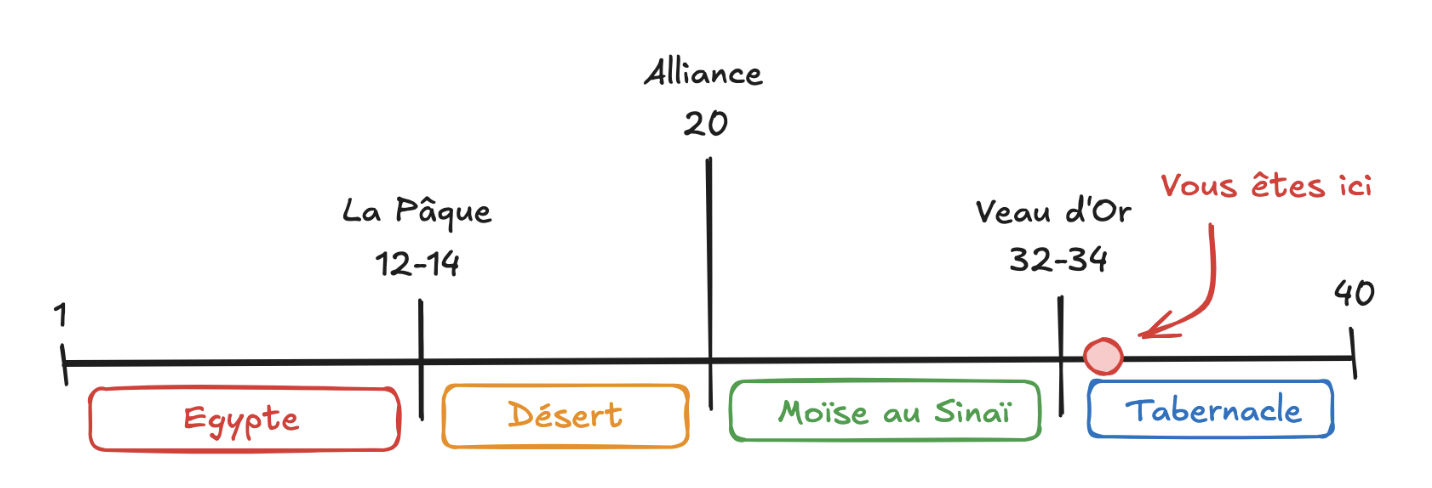
I'll try to summarize very quickly:
God frees the people from slavery in Egypt, using great miracles
He guides them through the desert to Mount Sinai
At Mount Sinai he concluded a Covenant with the people, where these people were supposed to belong to him particularly among all the peoples of the earth.
Moses goes up to Mount Sinai to receive instructions, including very detailed instructions about the Tabernacle, God's dwelling place among the people, filled with symbols and images
And there, in a very anticlimactic way, this whole plan is interrupted by a great collective sin. In the absence of Moses, the people decide to do exactly what they should not do: build an idol. Make a god with your own hands.
Even more than before, it becomes evident that a holy and perfect God cannot dwell among sinful and imperfect people. It is a sin that has consequences, and perhaps the most serious is that the plan of the Tabernacle, of a habitation of God among the people, seems completely canceled.
But Moses intercedes with God, imploring his grace, and he asks that despite this sin, that God keeps his plan and that he comes and dwells among the people.
He said, “Lord, if I have found favor in your sight, let the Lord walk among us, even though it is a refractory people. Forgive our faults and our sins and take us as your possession.” (Ex 34:9)
And God chooses to be gracious! God chooses to renew the Covenant with his people.
What I'm trying to say with this summary is that what we had seen before, these are the passages we had seen before, were the instructions for the Tabernacle. Now, in chapter 35, we see the beginning of the execution. Between instruction and execution, we find rebellion and forgiveness.
The repetition of each material and element of the Tabernacle shows a restoration of the time before the rebellion. And it is no coincidence that the first thing mentioned here, the law of the Sabbath, is the last thing mentioned before the episode of the Golden Calf. It’s as if we were returning to the state before the Rebellion.
This repetition, even more in this order, shows that with Moses' intercession and God's forgiveness, the sin of the people did not change the original plan of the Tabernacle. And now it is carried out according to the instructions.
Expression of the Heart
And here we see the entire people participating in the making of the Tabernacle, either through offerings of materials or through their service.
This is another difference in this text compared to the previous chapters: there is a word repeated 14 times which can help us understand what mobilizes all the people to give and serve. The word is “heart”.
If you are having trouble finding the word heart 14 times (and, in fact, the 14th occurrence is in 36:8), it is because in this passage our translations use the word “skilled”, whereas the original text uses the expression “wise of heart”.
We can take 36:2 as an example:
And Moses called Bezaleel and Oholiab, and every wise man of heart, in the heart of whom the LORD had given wisdom to all those whom they heart brought him closer to the work, to do it; [Darby]
The repeated use of this word is voluntary: it is the generosity and service that come from the heart that allows them to participate in the work of the Lord.
Here we do not see simply a mechanical obedience of instructions. Their intelligence is involved, their emotions are involved, their will is involved. Because when we see “heart” written in a Hebrew text, it involves all that: intelligence, emotions, will.
Obviously, the people emerged from the episode of the Golden Calf, after sin and forgiveness, with a heart renewed. And it affected not just a few, but many people.
This can be seen by the presence of several people working, not just the two artisans designated at the beginning - they have also received in their hearts the ability to teach others. Men, women, who voluntarily put themselves at service in different ways.
We can also see this by the abundance of offerings, which is cited at the end of the text. The experience of grace deeply impacted the hearts of the people, God gave wisdom and mobilized their hearts so that they could participate, voluntarily, in his work.
The Present Work
We saw a few weeks ago that the Tabernacle, ultimately, is an image, a concrete but temporary manifestation of God's plan to dwell in communion with men.
It is an image of the work of Jesus, who comes to dwell among men, who gives his life to obtain forgiveness of sins, who acts as a perfect intercessor to reestablish communion with God.
And Jesus establishes his church - the body of believers, individually and corporately - as the new temple, the new tabernacle, of the presence of God.
There is this triple parallel, between the Tabernacle, the Body of Christ and the Church, as places where God dwells among men. And the Church here is not a place or an institution, but all the people reconciled with God through Jesus.
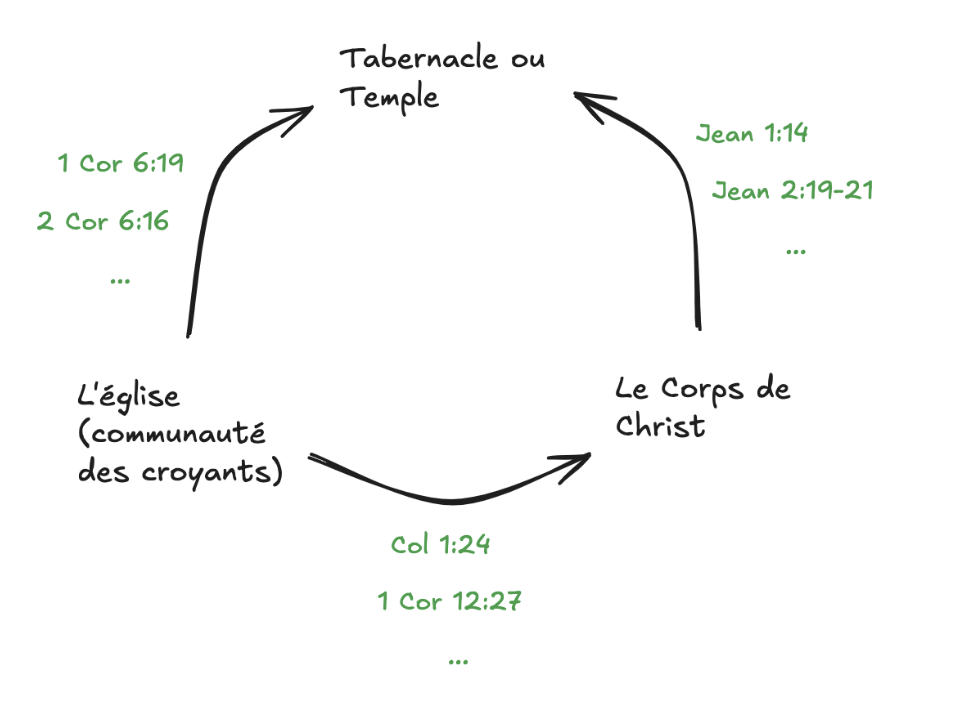
The work that is built today is the Church. It is the place where the presence of God dwells, and which continues to be built.
In the same way that the Hebrews are called to contribute to the construction of the Tabernacle, we are called to contribute to the construction of the new tabernacle, the Church - once again, we are talking about all believers.
It is he who gave some as apostles, others as prophets, others as evangelists, others as shepherds and teachers. He did this to train the saints for the tasks of service for the edification of the body of Christ, until we all come to the unity of the faith and of the knowledge of the Son of God, to the maturity of the adult, commensurate with the perfect stature of Christ.
Ephesians 4:11-13
And when we talk here about “tasks of service for the edification of the body of Christ”, we talk about everything that makes the Church Church.
Growing as a follower of Jesus, learning from his character and behavior, and helping others to grow too;
Witnessing to the whole world the Gospel of the Kingdom of God, by our words and by our actions;
Loving and praising God, individually and together;
But all of these things have very practical, material, down-to-earth components.
If we want to grow as disciples, together as a community, usually this involves people working full time for the Church, and who must receive a salary.
If we want to praise God together and encourage each other, we need to have a place to gather. There is equipment that is used.
If we want to bear witness, through our words and actions, it will take up our time, and perhaps our resources too.
The fact that the current tabernacle is not a tent with well-defined equipment and supplies, but rather a group of people who live the Gospel together, does not mean that there are not very concrete needs. And we are invited to contribute to the building of this tabernacle by addressing these needs too.
And the two elements that we saw today can better guide us in our participation in this work.
A Moment of Grace
The first is that, just like the Hebrews in the desert, we must recognize that our service is only possible because we have been forgiven and welcomed by the grace of God. We were recruited neither by competition nor by application, but through the intercession of Jesus Christ.
This should speak to someone who feels incapable of serving God because you may think you have sinned too much in the past or that your faith is too small. Our participation in God's work is not an expression of superiority, but an expression of his grace towards us. It is his grace that leads us from instruction to execution, it is his grace that works in our hearts, it is his grace that we enable.
And if it’s true that there are certain life opportunities that will require us to let ourselves work rather than work. But I dare say that it is rather the exception in the life of a Christian that we are in a situation where we can neither serve with our time, nor serve with our material resources.
The New Testament leaves very little room for the possibility of someone in the church who has not received any gift. On the contrary, we see people who receive different gifts and resources and who express God's grace in different facets.
Each of you has received from God a particular gift of grace: may you exercise it in the service of others as a good steward of the infinitely varied grace of God. - 1 Peter 4:10 [Sower]
As managers of the resources he gave us. This should uplift the one who feels helpless - no, you have received a special gift of grace. And this should give humility to those who may possibly feel indispensable: let us not forget that we use in our service and in our generosity what we have received by grace.
Expression of the Heart
And secondly, we can also see that our service and generosity in God's work must be an expression of our renewed heart, not less, not more.
Yes, no less, no more.
No less: it is normal as an expression of welcome of God's grace leads us to generosity and service.
We see, in 2 Corinthians, the example of the churches of Macedonia:
we make known to you the grace that God has granted to the Churches of Macedonia: even in the midst of the great trial of their suffering, their overflowing joy and their deep poverty led them to demonstrate great generosity. I attest, they gave voluntarily according to their means, and even beyond their means, and it was with great insistence that they asked us for the grace to take part in this service in favor of the saints. They did more than we expected, for they gave themselves first to the Lord, and then to us, by the will of God. - 2 Corinthians 8:1-5
No more: generosity and service cannot be imposed by constraint.
As Paul later says, again in 2 Corinthians:
Let each one give as he has decided in his heart, without regret or constraint, for God loves those who give with joy. - 2 Corinthians 9:7
It would have been easier to solve the material needs of the church through contributions. A kind of tax, everyone needs to pay a certain amount and we don't talk about it anymore. Everyone needs to contribute a certain amount of service hours and we talk about it more. It might have been easier for the organization.
But that would not have been faithful to the model that we have in the Bible, to the model that we have in this text.
Constraint does not engage the heart. So we limit ourselves to trusting in the work that God will do in each person's heart. We limit ourselves to encouraging, in the same way that Paul does here in Corinthians. We limit ourselves to inviting everyone to give and contribute according to their heart, in the same way that God commands Moses to do.
And I want to invite us all, myself included, to continue to reflect on our service and contributions as an expression of our heart. And as an expression of the grace of God who saved us in Jesus. God will fulfill His plan - and by grace I have the opportunity and privilege to participate in it. When I welcome this grace in my heart, in my intelligence, in my feelings and in my will, in which direction am I led?