

God With Us (Exodus 36.8-40.38)
At Connexion, several couples are preparing for marriage.
We're delighted! It's always struck me that our spring marriage preparation course is one of our best-attended meetings. It's a beautiful thing.
If you're one of these couples, I wonder how you feel about the new phase of life that's coming up.
My wife and I celebrated 15 years of marriage this year. (Not at all the record for Connexion ...)
When I think back to the months just before we got married, I remember the mixture of contrasting feelings.
Impatience - I can't wait for this to happen! I can't wait for us to move in together. I can't wait!
But also nervousness - am I ready?
In particular, this little worry: once we're past the honeymoon and into our daily routine, why do you think she's going to put up with living with me?
How many socks on the floor will she tolerate?
And so on.
I wonder if we've ever experienced the same kind of anxiety about God.
Why should we believe that God will always bear to be present with us?
How can you be sure it will always be there?
We've come to the end of the book of Exodus, which we've been meditating on for almost a year.
Exodus showed us who our God is - the Lord.
A God who fights for his people.
A God who delivers his people for an intimate relationship with them.
A God of grace and compassion.
We also saw that the biggest part of this book is neither the 10 plagues nor the crossing of the Red Sea, the parts highlighted in the films.
The biggest part is the description of a tent - a very expensive tent - in which God wanted to dwell among his people.
Our question this morning is: what enables us to be confident in God's constant presence with us? X 2
If you're like me, there are some things that make you doubt it.
Our recurring sins.
I did it again! I've done it again! How can God bear to be present with me after this?
Sometimes I look inside myself and wonder who would want to live there? If you knew my thoughts, you wouldn't want to listen to me! And God is going to want to live inside me?
Our problems.
If God were really present with me, would he have let me go through this?
This failure? This disappointment? This suffering?
Where was he when this happened to me?
Or quite simply, we may doubt its presence because we can't see it.
What tangible proof is there? We can't see any!
What enables us to be confident that God is always with us?
I wouldn't be surprised if some of you are directly confronted with this issue.
Yes or no, is God there with me?
***
We've never stopped saying it. Exodus was the book to which generations of Israelites returned when they asked themselves this type of question.
Let's recall the story of Exodus so far.
God had led Israel to Mount Sinai, where he entered into a covenant with them.
He had invited Moses to go up the mountain to receive his commandments and instructions for the Tabernacle.
But while Moses is on the mountain, the people violate the covenant by making a golden calf.
God threatened to stop accompanying them, but Moses interceded, God forgave them and the covenant was renewed.
Imagine the question on the minds of the Israelites the next day.
That was a close one. God almost told us it was over.
In the end, he stayed, because he is full of grace ... but is his plan to settle in our midst still on track?
Won't he want to keep his distance?
According to this last passage from Exodus, we can have great confidence in God's presence with us!
God is determined to live with his people today and forever!
He changes his people to be able to welcome them
***
Four observations on this text before drawing any implications.
Firstly, this passage introduces us to ...
God's heavenly palace
That God dwells in the midst of his people is no small thing.
This text compares it to a return to the happiness and rest of the Garden of Eden!
I mentioned our couples who are getting married.
And marriage means visits from the in-laws. I hope I'm not scaring you by saying that!
I've got great in-laws. Great in-laws who, strangely enough, never ask to sleep over. Must be the socks on the floor.
But when the in-laws come to spend a little time, you who have just got married may know all that's involved. Everything has to be spotless! The best sheets, the best plates, the best cleaning. Everything has to be perfect - like heaven - to make them feel welcome.
In our case, it gives us a glimpse of what our flat is supposed to be like.
An overview lasting perhaps 2 or 3 minutes.
In this text, we see the paradisiacal perfection of the place prepared to welcome God.
Last Sunday Eduardo talked about how the Israelites set to work preparing the materials for the Tabernacle.
In the passage we have been read, the construction is being completed.
Let's look at how this is described in verse 32
"So all the work on the tabernacle was completed" ... this expression "completed" echoes chapter 2 of Genesis where it was God who completed, not the building of a tent, but the creation of the world.
Verse 43
"Moses examined all the work and saw that they had done it" ... just as God in Genesis examined his creation and saw that it was very good.
Again in verse 43 - when the Israelites finished their work, "Moses blessed them" ... just as God blessed the world at the beginning of Genesis.
See also Exodus 40 verse 1
"The Lord said to Moses: "On the first day of the first month you shall set up the tabernacle".
The construction of the tabernacle represents a new beginning. Like a new creation.
The materials used - gold and precious stones - materials fit for a king and reminiscent of those found around the Garden of Eden.
Finally, the building of the Tabernacle is preceded by instructions on the Sabbath, the day of rest, which we saw last time.
This suggests that, by moving in with his people, God aims to give them rest ... as on the 7th day of Genesis, when creation enjoys rest ... in God's presence.
That is God's purpose in dwelling among his people.
A return to the rest and paradisiacal perfection of the Garden of Eden.
On the one hand, as long as the Israelites lived in the desert, this return was only symbolic and imperfect.
They don't live in a luxurious paradise. They get up every day with sand and dust in their sandals.
But on the other hand, the tabernacle goes further than Genesis. In Eden, we see God passing by from time to time. In Exodus, he settles right in the middle of the people to whom he wants to give this rest.
But as well as God's heavenly palace, we also see ...
God's perfectly obedient people
I'll use the example of the visit from the parents-in-law.
When you're welcoming someone, you don't just have to prepare the house!
Tonight we're hosting. What behaviour are we aiming for?
Perfect behaviour.
That's something Anne-Sophie never fails to tell me.
All joking aside, this text shows an obedient people able to welcome their God.
If you've read the last few chapters of Exodus, you may have a feeling of déjà vu.
Let's go back a few pages to Exodus 25 verse 10
God gives instructions: "They will make a chest of acacia wood. It will be 125 centimetres long, 75 centimetres wide and 75 centimetres high. You will overlay it with pure gold, inside and out, and make a golden border around it. You shall cast for it 4 gold rings and put them on its 4 corners, 2 on one side and 2 on the other. etc."
Now let's move on to Exodus 37 verse 1 where the Israelites carry out the instructions:
"Bezaleel made the ark of acacia wood. It was 125 centimetres long, 75 centimetres wide and 75 centimetres high. He overlaid it with pure gold inside and out and made a golden border around it. He cast for it 4 gold rings, which he put on its 4 corners, 2 on one side and 2 on the other. "
It's almost word for word and it's the same for all the elements of the tabernacle.
We have five chapters of instructions, and then instead of saying, "the Israelites followed the instructions and made the tabernacle", the author gives us another 5 almost identical chapters on construction. Why does this happen?
To show how they carried out to the letter everything God had asked them to do.
Then look again at Exodus 39 verse 32
So all the work on the tabernacle, the tent of meeting, was completed. The Israelites did everything the Lord had commanded Moses to do, and they followed it to the letter.
Verse 42
The Israelites did all this work according to all the orders the Lord had given Moses. Moses examined all the work and saw that they had done it as the Lord had commanded; they had done it exactly so.
It feels like the author is trying too hard. We get it! They did everything as the Lord commanded!
But the author doesn't want us to miss it.
A change has taken place in the hearts of these people.
A few chapters earlier, they had used the gold of Egypt to make a statue to worship. Now they are using it to make a dwelling to worship God, in perfect obedience to his commands.
These people, who were on the verge of being rejected by God for their disobedience, are now ready to welcome him thanks to their obedience.
This raises a question: where does this change come from?
Third observation
God's transforming forgiveness
What explains this change of heart since the golden calf?
Something happened between the golden calf and the building of the tabernacle.
God forgave them their sin.
Moses went up Mount Sinai, God came down and announced:
"The Lord, the Lord, is a God of grace and compassion, slow to anger, rich in kindness and truth. He keeps his love to 1000 generations, he forgives iniquity, rebellion and sin."
Perhaps you've already had a task to do that you did badly because you lacked the will to do it and were criticised for it.
But instead of saying you're finished, we've forgiven you and given you another chance.
This time you're much more motivated to do well because you're grateful for this forgiveness and this second chance.
I have a feeling there's something like that here.
God's forgiveness transformed the attitude - transformed the heart - of the Israelites, making them a people who conformed to God's demands.
Even in those chapters that look like a copy and paste of the chapters before the golden calf, there is plenty to marvel at.
Everything is exactly as it was in the chapters before their sin ... as if their sin had never happened.
God forgave them.
Except that something has changed. The heart of the people, transformed by God's forgiveness and ready to welcome him.
I've already said that Exodus tells the story of not one but two deliverances.
The first is well known. It was the spectacular deliverance from Egyptian captivity.
The second is less well known, but it is the one that occupies the most space. It is the deliverance of Egyptian hearts.
This is not a criticism of our Egyptian brothers and sisters in the church. There was one who gave an excellent message to the men's group yesterday.
The Egyptian heart is rebellious and disobedient. The heart that rejects its creator.
It is from this heart that God wants to save us so that we can welcome his presence.
When our hearts are changed, God moves in!
Fourth observation ...
The permanent presence of God
Exodus 40, verse 34 - Moses builds the Tabernacle
"Then the cloud covered the tent of meeting and the glory of the Lord filled the tabernacle. Moses could not enter the Tent of Meeting because the cloud remained over it and the glory of the Lord filled the tabernacle.
At each stage, the Israelites left when the cloud rose above the tabernacle. And if the cloud did not rise, they did not set out until it did. By day, the cloud of the Lord was over the tabernacle; by night, there was a fire inside the cloud. It was visible to the whole community of Israel every step of the way."
We're delighted for our couples who are getting married. We're also delighted for those who are welcoming a baby! There are several of them.
The other day I saw one of your rooms being prepared for the new baby.
Everything has to be perfect for the big day! You need the cot, the changing table, the little decorations and the little TV for daddy when he wakes up at night.
It takes a huge amount of preparation.
But all this preparation only makes sense because of the person you are expecting to welcome.
What we're really excited about is the person who's going to live in it.
Exodus concludes with the glory of God coming down to dwell among the Israelites.
This is what we've been waiting for! God with us at last.
It would be possible to read these last paragraphs with the glass half empty.
When the glory of God fills the Tabernacle, Moses can no longer enter. Access denied.
In fact, you have to see the glass as half full. Moses' inability to enter anticipates the book of Leviticus, which sets out the sacrifices to be offered to allow access.
What we need to remember here is that God ... dwells ... at last with his people!
That was the aim all along.
God didn't save the Israelites and then say: ciao, see you next time, you've got my number if you ever have a problem.
No! He said to Moses: "I am the Eternal One, I will free you from the burdens of the Egyptians, I will deliver you from their slavery ... I will take you to be my people, I will be your God".
God saves for life in his presence.
True rest, heavenly rest you might say, is having God living with us.
Have you noticed how the text insists on the permanent nature of God's presence?
At each of their stops, the Israelites left when the cloud rose above the tabernacle.
"[The cloud] was visible to the whole community of Israel at every step they took."
This is not a visit from in-laws who leave after a few days. God is with his people all the time!
Have you noticed how this presence is not static, but leads the people?
"the Israelites left when the cloud rose above the tabernacle. And if the cloud did not rise, they did not leave until it did."
God is present, not just to live with his people, but also to direct them towards their final destination - the promised land.
***
What all this shows ... is that our God ... is determined to be present in the midst of his people ... today ... and forever.
He's not there to keep us at arm's length. 'Not very keen.'
He is determined to live with his people, even if they are naturally disobedient, impure and idolatrous.
***
And friends, what the Israelites experienced was a teaser of what we experience as Christians.
This change in the hearts of the Israelites, which enabled them to welcome the presence of God, did not last.
The same people who had obeyed God's orders for the Tabernacle later disobeyed and died in the desert under his judgement.
Centuries later, the book of the prophet Ezekiel recounts the moment when God is so fed up with their disobedience that his glory leaves the temple and moves away.
Their experience of God's presence was just the teaser.
But Ezekiel also announced that the day was coming when God would once again forgive his people, transform their hearts and live with them, this time for good.
Ezekiel 36 verse 25 - page 558
"I will sprinkle you with pure water and you will be cleansed. I will cleanse you from all your impurities and all your idols. I will give you a new heart and put a new spirit within you. I will remove the heart of stone from your body and give you a heart of flesh. I will put my Spirit within you.
So I will make you follow my decrees, keep and respect my rules. You will dwell in the land I gave to your ancestors, you will be my people and I will be your God."
***
This transformed heart, anticipated in Exodus, announced by Ezekiel, capable of welcoming the presence of God, Jesus has given it to us, if we are Christians.
He has transformed our hearts to welcome his presence.
It's not that if I work super hard to clean myself up perfectly, clean everything out, then God might agree to live with me.
We have this heart transformed by God's forgiveness, thanks to Jesus. It is his gift! 🙂
In case you're thinking: Joe means that our hearts can potentially welcome God's presence when we do our best to be a good Christian, that's not what I'm saying.
If we believe in Jesus, God has given us a heart capable of welcoming his presence.
We often don't feel that we have a heart that can welcome his presence. I said that if you knew my thoughts, you probably wouldn't want to listen to me. I dare say that if I knew your thoughts, I probably wouldn't want to talk to you ... so sometimes ignorance suits everyone.
But when the Bible talks about the transformation of our heart, it's talking about something else. It's a heart that receives Jesus' forgiveness, that receives perfect obedience as if it were our own, and that gradually begins to want to please God.
That's the transformed heart.
It comes from God, because he is so determined to make his home with us that he does everything necessary in us to make that determination a reality.
***
What are the implications? Let's highlight a few.
God with us today ... and God with us always.
God with us today
Just as God was with the Israelites every step of the way to give them rest and guidance, the same is true for us today.
God promises us many blessings.
Material prosperity, perfect health, perfect relationships, a life without suffering - he promises us all these things ... but not yet. In the new creation, our promised land.
But there is one blessing that God is already giving today. His presence.
The Bible compares our life in this world to crossing the desert.
We're on our way. It's often arduous. You sweat a lot. Sometimes it's really painful
We have nothing in this world. God gives us our bread every day. Sometimes he makes us stop at oases.
It's still a life in the desert. If you find life in this world hard, that's why.
Our greatest blessing in this desert is his presence every step of the way.
You no longer need sacred buildings to access this presence, whether it's this one, Notre Dame Cathedral or the building you'd like to buy.
The only purpose of a building is to shelter us from the rain!
Nor do you need to have extraordinary spiritual experiences to access it - be it intense times of worship or ceremonies in a monastery somewhere.
You can enjoy God's presence anywhere, anytime.
On Sunday mornings here, but also on Monday mornings when I open my prayer app or my Bible app on a crowded train on my way to work.
At any time I can approach God to pour out my worries, confess my wrongs, thank him for his forgiveness, rejoice in his love.
It's the rest he offers us on our way through the desert.
Perhaps, with the local project and the work it involves, it's a rest we particularly need at the moment.
By prayer and the word, we come closer to God in the secret place ... to experience the rest of his presence.
This is the foretaste that God gives us in the desert ... of life in paradise. The restfulness of knowing he's there and we're never, ever, alone.
He is with us today to give us rest and also to lead us.
We don't have a cloud floating in front of us. If you have this above your flat, you might want to call GDF to check that there's no gas leak.
What we have is his Spirit to guide us.
He directs us by speaking to us through the Bible.
He also directs us by ensuring that all our circumstances, good and bad, point us in the direction of his new creation.
It's possible that part of our frustration in our life with God comes from the fact that we haven't understood where his presence is leading us.
Not to a trouble-free life in this world ... but to eternal rest in our promised land.
The average age at Connexion is quite young. We'd all do well to think about how we're going to stay Christian over the long term. What choices we're going to make to go the distance for the next ten, twenty, fifty years.
We have a desert to cross. We don't know how long it will take.
What enables us to embark on this journey with confidence is the knowledge that God offers us his presence at every stage, the good ones and the more difficult ones.
For several months I've been following the news of a young man I know from a summer camp for teenagers.
His name is Gabin.
Some time ago, he was diagnosed with cancer.
He passed away this week.
But it took time. Months of excruciating suffering, all the while knowing that he was going to die.
I asked myself: how is it possible to support this?
But Gabin was a Christian, which means that at every stage, God was present, not to take away Gabin's pain but to lead him.
When he found out he was ill - God was with him.
When he learned that it was terminal - God with him.
When day after day his body was wasting away - God with him.
When he finally fell asleep in death - God was with him.
I'm here every step of the way, my child, and soon you'll be home.
Thank you, Lord.
Because if his presence with us is real but invisible today, when we arrive at our destination, it will be real and visible forever.
God with us always
Mariya read us an extract from the book of Revelation about what we'll see when Jesus returns.
Let's read it again, it's so brilliant
Revelation 21 verse 3
I heard a loud voice from heaven saying, "This is God's tabernacle among men. He will dwell with them, they will be his people, and God himself will be with them. He will wipe away every tear from their eyes, death will be no more, and there will be no more mourning or crying or pain, for all that was before has passed away.
This is what awaits Gabin. This is what awaits us. God present to wipe away all our tears.
As I came to the end of Exodus, I couldn't help but think of the end of C S Lewis's Chronicles of Narnia.
If you haven't read them, they are stories about the adventures of 4 children who move from our world to the imaginary world of Narnia.
They are written as an allegory of the Christian faith.
At the end of the last volume, the children leave the world of Narnia to go to their new creation.
I'll read the last paragraph.
"This is for us the end of all our stories, and we can truly say that they all lived happily ever after. But for them, this was only the beginning of the real story. All their lives in this world and all their adventures in Narnia had only been the cover and the title page. Now, at last, they were beginning the first chapter of the great story that no one on earth has ever read. The one that lasts forever, and in which every chapter is better than the last."
Crossing the desert is often difficult. God is there every step of the way to point us home.
But this sometimes harrowing journey is just the cover and title page.
One day we'll be with him, we'll see his face, each chapter will be better than the last ... God will be with us forever.
Exodus 35:1-36:7
Introduction
I don't know about you, but when I first had contact with the Old Testament - the first times I really tried to read it - one of the things that impressed me was the amount of repetition.
There are texts that are almost identical, and I didn't understand why they were there twice. Are these two versions of the same text that have been taped together? - this is a hypothesis sometimes presented by skeptical intellectuals. But as Christians, who believe that the Bible was inspired by the Holy Spirit to teach us and therefore, if there is repetition, there is a reason.
The reason I talk about this is because most of the content of today's text is present in the previous chapters of Exodus, and perhaps you were there a few weeks ago when we read these passages together.
For example:
This passage begins with an instruction for the Sabbath, very similar to what was said in chapter 31;
In chapter 31 we also see the designation of the two master craftsmen, Bezaleel and Oholiab, with a list of the skills they received from God;
And in chapter 25, we saw an instruction for the collection of offerings for the construction of the tabernacle, with a list of materials almost identical to what we see here.
Why is all this information repeated?
So that we can answer this question, we will look together at what is different in this text compared to the previous chapters because it is similar but not identical. And, by looking at the differences, we will be able to better understand repetition.
A Moment of Grace
The first difference from previous texts that gave instructions for the Tabernacle is that this is a different time in the history of the Hebrew people.
Because the same information presented in a different context has a different meaning.
So that we can clearly visualize, I will show here a small diagram of the book of Exodus:
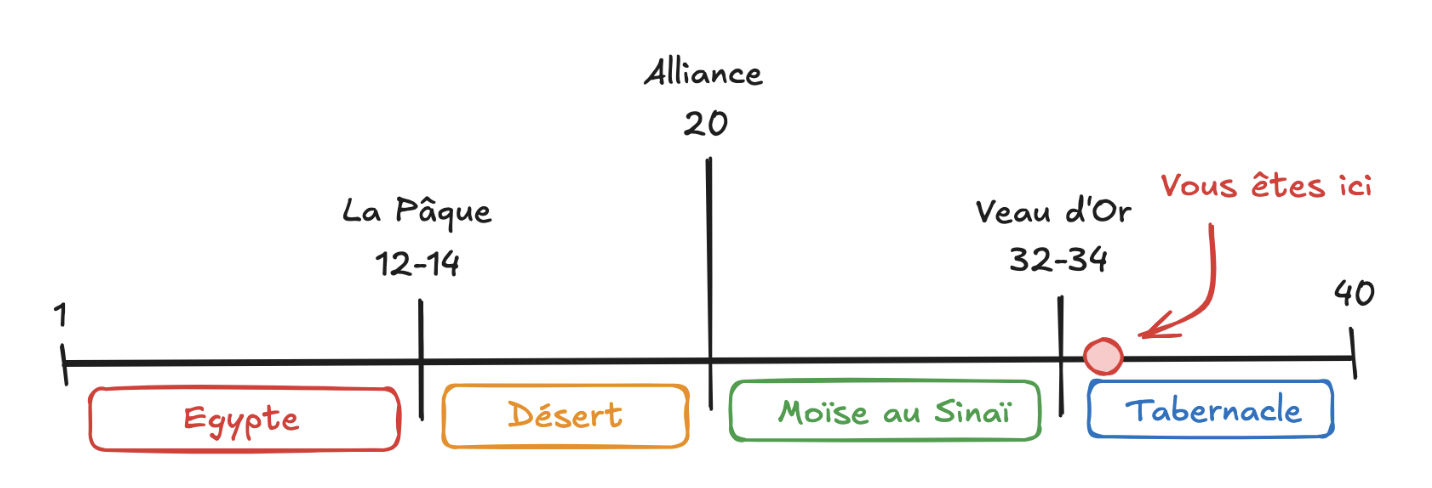
I'll try to summarize very quickly:
God frees the people from slavery in Egypt, using great miracles
He guides them through the desert to Mount Sinai
At Mount Sinai he concluded a Covenant with the people, where these people were supposed to belong to him particularly among all the peoples of the earth.
Moses goes up to Mount Sinai to receive instructions, including very detailed instructions about the Tabernacle, God's dwelling place among the people, filled with symbols and images
And there, in a very anticlimactic way, this whole plan is interrupted by a great collective sin. In the absence of Moses, the people decide to do exactly what they should not do: build an idol. Make a god with your own hands.
Even more than before, it becomes evident that a holy and perfect God cannot dwell among sinful and imperfect people. It is a sin that has consequences, and perhaps the most serious is that the plan of the Tabernacle, of a habitation of God among the people, seems completely canceled.
But Moses intercedes with God, imploring his grace, and he asks that despite this sin, that God keeps his plan and that he comes and dwells among the people.
He said, “Lord, if I have found favor in your sight, let the Lord walk among us, even though it is a refractory people. Forgive our faults and our sins and take us as your possession.” (Ex 34:9)
And God chooses to be gracious! God chooses to renew the Covenant with his people.
What I'm trying to say with this summary is that what we had seen before, these are the passages we had seen before, were the instructions for the Tabernacle. Now, in chapter 35, we see the beginning of the execution. Between instruction and execution, we find rebellion and forgiveness.
The repetition of each material and element of the Tabernacle shows a restoration of the time before the rebellion. And it is no coincidence that the first thing mentioned here, the law of the Sabbath, is the last thing mentioned before the episode of the Golden Calf. It’s as if we were returning to the state before the Rebellion.
This repetition, even more in this order, shows that with Moses' intercession and God's forgiveness, the sin of the people did not change the original plan of the Tabernacle. And now it is carried out according to the instructions.
Expression of the Heart
And here we see the entire people participating in the making of the Tabernacle, either through offerings of materials or through their service.
This is another difference in this text compared to the previous chapters: there is a word repeated 14 times which can help us understand what mobilizes all the people to give and serve. The word is “heart”.
If you are having trouble finding the word heart 14 times (and, in fact, the 14th occurrence is in 36:8), it is because in this passage our translations use the word “skilled”, whereas the original text uses the expression “wise of heart”.
We can take 36:2 as an example:
And Moses called Bezaleel and Oholiab, and every wise man of heart, in the heart of whom the LORD had given wisdom to all those whom they heart brought him closer to the work, to do it; [Darby]
The repeated use of this word is voluntary: it is the generosity and service that come from the heart that allows them to participate in the work of the Lord.
Here we do not see simply a mechanical obedience of instructions. Their intelligence is involved, their emotions are involved, their will is involved. Because when we see “heart” written in a Hebrew text, it involves all that: intelligence, emotions, will.
Obviously, the people emerged from the episode of the Golden Calf, after sin and forgiveness, with a heart renewed. And it affected not just a few, but many people.
This can be seen by the presence of several people working, not just the two artisans designated at the beginning - they have also received in their hearts the ability to teach others. Men, women, who voluntarily put themselves at service in different ways.
We can also see this by the abundance of offerings, which is cited at the end of the text. The experience of grace deeply impacted the hearts of the people, God gave wisdom and mobilized their hearts so that they could participate, voluntarily, in his work.
The Present Work
We saw a few weeks ago that the Tabernacle, ultimately, is an image, a concrete but temporary manifestation of God's plan to dwell in communion with men.
It is an image of the work of Jesus, who comes to dwell among men, who gives his life to obtain forgiveness of sins, who acts as a perfect intercessor to reestablish communion with God.
And Jesus establishes his church - the body of believers, individually and corporately - as the new temple, the new tabernacle, of the presence of God.
There is this triple parallel, between the Tabernacle, the Body of Christ and the Church, as places where God dwells among men. And the Church here is not a place or an institution, but all the people reconciled with God through Jesus.
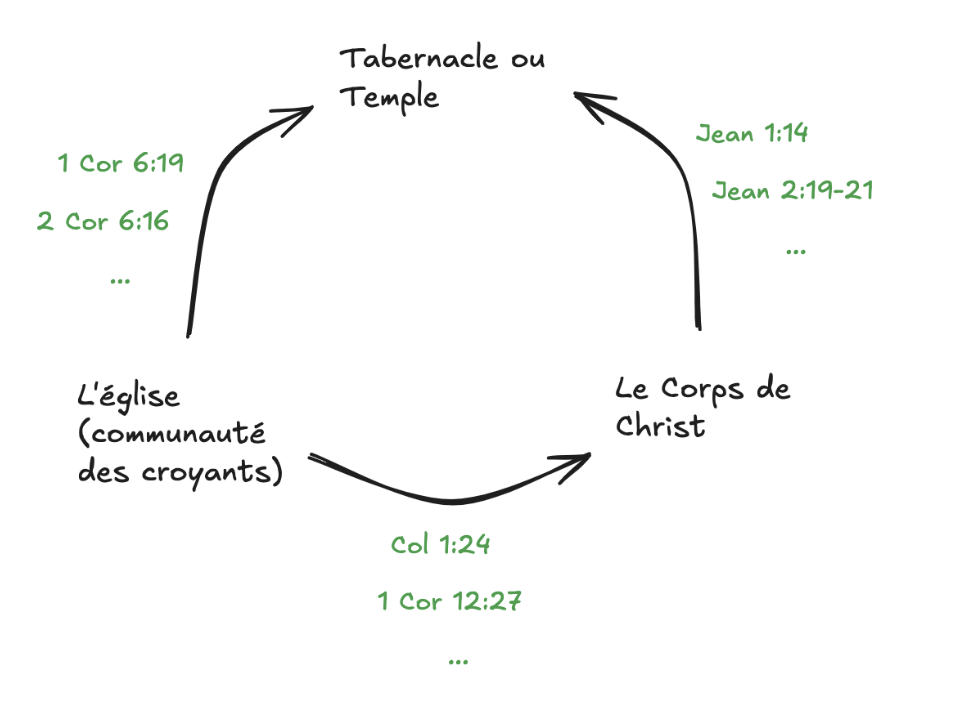
The work that is built today is the Church. It is the place where the presence of God dwells, and which continues to be built.
In the same way that the Hebrews are called to contribute to the construction of the Tabernacle, we are called to contribute to the construction of the new tabernacle, the Church - once again, we are talking about all believers.
It is he who gave some as apostles, others as prophets, others as evangelists, others as shepherds and teachers. He did this to train the saints for the tasks of service for the edification of the body of Christ, until we all come to the unity of the faith and of the knowledge of the Son of God, to the maturity of the adult, commensurate with the perfect stature of Christ.
Ephesians 4:11-13
And when we talk here about “tasks of service for the edification of the body of Christ”, we talk about everything that makes the Church Church.
Growing as a follower of Jesus, learning from his character and behavior, and helping others to grow too;
Witnessing to the whole world the Gospel of the Kingdom of God, by our words and by our actions;
Loving and praising God, individually and together;
But all of these things have very practical, material, down-to-earth components.
If we want to grow as disciples, together as a community, usually this involves people working full time for the Church, and who must receive a salary.
If we want to praise God together and encourage each other, we need to have a place to gather. There is equipment that is used.
If we want to bear witness, through our words and actions, it will take up our time, and perhaps our resources too.
The fact that the current tabernacle is not a tent with well-defined equipment and supplies, but rather a group of people who live the Gospel together, does not mean that there are not very concrete needs. And we are invited to contribute to the building of this tabernacle by addressing these needs too.
And the two elements that we saw today can better guide us in our participation in this work.
A Moment of Grace
The first is that, just like the Hebrews in the desert, we must recognize that our service is only possible because we have been forgiven and welcomed by the grace of God. We were recruited neither by competition nor by application, but through the intercession of Jesus Christ.
This should speak to someone who feels incapable of serving God because you may think you have sinned too much in the past or that your faith is too small. Our participation in God's work is not an expression of superiority, but an expression of his grace towards us. It is his grace that leads us from instruction to execution, it is his grace that works in our hearts, it is his grace that we enable.
And if it’s true that there are certain life opportunities that will require us to let ourselves work rather than work. But I dare say that it is rather the exception in the life of a Christian that we are in a situation where we can neither serve with our time, nor serve with our material resources.
The New Testament leaves very little room for the possibility of someone in the church who has not received any gift. On the contrary, we see people who receive different gifts and resources and who express God's grace in different facets.
Each of you has received from God a particular gift of grace: may you exercise it in the service of others as a good steward of the infinitely varied grace of God. - 1 Peter 4:10 [Sower]
As managers of the resources he gave us. This should uplift the one who feels helpless - no, you have received a special gift of grace. And this should give humility to those who may possibly feel indispensable: let us not forget that we use in our service and in our generosity what we have received by grace.
Expression of the Heart
And secondly, we can also see that our service and generosity in God's work must be an expression of our renewed heart, not less, not more.
Yes, no less, no more.
No less: it is normal as an expression of welcome of God's grace leads us to generosity and service.
We see, in 2 Corinthians, the example of the churches of Macedonia:
we make known to you the grace that God has granted to the Churches of Macedonia: even in the midst of the great trial of their suffering, their overflowing joy and their deep poverty led them to demonstrate great generosity. I attest, they gave voluntarily according to their means, and even beyond their means, and it was with great insistence that they asked us for the grace to take part in this service in favor of the saints. They did more than we expected, for they gave themselves first to the Lord, and then to us, by the will of God. - 2 Corinthians 8:1-5
No more: generosity and service cannot be imposed by constraint.
As Paul later says, again in 2 Corinthians:
Let each one give as he has decided in his heart, without regret or constraint, for God loves those who give with joy. - 2 Corinthians 9:7
It would have been easier to solve the material needs of the church through contributions. A kind of tax, everyone needs to pay a certain amount and we don't talk about it anymore. Everyone needs to contribute a certain amount of service hours and we talk about it more. It might have been easier for the organization.
But that would not have been faithful to the model that we have in the Bible, to the model that we have in this text.
Constraint does not engage the heart. So we limit ourselves to trusting in the work that God will do in each person's heart. We limit ourselves to encouraging, in the same way that Paul does here in Corinthians. We limit ourselves to inviting everyone to give and contribute according to their heart, in the same way that God commands Moses to do.
And I want to invite us all, myself included, to continue to reflect on our service and contributions as an expression of our heart. And as an expression of the grace of God who saved us in Jesus. God will fulfill His plan - and by grace I have the opportunity and privilege to participate in it. When I welcome this grace in my heart, in my intelligence, in my feelings and in my will, in which direction am I led?
What incomparable grace (Exodus 34.4-35)
Please keep your Bible open.
For several Sundays now, we've been asking ourselves where to look when we realise that our relationship with God has broken down.
Where to look when we understand that because of our sins, God would have every reason to tell us it's all over.
This morning we'll be asking ourselves: is grace enough? x 2
What a question! Of course grace is enough, you'll tell me.
Grace is our greatest source of praise! It's the air we breathe! It's the firm ground on which we walk!
Think of the songs we sing Sunday after Sunday.
Your grace is incredible!
It is by grace that we come
Infinite grace
Of course grace is enough!
***
Let me rephrase the question. I've been known to explain the word grace to my children by saying that grace is when God gives us what we don't deserve.
It is God's free choice, because of his character, to give us what we do not deserve.
So my question this morning is: is this grace enough?
God's free choice, because of his character, to give us what we don't deserve.
I'm thinking of conversations with Muslim friends, to whom I've asked: what do you think will happen to you after death?
My good deeds and my evil deeds will be weighed in a balance, and if my good deeds weigh more than my evil deeds, I will go to heaven'.
Do you think you've done enough?
'I don't know ... but ... Allah is compassionate and merciful. He may choose, just like that, to forgive me.'
He can choose to give me what I don't deserve.
Is this grace, from the living God, the God of the Bible, enough?
The trouble with understanding grace in this way is that you risk being haunted by a little fear: 'what if this time I've gone too far?
What if I've abused God's generosity too much?
Is grace enough?
We are in a section of the book of Exodus that talks about how a holy God can live in the midst of a sinful people.
God gave Moses the instructions for the tabernacle, the tent of his dwelling place, but in the meantime the Israelites became impatient and made and worshipped a golden calf.
On Sunday Jason talked about how Moses acts as an intermediary to prevent God from abandoning his people, despite their unfaithfulness.
Moses pleads, "You told me I'm your friend, but how is that going to come out, if you don't continue to accompany Israel?"
Moses, God's friend, begs God to let others benefit from their friendship too.
God replies: I will do what you ask, because you have found favour in my eyes.
For Moses it must have seemed too good to be true. They had sinned, they deserved the relationship to be over ... and now God decided to give them another chance.
So Moses asked for confirmation: "Show me your glory!
Why this request?
If you're a Christian, you might take it for granted that God forgives. We've read the rest of the story.
Not Moses.
He knew God's promises to his people. He had seen God's patience with his people. But that God could forgive, after such a great sin, must have seemed hard to believe.
So he asks to see the glory of God, in other words, who this God really is who is announcing such surprising things.
That brings us to our first point.
Is God's grace enough?
Abundant grace
To be willing to love, to forgive, to be gracious ... that is quite simply the very character of our God!
How do you usually present yourself?
My name is __, I am __.
It often depends on the context. At church, my name is X and I've been coming to Connexion for x weeks, months, years.
At work, my name is X, I'm [the name of my job].
If you have an accent, my name is __, I come from such and such a country.
If we have an exceptional wife, my name is Joe, I’m married to Anne-Sophie.
But when there's no specific context and you introduce yourself to everyone - a status on whatsapp that everyone can read, a bio on the networks. How do you introduce yourself?
What could you say that would explain who you are at the deepest level?
My name is Joe, I'm ___.
Moses had asked to see the glory of God.
He went back up to Mount Sinai, ready to see God manifest himself, new stone tablets in his hand to replace the ones he had broken.
If it had been you, and you hadn't read on, what would you have expected? What would you have expected to see as a manifestation of God's glory?
Miracles - the mountain shaking, the fire coming down?
The laws of nature suspended.
Perhaps to see something even more impressive.
In reality, Moses couldn't see much.
God comes down, but he hides Moses in the hollow of a rock, covers him with his hand and makes his glory pass before him. Moses sees almost nothing.
But he hears something .
Exodus 34v6
"The LORD passed before him and cried out, 'The LORD, the LORD is a *God of grace and compassion, slow to anger, rich in kindness and truth. He keeps his love to 1000 generations, he forgives iniquity, rebellion and sin".
Let's take a closer look at these words.
God proclaims his name, "the LORD" - YHWH - a name that expresses the freedom to define himself as he wishes: I am who I am. I will be who I will be.
He repeats this name: The Lord, the Lord.
As if to emphasise that what he is announcing at this moment will be the ultimate presentation of who he is.
Then there are the majestic words that follow, which we would do well to learn by heart.
"A God of grace and compassion - who gives us what we don't deserve and doesn't give us what we do deserve
"Slow to anger" - that should correct any misconceptions we might have about the God of the Old Testament!
This summer at the Christian teen camp where several of us have served, we had to deal with a number of nocturnal runaways. I can tell you that at 4am, when we'd been looking for them for an hour and a half, two youngsters turned up ... my anger wasn't slow to flare.
God is not like that. He's patient. He doesn't rush into things. He gives us the chance to turn around.
"Rich in goodness and truth. We could also say, rich in loyalty and fidelity.
These words express God's commitment to his people. The fact that he doesn't let them down, even when they deserve to be let down!
"He keeps his love for 1,000 generations; he forgives wrongdoing, rebellion and sin".
He insists. He is a God of forgiveness.
In English, if you want to say that a certain virtue characterises you, there's an expression that says: this virtue is my middle name.
Patience is my middle name.
Honesty is my middle name.
Now, if someone needs to tell you that honesty is their middle name, they're probably lying.
But here, it's as if God is saying that forgiveness, grace, undeserved love, is ... not just his middle name, but his first name!
A fortnight ago I talked about Catherine the Great, the Russian empress, who said: "The good Lord must forgive me, it's his job!
That could not be more presumptuous. It is not God's job to forgive. He is under no obligation to forgive anyone.
It's not his job.
But it is his name.
It's as if God were saying to Moses: do you want to know why I'm prepared not to abandon you despite your sin? You want to know why I'm prepared to give you another chance? It's because loyal love, abundant grace and free forgiveness are ... my name!
That's my name!
This is how I wanted to present myself to the world - without being under the slightest constraint.
I am a God of abundant grace!
That's my name, that's my character, that's my glory!
...
Let's think of the other ways in which he could have shown who he was.
Some people have already heard me talk about it.
The universe contains 200 trillion stars. God created them.
But that's not the ultimate revelation of his glory.
The universe is 92 billion light years across.
God governs it.
Yet this is not the ultimate revelation of his glory.
The glory of God, the ultimate expression of his character, is the fact that when his people turn their backs on him, reject his commandments and commit spiritual adultery ... he forgives.
This is our God!
***
This is not in competition with the other descriptions of God in Exodus.
The Lord, the valiant warrior. The Lord my standard. The Lord, who sanctifies you.
It's not that he's sometimes one, sometimes another.
No, this presentation - the God of grace and compassion, rich in love and faithfulness - sums up and completes the others.
We saw God's commitment to his people. How he fights for them and provides for their needs.
Now we see that this commitment holds even when his people behave like his enemies!
He is ready to renew his relationship with them.
This is what we see in the rest of this passage.
Verse 10
"Behold, I myself make a covenant. I will do wonders in the sight of all your people that have never been done in any land or among any nation."
The broken relationship is restored. God will accompany the Israelites to the land of Canaan. There is a new wedding ring - new tablets of stone with the Ten Commandments written on them.
Then Moses came down, his face beaming - the sign that the glory of God was still in their midst.
All because it is the character of our God, the glory of our God, to be gracious.
It should make us question the image we have of God.
I spent my early teens deliberately behaving like an enemy of God.
If I could do something to offend those who believed in Jesus, I would, starting with my parents.
I hated the church and had no desire to conform to my idea of what it meant to be a Christian.
The turning point came when I realised that even though I was behaving like an enemy of God, God was ready to forgive me.
I received this letter on Tuesday 6 February 2001.
It is the glory of our God to be gracious.
This means that as long as we're breathing, it's never too late to come back to him.
Maybe this morning, that's what some people here need to do.
Perhaps others still operate with the image of a harsh God who has little desire to forgive them.
God is strict, in a way.
Faced with the golden calf, he said in no uncertain terms that the people deserved to be abandoned. Our sin is abominable to him. He hates it.
The glory of it is that despite this hatred of sin, it is always in his character to forgive.
Maybe we need to rethink our image of him.
He is abundantly gracious.
...
Now for the twist.
Our question is whether grace is enough in the face of a broken relationship with God.
Grace understood as God's free choice, because of his character, to give us what we do not deserve.
Which brings us to the second point ...
2. Sufficient grace ?
The answer to the question of whether this grace is enough ... is no!
***
If grace is when God passes over our sins and simply gives us another chance, well, we need more.
Firstly, because God's justice is always the same
You may have noticed that God says things about himself that we've skipped over.
Verse 7 continues:
"He keeps his love to 1000 generations, he forgives fault, rebellion and sin, but he does not treat the guilty as innocent and he punishes the fault of the fathers on the children and grandchildren to the third and fourth generation!"
Let's start with what this verse doesn't mean. God does not punish innocent children for the sins of their parents. Elsewhere in Exodus, God says that he punishes those who have sinned. In the original language, this verse says that God 'visits' the sins of the fathers on the children.
In other words, when a parent sins, there is collateral damage for the family. We can perhaps think of sad situations where the consequences of a parent's alcoholism, for example, fall on the children.
One of the things that makes sin so horrible is that it reflects on those close to us.
God doesn't make the innocent look guilty ... but he doesn't make the guilty look innocent either!
God doesn't just sweep them under the carpet.
Imagine if he did!
Imagine if he let evil happen without ever being held to account. That would be atrocious!
God does not treat the guilty as innocent - at some point, the sword of His righteous judgement must fall.
Then ... the grace granted to the Israelites here is not enough because ...
the alliance was always the same
God renews the covenant ... but it's not a new covenant!
The basis of the relationship was always the Ten Commandments, which they were obliged to respect on pain of being cursed.
God just gave them a second chance to succeed.
Which was a problem, if, thirdly...
The people were always the same
Verses 10 to 27 contain a list of commandments.
You can read them and think: another boring list of rules.
If we take a closer look, we can see that this list focuses on two areas: how to avoid worshipping idols ... and the religious festivals to observe.
The two areas in which they had just sinned with the golden calf - idols and religious festivals.
It's as if God gave them back their copy with the teacher's comments in red. Here's where you need to improve to succeed.
That raises the question - can they improve?
There's a line from a comedian that I like.
Someone asks him: would you say that you've learnt from your mistakes?
Of course, of course. I've learned from my mistakes, and I'm sure I can repeat them!
If the people are still the same, we can give them a second chance. But why believe that things will go better this time?
I can try to run 10 kilometres in under half an hour. I can ask professional athletes to watch me and give me advice on how to improve, but the fact is I'm never going to run 10 kilometres in under half an hour!
Unless I take myself back ten years, change my whole diet, my whole lifestyle and probably my DNA too, I can't do it, no matter how many chances I'm given!
The people are always the same
And finally..,
Access to God is always the same - limited.
Verse 30
"Aaron and all the Israelites looked at Moses and saw that the skin of his face was glowing; so they were afraid to come near him."
Then verse 33:
"When Moses had finished speaking to them, he put a veil over his face."
The glory of God is always present with the Israelites, but it frightens them. It has to be hidden behind a veil, as in the tabernacle, where it had to be hidden behind a curtain.
These sinful people still have only limited access to their holy God.
What all this shows...
is that if grace means giving a rebellious people another chance ...
... turn the page and sweep our sins under the carpet - as God seems to be doing in this passage ...
... this grace is not enough. X 2
***
There comes a time when there's no more room under the carpet.
It's coming out on all sides. A real clean-up is needed.
Grace has to clean under the carpet.
***
Joe, aren't you contradicting everything you've said about forgiveness?
No !
But God wants to teach us what kind of grace we will need if we are to be guaranteed forgiveness.
***
History has shown that it's not enough to give people a "get out of jail free" card like in monopoly, and a second chance to succeed.
These thousands of people forgiven by God after the golden calf did not enter the promised land because of their sin, with two exceptions.
Moses did not enter the promised land because of his sin.
A few centuries later, all the descendants were exiled because of their sin.
God was slow to anger, but after a while his judgement fell.
To truly repair a broken relationship with God, his grace must go further than simply sweeping our sins under the carpet.
He has to clean under the carpet.
At home, we try to encourage each other to say sorry when we need to.
It's not easy to prevent the word "forgiveness" from becoming a kind of magic formula that has to be said in the right way to be valid.
I'm so sorry!
Say it nicely!
I'm so sorry!
Looking you in the eye.
Sorry, sir.
But forgiveness is not a magic word.
In fact, what difference does it make to say sorry?
In a sense, nothing.
The wrong has been done, the damage has been done. There's nothing to say it won't be done again.
Why should saying sorry be enough to repair a relationship?
Don't get me wrong, forgiveness is essential in any relationship.
But if God's forgiveness is to be guaranteed ...
... it can’t just be about passing over sin.
Sin must be paid for.
It's not just about giving us a new chance. We need to change.
Exodus 34 confronts us with a tension
There is God's love, compassion and grace on the one hand, and his justice on the other.
If we affirm only some of these qualities and not the others, we are worshipping an idol.
So if God's grace is really going to repair our relationship with him, it has to come down from the mountain, deal with sin at its root and defeat the inner Pharaoh in our hearts once and for all.
She must descend from Mount Sinai, become incarnate, and ascend to the Mount of Calvary.
John 1:14
"And the Word became man, and dwelt - literally 'Tabernacled -among us...
full of grace and truth- two words that recall those of God on Mount Sinai... and we beheld - saw - his glory, which Moses had not been able to do
a glory like that of the only Son from the Father".
On Mount Sinai God had announced that his glory is his grace.
In the person of Jesus, this glory became flesh.
When do we see this glory shining brightest?
John 17.1 - the day before Jesus died
"Jesus looked up to heaven and said, 'Father, the time has come! Reveal the glory of your Son so that your Son [also] may reveal your glory."
I was discussing Exodus with a pastor friend of mine, who said that if you compress Exodus 34 to the max ... you get to the cross.
It is here, when Jesus bleeds to pay for our sins, that we see how God forgives sin while punishing sin.
It's not just an audible but a visible manifestation, this time, of the glory of God.
😊 And the Bible also insists that by contemplating the glory of the cross, we are not only forgiven but also transformed from glory to glory.
The inner pharaoh is defeated.
Where do we look when we realise that our relationship with God is broken?
In a word, to Christ.
So easy to say without measuring what's behind those words.
It is said that grace is free. And it is. But that doesn't mean there wasn't a price to pay.
But it is only this costly, transforming grace, which reconciles God's love and justice, that is sufficient.
What do you count on when you realise that you have sinned?
It's easy to think that what counts is the quality of our request for forgiveness.
A small sin - all you have to do is ask forgiveness once and then you can move on.
A big sin - you have to ask for forgiveness three times and feel bad all day.
A very big sin - you have to ask for forgiveness every day for a week and go without food.
We have to ask for forgiveness. But it's not the quality of our request that fixes anything. It is his grace.
Maybe we’re counting on God's compassion when we have sinned?
Of course you should! But as I said at the beginning, if we stop there, hoping that God will be indulgent, we risk being haunted by this fear - what if this time I've gone too far?
What really counts is this : since the Lord is rich in goodness, he sent a saviour capable of satisfying both his compassion and his justice.
That's what you can count on.
***
Three implications ...
First, there is a call to be heard. It's never too late to return to God. In Jesus, he has done everything necessary to welcome us with open arms.
Maybe that's what you need to do.
But there's also a warning.
If I go through life saying to myself: I'm going to do things my own way, without bothering with Jesus because the good Lord has to forgive me anyway - watch out!
God wants to forgive, but only if we bow before the Saviour he has sent.
Woe betide me if I take his forgiveness for granted and turn my back on Jesus.
But above all, we can see how much assurance we have.
That's been the theme for the last three weeks - assurance ... and where to find it when we understand that our relationship with God is broken.
We've said that we can't find it by putting our sin into perspective - it's not that serious!
Nor do we find it by imagining that God's forgiveness is easily granted - that's his job!
No! We find it by measuring, on the one hand, the size of the obstacle, which is insurmountable for us, and on the other hand, the size of his grace, because of which he himself pays the high price for the obstacle to fall.
If you're like me, you're often torn between presumption and anxiety about God's forgiveness.
Presumption: I'm familiar with the message of forgiveness. It allows me to live the way I want, knowing that it will normally pass.
Anxiety: I've done everything wrong. God is bound to make me pay for it.
God offers us assurance.
Yes, our sin is serious. No, God is not indifferent. No, we can't do it alone.
But God be praised for the glory of his grace ... who goes further, who pays the highest price ...
... which, in Jesus, finally ... is enough.
John Newton, the slave trader turned preacher and author of the hymn Amazing Grace, summed up what this assurance looks like just before he died.
"My memory is failing me, but I remember two things: I am a great sinner and ... Christ is a great Savior."
The Name of God: His Right to Choose
Exodus 33
In 1981, a film entitled simply Roar! was released. This film followed a man named Hank and his family living on a nature preserve in Africa, where they raised hundreds of big cats: mostly lions and tigers. What made this nature preserve unique was that the animals were totally free to go wherever they pleased—including inside Hank’s house. They’d camp out in the living room, wander the halls, get in the beds.
The movie itself isn’t very good; but the making of the movie is legendary. The director and lead actor, Noel Marshall, and his wife, actress Tippi Hedren, were passionate conservationists. They filmed this movie with real, untrained lions and tigers, in their real home, with their real kids. They loved these animals so much they wanted to make a film showing that humans and big cats could live together in harmony.
The problem is that lions and tigers are wild animals. Put them together in a house with human beings, and it’s not going to go well. Of the 140 people working on the film, 70 of them—including the lead couple’s own daughter, Melanie Griffith—were seriously injured, many of them multiple times. I’ll spare you the details, but Google it if you want—it’s gruesome.
Although this couple felt they couldn’t live without these animals, it became clear very quickly that they couldn’t live with them either.
Oddly enough, this is very close to the situation in which the people of Israel find themselves in Exodus 33.
If you were here last week, you’ll remember that while Moses was on the mountain receiving instructions for the tabernacle from God, the people of Israel grew impatient, and demanded that Aaron make an idol for them that they could worship, that would stand in for the God who seemed to be absent. Aaron, despite having received the commandment that they must not make any graven images or worship any other gods, built this idol for them.
God tells Moses what’s going on, says he’s going to go down and destroy them. Moses prays that God wouldn’t do this, and God answers his prayer. Instead, Moses comes down off the mountain and shatters the tablets of stone on which God had written his commandments. He sends the Levites out to kill the perpetrators, and 3,000 people die that day.
Essentially when we pick up the thread in chapter 33, Moses is talking to God and they are discussing what will happen next. But in order to get a feel for the situation in this chapter, I’d like us to skip down a bit.
What They’ve Lost (33.1-3)
In v. 7, we learn that Moses took a tent and pitched it outside the camp; he called it the tent of meeting. It was sort of a precursor to the tabernacle, and apparently anyone could go out there to pray and seek God.
But when Moses went out to the tent, things were different. V. 8:
8 Whenever Moses went out to the tent, all the people would rise up, and each would stand at his tent door, and watch Moses until he had gone into the tent. 9 When Moses entered the tent, the pillar of cloud would descend and stand at the entrance of the tent, and the Lord would speak with Moses. 10 And when all the people saw the pillar of cloud standing at the entrance of the tent, all the people would rise up and worship, each at his tent door. 11 Thus the Lord used to speak to Moses face to face, as a man speaks to his friend.
Think about this picture. When Moses went out to the tent, people would stand outside their tents in the camp and watch him go. When Moses went into the tent, the pillar of cloud that guided them would come down and stand at the entrance. And when the people saw this, they would stand up and worship.
This was probably a joyous sight before Moses went up to the mountain, before the golden calf. But can you imagine what that “worship” must have been like after? The people of Israel stood there, watching Moses go into the tent and benefit from everything they think they’ve just lost. V. 11 says that God would speak to Moses “face to face, as a man speaks to his friend.” And this intimate relationship was accompanied by a sign of great power: the pillar of cloud.
That’s what the people stand to lose, now that their covenant with God—their relationship with God—has been fractured.
So the question is, what will God do with this sinful people who have broken covenant with him?
We Can’t Live With God (33.1-3)
Chapter 33, verse 1:
The Lord said to Moses, “Depart; go up from here, you and the people whom you have brought up out of the land of Egypt, to the land of which I swore to Abraham, Isaac, and Jacob, saying, ‘To your offspring I will give it.’ 2 I will send an angel before you, and I will drive out the Canaanites, the Amorites, the Hittites, the Perizzites, the Hivites, and the Jebusites. 3 Go up to a land flowing with milk and honey; but I will not go up among you, lest I consume you on the way, for you are a stiff-necked people.”
Already this is a grace. God says he will make good on the promise he made to the people, to bring them into Canaan—not for their sake, but because it is what he promised to Abraham, Isaac and Jacob. He does, however, establish a significant consequence. He will send an angel before them to drive out the people of the land, but God himself will not go with them.
Why?
Because, he says, “you are a stiff-necked people.” You are obstinate. You are unruly. And if I were to go with you, I would destroy you.
A lot of people might read this and think God is setting up guardrails for himself—like those people who decide not to have kids because they’re afraid they’ll be too impatient with them. Our reflex to this passage is to find God kind of childish; sure, the people are difficult, but he’s God—can he not hold his temper?
That’s not how we should be reading this.
God isn’t afraid of losing control of his own anger if he goes with the people. He’s a just God, and none of this is a surprise to him. He’s not worried. He’s saying that in the normal state of things, no matter how bad the people feel about their sin right now, eventually they will turn against him again. Which means that in his justice, God would have to consume them, because that would be the just punishment for their rejection of him.
In other words, in the current state of things, God with them would be dangerous for them. For the people to have God dwelling in their midst would be a foretaste of what hell will actually be.
If that sounds shocking, it’s because we’ve long heard that hell is the absence of God. That’s not true. God is omnipresent: he’s everywhere, all at once. God is present in heaven and in hell, and he is the Lord of all things—of both heaven and hell.
Hell is not the absence of God. It is the absence of union with God.
If we are united to God, God’s presence is a blessing for us. It is the presence of a benevolent and loving Father.
If we aren’t united to God, his presence is eternal condemnation and punishment for us. It is the presence of a righteous Judge, who hates the sin we have allowed to be our master.
What God is saying here, essentially, is simple: because of sin, God and human beings have become incompatible. God made man in his image, but man rebelled against God and became infected with sin. Sin and God’s holiness are fundamentally incompatible—like oil and water, like lions and people.
In the normal state of things, there is simply no way for man to live with God and survive. Sooner or later we will sin against him, and God’s justice would require him to punish that sin.
But even if this is true, its opposite is also true. We can’t live with God, but we can’t live without him either.
We Can’t Live Without God (33.4-6)
V. 4:
4 When the people heard this disastrous word, they mourned, and no one put on his ornaments. 5 For the Lord had said to Moses, “Say to the people of Israel, ‘You are a stiff-necked people; if for a single moment I should go up among you, I would consume you. So now take off your ornaments, that I may know what to do with you.’ ” 6 Therefore the people of Israel stripped themselves of their ornaments, from Mount Horeb onward.
This is interesting. The people of Israel have seen these incredible manifestations of God’s power, rescuing them from slavery in Egypt, and guiding them into the wilderness, and coming down on Mount Sinai… And now they’re realizing they were ready to give all of that up!
So they mourn. They strip off their party clothes, the “ornaments” of their idolatry, and they mourn.
Now that is not to say that this is actual, true repentance. For some of them it probably was, but Israel’s history will show us that plenty of them weren’t repentant at all. They’re mourning over what they stand to lose, and not necessarily mourning over their sin.
The one person who seems to have fully understood the situation is Moses himself, even though he didn’t participate in their sin. Skip down to v. 14 (this is God speaking to Moses):
14 And he said, “My presence will go with you, and I will give you rest.”
One thing that we can’t see in our English translations is really important. The “you” in verse 14 is singular, not plural. God is talking to Moses, and Moses alone here. He says, “Okay, I can’t go with them; but I’ll go with you.”
15 And [Moses] said to [the Lord], “If your presence will not go with me, do not bring us up from here. 16 For how shall it be known that I have found favor in your sight, I and your people? Is it not in your going with us, so that we are distinct, I and your people, from every other people on the face of the earth?”
Listen carefully to what Moses is saying. First of all, he’s saying he can’t take God without God’s people. His response in v. 15 might seem strange, because God has just said he’ll go with him, and then Moses turns around and says, “If your presence won’t go with me, don’t bring us up from here.” But v. 16 explains what he means. He says, Is it not in your going with us, so that we are distinct, I and your people, from every other people…?
He’s telling God that Moses and the Israelites are a package deal.
And he’s not saying it for his own sake, out of loyalty to his people. He’s saying it for God’s sake. It’s exactly what we saw last week, when God threatened to go down and destroy them after they made the golden calf. Moses pleads with God not to do it, because God made promises to Abraham, Isaac and Jacob, and if God doesn’t do what he promised, then he will be maligned by enemy nations. It is for God’s sake that he’s pleading with him.
Here’s the second thing, that I find even more remarkable. God has promised them a beautiful country, “flowing with milk and honey”, with unlimited resources, incredible produce, all the good things they’ve been desiring for centuries. And God has just told them that he’ll send an angel ahead of them to get them there.
Even if I’m not with you, he says, you’ll get to where you’re going. You’ll get what I promised. But I won’t be there.
And Moses says, “If you’re not going to be there, keep us in the desert. That would be better than getting everything you promised us, but without you.”
So there is a natural tension to their situation. They can’t live with God, because they’re sinners; but they can’t live without God either, because he is their Lord and their Creator, their very life.
How can this tension possibly be resolved?
The Tension Resolved (33.12-23)
There’s only one way, and we see it in the following verses. V. 12:
12 Moses said to the Lord, “See, you say to me, ‘Bring up this people,’ but you have not let me know whom you will send with me. Yet you have said, ‘I know you by name, and you have also found favor in my sight.’”
Just to clarify: when God told Moses, “You have found favor in my sight,” he’s not saying, “Moses, I’ve looked at all humanity, and you’re the best. You’re the guy I want to work with.” He’s saying, “I have decided to give you the grace to belong to me and to lead my people.”
Keeping that in mind, look at what Moses says in v. 13—it’s really interesting:
13 Now therefore, if I have found favor in your sight, please show me now your ways, that I may know you in order to find favor in your sight.”
Do you see what he’s saying? He’s saying, “If I have received your grace, show me your ways that I may know you, and continue to benefit from that grace.”
In other words, Moses is very lucid about his own situation. He knows that the only reason he’s here speaking to God, and not down there with the people worshiping idols, is because God has given him grace. And he knows that if he doesn’t know God, if he doesn’t know what God expects of him and what God’s character is like, even if he’s here talking with God today, he’ll run the risk of drifting away from him tomorrow.
So he is asking God to keep him. He’s asking God for a deeper knowledge of who he is, so that Moses might continue to be faithful.
And then he adds the argument we saw earlier, at the end of v. 13:
“Consider too that this nation is your people.”
He tells God, your presence is what is meant to make this people distinctive. Your presence is what sets us apart from other nations. You have committed yourself to this people, and everyone knows it. Just as Moses and the people of Israel are a package deal, so are God and the people of Israel.
So then in v. 15-16, we see what we talked about earlier: God offers to go with Moses, but not the people, and Moses refuses, saying, “No, I can’t go without my people—and if you’re not with us, leave us here in the desert.”
Now listen to God’s response, in v. 17:
17 And the Lord said to Moses, “This very thing that you have spoken I will do, for you have found favor in my sight, and I know you by name.”
It’s really important to see why God agrees to do what Moses is asking him to do. He says that he will go with the Israelites, despite the fact that they are sinful. But it’s not because Moses has convinced him or changed his mind. God is omniscient—he knows all things. He was not surprised by what Israel did, and he knew exactly how this conversation was going to go.
He is doing all this for Moses’s sake, and for the people’s sake. They need to know, in their gut, not just in their heads, that they can’t live without God. And the idea that they might get the promised land without God needed to be unthinkable to them. Moses understands it, and he will lead the people to understand it.
So God says that he will go with them, not because Moses has changed God’s mind, and not because Moses has been so super faithful. God says that he will go with the people, because he has decided to give Moses this grace, and he knows him by name.
God justifies his decision on the basis of his own gracious will—we’ll come back to this in a second.
Now put yourself in Moses’s shoes. After everything that’s just happened, he hears what God says, and it’s good news: but he’s hungry for more. V. 18:
Moses said, “Please show me your glory.”
Remember that at the root of everything Moses has just asked of God is his request that he might know God. He’s saying, I want to make sure that we stay on the rails here. So let me see you as you are. Let me know you fully. He’s essentially asking for a more intimate repetition of Mount Sinai, a covenant validation that God really is still with them.
And to this risky request, God (maybe surprisingly) agrees. Look at v. 21:
21 And the Lord said, “Behold, there is a place by me where you shall stand on the rock, 22 and while my glory passes by I will put you in a cleft of the rock, and I will cover you with my hand until I have passed by. 23 Then I will take away my hand, and you shall see my back, but my face shall not be seen.”
So he agrees, with a small condition attached. You can’t see me in all my fullness and live—you are still a sinner, and I’m too holy for you. But I will give you a glimpse of me, but I won’t show you my face.
It’s easy to get sidetracked by this (which we’ll see next week) and miss the most important part of this passage, which comes just before, in v. 19:
19 And he said, “I will make all my goodness pass before you and will proclaim before you my name ‘The Lord.’
So Moses won’t be able to see all of God’s glory. He won’t get to see God’s face.
What he will get is God’s proclamation of his name.
This is an idea that shows up over and over again in the Bible: God’s name is a representation of who he is. He will go on to give a longer, more detailed description of what his name entails in chapter 34, but right now he gives the essential, and it hits hard. He says in the second half of v. 19:
And I will be gracious to whom I will be gracious, and will show mercy on whom I will show mercy.
The apostle Paul quotes this verse in Romans 9 to show that when God saves a person, it’s not because they deserve it, but because God has chosen to save them. He chooses to save us, not on the basis of who we are or what we have done, but on the basis of his own totally free will to do whatever he pleases.
He is the God who is obliged to do nothing. He is the God who receives no commands, who has no rulers, who is subservient to no one. God is the God whose prerogative it is to forgive or not.
We talked about this tension: we can’t live with God, but we can’t live without him. This is what resolves the tension: it is God’s name, God’s sovereign right to do what he will.
Now obviously we don’t see how God’s right to do what he will ultimately manifests itself. A couple of weeks ago we talked about the limits of the sacrificial system God had already given the people, that they would need more than that. But God tells Moses that he will proclaim his name to him, and his name is “The Lord”—that is, the one who has the absolute right to be gracious to whom he will, and show mercy on whom he will.
And this is exactly what we see, hundreds of years later, when God sends Jesus Christ. This should make our heads spin. Just as God is under no obligation to forgive anyone, he was under no obligation to send Christ.
Jesus lived a perfect life in a human body, a body susceptible to temptation, tortured daily by the onslaught of sin in the world around him. He resisted temptation at every turn, and constantly showed his desire to love the unlovable, to live with sinful people. And ultimately, he suffered the punishment we sinful people deserve when he died on the cross for our sins.
No one was forcing him to do that. The Son of God could have stayed in heaven, and he still would have been God, because it is his right to be gracious or not, to show mercy or not.
But he chose to be gracious to his people. He chose to show mercy to his people.
This is what God was looking forward to when he told Moses he would continue on with the people of Israel, despite their sin. And this is what God was looking forward to when he gave Moses the grace to intercede for the people of Israel, to (in a sense) argue with God in favor of the people.
That was God, showing his people patience they didn’t deserve, because he knew Jesus was coming. Jesus would cover all the sins of his repentant people—including the sins that Moses himself committed—when he died on the cross. Jesus would stand as his people’s advocate before the Father, showing him proof that our sins were covered. So God could pass over their sins for now, and make his dwelling among them, despite what they deserve—exactly as he does for us.
So here’s what we have to see here:
This story is our story.
This text is a microcosm of the story of all of God’s people, throughout all of history.
We have a sinful, rebellious people, who deserve to be separated from God, as God promises. And we have one man who rightly understands the situation, and who stands as an intercessor for this sinful people. It shouldn’t matter what he says, because the people deserve to be separated from God.
And even so, God stays with them. He chooses to show them grace.
We have a sinful, idolatrous people, who deserve to be separated from God. And we have one man who rightly understands the situation, and who stands as an intercessor for this sinful people. It shouldn’t matter what he says, because the people deserve to be separated from God.
And even so, God stays with them. He chooses to show them grace.
All of us, at some point in our lives, will have an experience that makes us realize the immensity of our sin. We’ll think we’ve made progress, we’ll think we’ve grown up, we’ll look at our Christian lives and be proud of ourselves and all we’ve accomplished. And then in a moment, over the course of a single conversation, we’ll be left thinking to ourselves, I have made no progress at all.
One day we’ll find ourselves on our knees before him with nothing in our hands, nothing to show for ourselves except our sin. We’ll see that all of our accomplishments, all the seemingly beautiful the things we did without him, are just the ornaments of our idolatry.
He’ll remove all that, and we’ll be there, naked in front of him, feeling the shame and the fear of our sin, and we’ll hear him say, “I will show grace to whom I will show grace, and I will have mercy on whom I will have mercy.” And that will feel like a terrifying sentence to us.
And then we’ll hear him say, “But my Son says you’re mine. So I will go with you.”
The fact that God forgives the people of Israel is so astounding that we are almost left with a feeling of incompleteness, because God’s conversation with Moses doesn’t make a lot of sense. That argument shouldn’t have worked. But it did, because God is the God who has the sovereign authority to show grace to whom he will.
And he decided to save us.
So faced with this confusing, incomprehensible, undeserved grace, we have to ask ourselves a question: if we could have everything we have ever wanted without this God, would we take it?
That’s the question the text asks, because that’s what God says to Moses—I’ll send my angel with you, and they’ll drive out your enemies, and I’ll give you the land. It’s everything you’ve always wanted. But you’ll do it without me.
And Moses said no.
I wonder how many of us would be willing to say the same thing. If God promised to give you everything you prayed for, for the rest of your life, but without Christ, would you take that deal?
This is a question we have to ask ourselves, every day for the rest of our lives, because every day the world around us is going to present us with an illusion of happiness, an illusion of perfection. It will give us a million things we think we need in order to be happy, and we might even feel happy for a time. But a day will come when we’ll stand before God and realize that every good thing without God is actually another nail in our coffin, another idol we’ve worshiped, another lie we’ve believed.
But knowing that he is our ultimate good changes the way we see every good thing. Our happiness is no longer idolatrous. We delight in good things, not just because they’re good, but because they lift our eyes to the good God who gave them to us. We delight in the gift, for the sake the Giver.
The Christian life is a life of reordered affections. We want good things, yes—but most especially, we want God. So if we get those good things, we delight in God all the more. And if we don’t, then that’s okay—because we’ve still got God. This is why the apostle Paul can legitimately tell us to rejoice in every circumstance.
This is how the cancer patient can still delight in God.
This is how a funeral can still be joyful and filled with hope.
This is how a broken relationship can not destroy our lives.
This is how our children can not become idols to us.
This is how our jobs can be a good endeavor rather than the purpose of our lives.
This is how we can live sacrificially.
This is how we can be generous even when we have little.
This is how we can resist temptation.
We can do all these things, because Christ has made it possible for sinful people to finally live with God. He has made the choice to show us unthinkable grace. He has proclaimed to us his name, The Lord—he will be gracious to whom he will, and he will show mercy to whom he will. Why would we ever want anything without him?
The Break-Up (Exodus 32:1-29)
It was Tuesday evening. I was in my kitchen when I heard shouting in the car park. Angry screams.
When I looked out of the window, I saw a young couple arguing. He was sitting behind the wheel of the car, ready to drive off. She was holding the door open and shouting.
This went on for some time. Violent words were exchanged in public.
I don't know where the argument started, nor do I know how it ended, but I have to say I was worried that at some point I would hear the words, "if that's the way it is between us, that's the end of it!"
As we meditate on Exodus 32 this morning, this is our question.
Should we be worried that God might one day say to us: we're finished!
Could we push God so far that he decides it's all over?
***
Of course not, some would say. God always forgives. He is a God of grace.
No sin is too serious to be forgiven, as long as you confess it and move on.
God could never tell us it's over!
***
Wait," replies another, "are you sure?
Are you sure you can't push God too far?
Isn't it a bit presumptuous to think that he'll always forgive?
It was Catherine the Great, the Russian empress, who said: "The good Lord must forgive me ... it's ... his job!
Isn't that a bit big of an attitude?
If I analyse my conscience, I realise that I've done things that I can barely forgive myself for. And God is going to forgive me?
If I commit the same sin over and over again, over and over again, won't there come a time when God's patience reaches its limit?
Are you sure he could never tell us it's over?
***
Should we be worried that God might one day say to us: it's over?
Chapters 32 to 34 of Exodus are the climax of the book of Exodus. These chapters were written to show where to look when you fear that God will say: it's over.
In the Old Testament, the Israelites often returned to these chapters.
When they disobeyed God before entering the land of Canaan ...
When they disobeyed God in the land of Canaan ...
When they disobeyed and were exiled from the land of Canaan ...
When they returned to the land of Canaan when everything was a ruin ...
... it was to these chapters that they returned to find hope.
The structure of Exodus shows us why these chapters are important.
Over the last two weeks we have been meditating on the description of the Tabernacle, the tent where God was to dwell among his people.
From chapter 35 to the end of the book, we are told about the building of the Tabernacle. The people follow God's instructions to Moses.
Between these parts on the tabernacle, in the middle of the sandwich, there is the golden calf
By structuring the story in this way, the author shows what question he wants to address. How can a holy God dwell in the midst of a deeply rebellious people?
These chapters are essential to understand. They are full of good news. We'd do well to come back to them regularly.
But before you hear the good news, you have to hear the bad.
That's the aim this morning.
I warn you - Exodus 32 is bound to be disturbing.
May God grant us the humility to listen to what he wants to tell us, rather than what we want to hear.
Should we be worried that God might one day tell us it's all over?
This morning's message is simply this: God would have every reason to tell us, it's over.
Exodus 32 verse 1
"The people saw that Moses was slow to come down from the mountain. So they gathered round Aaron and said to him, 'Come on! Make us gods that go before us, for this Moses, the man who brought us out of Egypt, we don't know what has become of him." Aaron said to them, "Take off the gold rings that hang from the ears of your wives, sons and daughters and bring them to me." Everyone removed the gold rings that hung from their ears and they brought them to Aaron. He received them from their hands, threw the gold into a mould and made a calf of molten metal. Then they said, "Israel, these are your gods that brought you out of Egypt." When Aaron saw this, he built an altar before it and cried out, "Tomorrow there will be a feast in honour of the Lord!" The next day they rose early and offered burnt offerings and communion sacrifices. The people sat down to eat and drink; then they got up to enjoy themselves."
Firstly ...
1. The scandal of adultery towards God
Let's go back one verse.
Exodus 31:18 - If you were writing the rest, what would you want to write?
When the Lord had finished speaking to Moses on Mount Sinai, he gave him the two tablets of testimony, stone tablets written with the finger of God.
The answer from someone in my community group: then they lived happily and had many descendants ...
Now imagine the scene.
It's a wedding day.
The couple have just left the town hall. They've just said 'I do'! The ink on the register is barely dry.
It's time to get ready for the church ceremony.
It takes a bit longer than expected. The bride has to change her dress, change her hairstyle, do her make-up and so on. She's falling behind schedule.
It's time to start.
Monsieur is waiting. He is getting impatient. A quarter of an hour, half an hour, three quarters of an hour.
At last the bride arrives at the church, but as she enters the hall, instead of being filled with joy, she is filled with dread. She finds her husband ... in the arms of another woman.
As a guest, you'd be floored. Imagine we were the bride.
It's a bit like the scenario in Exodus 32.
Rejecting the true God and replacing him with another, even if it seems justifiable, is nothing less than atrocious adultery.
Since the beginning of Exodus, we have seen how God has presented himself to Israel as a faithful God who remembers his promises. We have seen how he fought for them against their adversaries.
And we have seen that he did this in order to take them as his own, binding himself to them, as in a marriage, by the covenant at Mount Sinai.
We heard the description of the 'palace' in which God wanted to dwell among his people - the Tabernacle. A paradisiacal palace, with its nods to the Garden of Eden.
All this to say that if God presented himself as the husband of his people, he cannot be reproached for being an indifferent or incompetent husband! He is the best of husbands!
But while God was speaking to Moses at the top of the mountain, people down below were getting impatient.
There are three stages.
Rejection, replacement, revolution.
Verse 1
The people saw that Moses was delaying his descent from the mountain. So they gathered round Aaron and said to him: "Come on! Make us gods that go before us, for this Moses, the man who brought us out of Egypt, we don't know what has become of him."
What is striking about this verse is that the Lord is not mentioned. It's not, the Lord, who brought us out of Egypt, we don't know what has become of him.
It's this: we don't know what happened to Moses.
The Eternal is forgotten.
But it's not an innocent oversight. It's a guilty and senseless oversight.
The impatience and nervousness of a bridegroom who waits three quarters of an hour on his wedding day - we understand a little.
But that wouldn't stop us from being scandalised if, because of that wait, he rejected the person who had kept him waiting and threw himself into the arms of someone else.
Are you so foolish? Don't you realise how much this person has done to get to this day? All the ways she's already shown her affection for you? She's just signed on the dotted line to say she wants to be with you!
'And you're going to reject it because of a few minutes' wait?'
That would be insane.
But in human beings, impatience and disbelief often get the better of rationality and trust ... and we reject what the Eternal One had so clearly shown us.
God doesn't answer my prayers when I want, how I want - pfff, is he really there?
He doesn't give me the person, the job or the pleasure I want, when I want it - pfff. I knew I couldn't count on him.
The rejection of God and his revelation is the starting point of all sin.
Israel's, and if you dig a little deeper, ours too.
Replacement
Verse 2
Aaron said to them, "Take off the gold rings that hang from the ears of your wives, sons, and daughters and bring them to me." Everyone took off the gold rings that hung from their ears, and they brought them to Aaron. He received them from their hands, threw the gold into a mould and made a calf of molten metal. Then they said, "Israel, these are your gods who brought you out of Egypt."
They say that nature abhors a vacuum.
The human heart too.
When you reject the living God, you don't become independent.
This is one of our modern lies - to reject God, not to believe in him, is to become independent.
We don't know how to be independent. We were created to love and trust others.
When you turn your back on the Eternal One, you always end up in the arms of another, even if that other only imperfectly imitates the true spouse.
Maybe you think: worshiping a metal calf ... why? I would never do that, it's absurd.
But beware. The Israelites had spent 400 years in Egypt, surrounded by statues. All other peoples worshipped statues. The calf was a very common symbol in the ancient Middle East of strength and fertility.
Making a calf out of metal, that you could see and touch, must have seemed natural to a people in search of security.
They were simply following the prevailing ideas of their time.
Just as in our time, it may seem natural to seek security in tangible things like money, career, comfort and relationships.
But just because it's commonplace doesn't mean it's not culpable.
We reject the one who already offered us love and security - God, the creator of heaven and earth, who has given us incontrovertible proof that he is faithful - to run into the arms of those who will only offer a cheap version of what we were looking for, because they are only creations.
It's foolish. It's ungrateful. It is unbelief. It is adultery.
That's what we all do.
Rejection, replacement ...
Revolution
When Aaron saw this, he built an altar before it and cried out, "Tomorrow there will be a feast in honour of the Lord!" The next day they rose early and offered burnt offerings and communion sacrifices. The people sat down to eat and drink; then they got up to enjoy themselves."
Rejecting and replacing the true God produces a domino effect.
You don't settle down with an inferior spouse without it changing you for the worse in just about every way.
Israel's marriage vows to the Lord were the 10 Commandments.
How many of the 10 Commandments are they breaking?
Clearly the first - you will have no other gods before me.
The second - You shall not make a sacred sculpture for yourself
Aaron tries to make up for it by saying that worshipping the statue is in fact worshipping the Lord, except that in doing so he is taking the Lord's name in vain.
Their party looks an awful lot like a parody of the Sabbath.
They dishonour God their father.
They are already committing adultery against God and probably against each other - "getting up to have fun" is probably a euphemism for a sexual orgy.
They stole the gold intended for the Tabernacle to make the statue.
They bear false witness to God.
And they covet a different god as well as the wives and husbands of their neighbours.
9 out of 10 commandments is not bad.
You can't reject God without it changing you for the worse in every way.
...
But what's frightening is that, despite this, we're still tempted to think it's harmless.
All the other peoples did it.
Nobody seems to have been hurt.
Everyone seems to have had a good time.
There's nothing to say that they didn't all consent.
It even looked quite religious! They're singing hymns to the Lord!
What's the problem?
Just because it seems harmless to us doesn't mean that in God's eyes it isn't adultery and a violation of our relationship with him.
...
This is the crux of the problem.
The Israelites may have come out of Egypt, but Egypt had not yet come out of them.
They had been freed from the outer Pharaoh, sitting on his throne. But the inner Pharaoh, hardened, idolatrous, adulterous, ... was still sitting in their hearts.
[Slowly] You know the inner pharaoh?
It's in all of us. Glued to the skin of every human being.
As jealous as ever that the Eternal One wants to take us as his own.
As eager as ever to prostitute ourselves to counterfeit gods.
It's easier to spot it in the idolatry of others than at home.
In modern society, with its idols of money, sex and comfort.
In some churches, God is reshaped by erasing disturbing aspects - certain moral requirements, for example, or his wrath against sin.
And by pointing the finger at others, if you're like me, we can convince ourselves that we're fine.
But this passage is addressed to people whom God had 'saved' - people like us, in whom the inner, adulterous Pharaoh is still rampant.
Over the last few weeks, our trainees have been reading two excellent books on the theme of our relationship with God.
Knowing God' by J I Packer. At the risk of being happy' by John Piper.
Great books that invite us to find our supreme joy in God.
But I'm speaking for myself; if these books have revealed anything, it's that more often than not I don't seek my supreme joy in God.
So easily, I convince myself that it's things I can see, touch or make that will give me joy and security.
Author Tim Keller says that "if you start looking for your joy, your identity or the meaning of your life in something other than God, then that thing is an idol".
I may take the name of the Lord upon my lips. I may look religious.
But just as my wife wouldn't be fooled if I took her name on my lips and visited her sometimes while giving my affection to another, God isn't fooled either.
He sees the scandal of adultery, and no one can plead innocent.
...
What are the consequences?
After rejection, replacement and revolution, there's another word beginning with 'R' that this passage anticipates.
2. the relationship on the verge of breaking up
If you walk into a church only to find your husband or wife in someone else's arms, what are you going to do?
Cancel the ceremony and leave without the ring on your finger.
In this passage, we see God very close to putting an end to the relationship.
We see this first in two chilling words in verse 7.
"The Lord said to Moses: "Go, come down. For ... your people, ... those whom you brought out of Egypt, have become corrupt."
What do you mean 'your people'?
Until now, God has always referred to Israel as "my people".
"I have seen the suffering of my people in Egypt".
"Let my people go."
"I will take you to be my people".
Why does he say to Moses "your people have become corrupt"?
It's because God distances himself.
You want to be someone else's people? I consider that you are no longer my people.
Verse 9 contains his threat
"I can see that this people is a resistant people. Now, leave it to me! My anger will flare up against them and I will make them disappear".
The idea of a husband wanting to kill the person who has been unfaithful to him can be disturbing.
We must remember that this union between God and Israel is not just any union.
The background to Exodus is Genesis. In the Garden of Eden, God had announced that if we rejected communion with him, the source of life, all that remained was death.
When God intervened to save Israel from Egypt, the land of death, to bring them to him, it was to offer them, by pure grace, life through a relationship with him.
By rejecting it, what else could they expect but to disappear?
Finally, there are the tables of stone broken by Moses.
Tempting to think he's losing his grip. That he's acting on a whim.
In fact, the text suggests that he is simply expressing God's attitude.
His anger flares up, just as God's anger has just flared up.
He broke the tablets containing the Ten Commandments to symbolise the fact that the Israelites had already broken these commandments.
It's as if he noticed their infidelity, took the wedding ring and threw it out of the window.
The break-up.
You want to love someone else? OK. We're facing a break-up.
...
[Slowly] What's really terrible is that in this passage, and I mean in this passage, there's not much hope.
I have not dwelt on Moses' plea to God.
There will be much more to say about Moses' intercession next week.
But even if we note that thanks to Moses, God renounces the idea of annihilating Israel, we can do better in terms of reconciliation.
There's a big difference between not wiping them off the face of the earth and marrying them.
Even if he doesn't destroy them, God will still say in the next chapter: go and settle in Canaan, but know that it will be without me.
The future remains bleak.
Their covenant with God offers no hope.
God had promised that they would be his precious people ... if ... they were faithful to him.
If you've been unfaithful, there's not much point in protesting that you made vows to each other.
It's precisely these wishes that we're accused of.
The priest offers no hope.
Last week, Jason talked about the importance of this intermediary between the people and God to make the relationship possible.
But here it's the priest, Aaron, who makes the idol ... before further undermining his credibility with his tragicomic apology:
"They gave me the gold. I threw it into the fire and out came this calf.""
And finally, the Levites offer no hope.
The role of the Levites was to assist the priests in their ministry.
But have you seen why they are ordained for this ministry?
Verse 27
"Moses announced to them: "This is what the Lord, the God of Israel, says: Let each of you put his sword to his side. Cross over and go through the camp from one entrance to the other, and let every man kill his brother, his neighbour, his neighbour." The Levites did as Moses commanded and about 3000 of the people died that day. Moses said, "Today you have been established in your duties in the service of the Lord, and at the cost even of your son and your brother, so that today he grants you a blessing.""
A few months ago, Connexion Church ordained a new elder.
Eduardo underwent an evaluation process which culminated in a vote at the General Meeting to appoint him as manager.
Imagine if this was the ordination process!
Going door to door, sword in hand, to all those who refused to renounce idolatry, to execute their brother, their neighbour.
The idea is enough to turn our stomachs.
That's what's happening here.
And as terrible as it may sound, it's God who mandates it.
...
Ah, someone will say, but that's the God of the Old Testament.
Severe, violent. I believe in the God of the New Testament - gentle, patient, non-violent.
[slowly] But when you read the New Testament, you discover that episodes like this are just vignettes anticipating God's eternal judgement against an adulterous world ... in hell.
...
Moses is described as the gentlest man in the Old Testament. But that didn't stop him from calling for the judgment of sinners.
Jesus was the gentlest man who ever lived. But that didn't stop him from talking more than any other person with tears in his eyes about the reality and necessity of eternal judgment.
...
And my friends, all this should convince us that God is not indifferent to infidelity and spiritual adultery.
He values his relationship with his people.
It's so important to him that if we violate that relationship, he won't pretend it never happened.
This passage may seem a little violent.
But we also know that if you were the victim of adultery, of course the future of your relationship with that person would be in doubt.
Of course the question of the break-up would be raised, even if it wasn't inevitable.
And if we find this conclusion a little exaggerated when it comes to God, we're only confirming the problem.
We have imagined a counterfeit God, indifferent to his relations with human beings, indifferent to the wrongs they commit, a God who is not the living and true God.
For the Lord, the reality is that faced with the scandal of adultery, the relationship is on the verge of breaking down.
***
Why show us these things?
I said at the beginning that the aim of Exodus 32-34 was to give hope. Now that sounds a lot like despair, you might say.
[slowly] To understand where to look when you fear that God will say, it's over ...
To avoid putting our trust in solutions that are not solutions ... a few good deeds, a bit of religion, a façade of piety ...
To find real insurance ... you first have to understand the seriousness of your situation.
The idea that God can tell people it's over is not a fantasy.
That's no exaggeration.
It's not an irrational phobia.
It is the justified response of a faithful God to unfaithful people.
***
Where is the grace in all this, someone might ask? Where is the forgiveness?
We're getting there.
We'll get there in the next few weeks.
But to understand how glorious grace is, we have to understand how awful our default situation is.
We have known since the Garden of Eden that the consequences of sin are serious.
What Exodus shows us is the extent to which this sin, this inner Pharaoh, sticks to us, pursues us, even those who have seen God act to save them.
The liberation we need is not just an external liberation. It's an inner liberation.
If you're like me, you might tend to think of God as an indulgent grandpa - the most indulgent of grandpas.
Did you set the house on fire? Don't do it again and I won't tell Mum.
We also tend to put our faults into perspective.
I go to church on Sundays. I try to be nice. I haven't killed anyone this week. What can God blame me for?
And we convince ourselves that between a forgiving God and minor sins, we'll be able to work something out.
The good Lord must forgive me ... it's ... his job!
But it's all lies.
God is not a spoilt grandpa, our sins are not small and God is under no obligation to forgive anyone.
They're lies, and they offer no comfort when we do something that even we realise is serious.
Exodus 32 makes an honest diagnosis.
Yes, it's serious. No, God is not indifferent. No, we can't do it alone.
The Bible tells us this not to destroy us, but to make us bend the knee to look to God with dependence and healthy fear, knowing that help will come from no one else, to listen, grasp and rejoice in the greatness of the true solution.
What is it?
We'll know more next week.