

Pictures of Real things
Exodus 28-31
We’ve got a lot to see today, so we’re going to jump right into it. Keep your Bibles open to Exodus, starting in chapter 28—you’ll need them.
Last week we spoke about the tabernacle. God has taken the people of Israel, who had been in bondage in Egypt for centuries, and he has rescued them from their slavery, taken them out of Egypt, and brought them into the desert. Now, Moses is on the top of Mount Sinai with God, in the cloud of his presence, and God is giving him the particulars of the covenant that he has established with the people.
He’s commanded the people to build this tabernacle in the desert, this place of worship which would, essentially, be God’s dwelling place among his people. The point of the tabernacle, as we saw last week, was to illustrate the point that the people’s true home would not be found in a particular country or building; their home would be wherever God is.
But there’s a problem. To understand everything that we see here, we need to understand one thing: we seriously underestimate the gravity of sin. Sin is our rebellion against God, our desire to be our own Masters. We are all sinners, we all have this instinct to reject God in us. When sin came into the world, it corrupted everything, and it separated us from God.
We tend to think of sin as something annoying we have to deal with, but as we’ll see in these chapters, sin is a much bigger deal than we think. If God is showing his people that they now have a home in him, they need someone to bring them into that home, into God’s presence.
This person would be the priest.
The Priest’s Garments (28.1-43)
The first thing we see described in chapter 28 is a kind of uniform for the high priest: it’s what he wears when he goes about his work, a sign that he is acting with God’s authority.

Image credit: ESV Study Bible
But unlike a suit or my “work uniform”, the high priest’s uniform was full of symbolism.
The first thing we see described is an ephod (v. 6-14). It’s a little like an apron, but made with multicolored linen; it has two shoulder pieces, each holding an onyx stone. The names of the twelve sons of Israel are engraved on each of these stones.
Next we see a breastplate, called the breastplate of judgment (v. 15-30). The breastplate has twelve different stones, set in four rows of three, each with the name of one of the twelve tribes. The ephod and the breastplate, taken together, show the value God places on his people as a nation, and as individual tribes of that nation.
Under the ephod, the high priest wore a blue robe (v. 22-26). He wore coats of fine linen, undergarments to go underneath the whole outfit, and a turban on their heads. On this turban there was a plate of gold, and inscribed on this plate was this engraving: “Holy to the LORD” (v. 27-31).
So think about this for a minute. In 28.29, God says,
So Aaron shall bear the names of the sons of Israel in the breastpiece of judgment on his heart, when he goes into the Holy Place, to bring them to regular remembrance before the Lord.
The names of the tribes of Israel are both on the shoulders of the high priest, and over his heart. So every time the high priest comes into the tabernacle, he’s coming in representing the people; he’s carrying them (figuratively) into God’s presence.
And he has to do so, because as we saw in chapter 19, it is a dangerous thing for sinful people to come into the presence of a holy God. This is why the high priest has bells on the hem of their robe. 28.35:
And it [the robe with the bells on the hem] shall be on Aaron when he ministers, and its sound shall be heard when he goes into the Holy Place before the Lord, and when he comes out, so that he does not die.
Now of course God doesn’t need bells; he doesn’t need a warning that the high priest is coming into his presence. The bells are for the people—even outside the tabernacle, they will hear the sound of the bells as the priest does his work, and be reminded that sinners cannot come into the presence of God alone.
They need a mediator.
The Priests’ Consecration (29.1-46)
But this is where we run into an obvious problem. When someone goes in for surgery, their body is disinfected and made sterile before the surgery can begin, to avoid infection. But before that happens, the doctors and nurses working on them have to disinfect themselves: the wash their hands and put on sterile gowns, to avoid transmitting infection to the patient.
It’s a similar problem here. Because the people of Israel are sinful human beings, they need a mediator to come into God’s presence. But any mediator they could have is also a sinful human being. The priests are just as guilty before God as the people are.
So how will the priests be made holy, in order to bring the people of Israel before God? That’s what we see in chapter 29.
In this chapter, God tells Moses how to “consecrate” the priests. It happens through a process of ceremonial washing, anointing and sacrifice. The word “consecrate” means “to make holy” or “to set apart.”
Everything they do here is symbolic. When the priests wash, they are symbolically making themselves clean to come into God’s presence. When they are anointed with oil, and when they put on their priestly garments, they are symbolically showing that they are acting on God’s behalf. And when they offer the sacrifice, they are symbolically covering their sins to come into God’s presence.
During these sacrifices, something interesting happens. God commands the priests to make a sacrifice. But before they kill the animal, they do something else first. Look at v. 10—God says:
10 “Then you shall bring the bull before the tent of meeting. Aaron and his sons shall lay their hands on the head of the bull.
Only then do they kill the animal and proceed with the ritual sacrifice. They lay their hands on the animal, as a way of symbolically transferring their sin from themselves to the animal. So when they kill the animal, they are symbolically killing their own sin. In v. 20-21, we see that blood from one of the offerings is placed on their ears, their thumbs and their big toes, as a sign that their sin has been paid for.
And at the end of the process, the priests eat some of the sacrifice.
This isn’t new. This is the sign God has already set in place, that they have been accepted into his presence: they eat a meal in his presence.
The point is that before the priests can themselves come near to God, they have to be consecrated. Their sin has to be paid for.
And it’s not only the priests who have to be consecrated, but the altar as well and the tabernacle as well. Some of the blood from the sacrificed animals is thrown on them, and then they are anointed with oil, in order to be set apart and made holy for God.
Let me read this quote from Tim Chester’s commentary (which is really helpful for understanding these passages):
“Notice the flow, or movement, in these chapters. The people’s guilt is transferred to the priests (Exodus 28:38). The priest’s guilt is transferred to the animals. The animals die. The sin, as it were, reaches a dead end, and the end is death. But then 29:37 says, ‘For seven days make atonement for the altar and consecrate it. Then the altar will be most holy, and whatever touches it will be holy.’ Sin is dealt with and now holiness flows back in the other direction.
“The Holy Place, inner tabernacle and altar for burnt offerings are anointed with holy oil and therefore communicate holiness to anything that touches them. We could call this ‘contagious holiness’.”
This was potentially dangerous—if anyone who is not consecrated touches these holy objects, the consequences were always serious. But the task of the priest was so heavy, so dramatic in its implications, that he could touch these objects without dying; since he was consecrated, he is made holy too through this process.
Then, in chapter 30, v. 11-16, we see that the people are called to enroll in a census, in which they each have to pay a sum of money for the upkeep of the tabernacle. Bernard Ramm writes that this is “the way in which the covenant was made personal … each Israelite … willing to be counted.” The people of God are, collectively, brought into God’s presence; but through their participation in the census, they are also individually and personally engaged in this relationship.
The process of consecration and sacrifices and vestments for the priest can seem complicated, so if we need to retain anything it’s this: the people of God meet God in the tabernacle, and they have to meet God through the high priest, who is set apart and made clean for this task.
And what happens when they do meet God through the high priest? What happens in this exchange?
Rest in the Presence of God (30.1-31.18)
We get a clearer picture of where this is heading as we keep reading.
The altar of incense, which stood in the antechamber of the tabernacle along with the table for the bread and the lampstand, was an altar of wood that was covered in gold. This altar for incense is to be placed in a very specific location in the tabernacle.
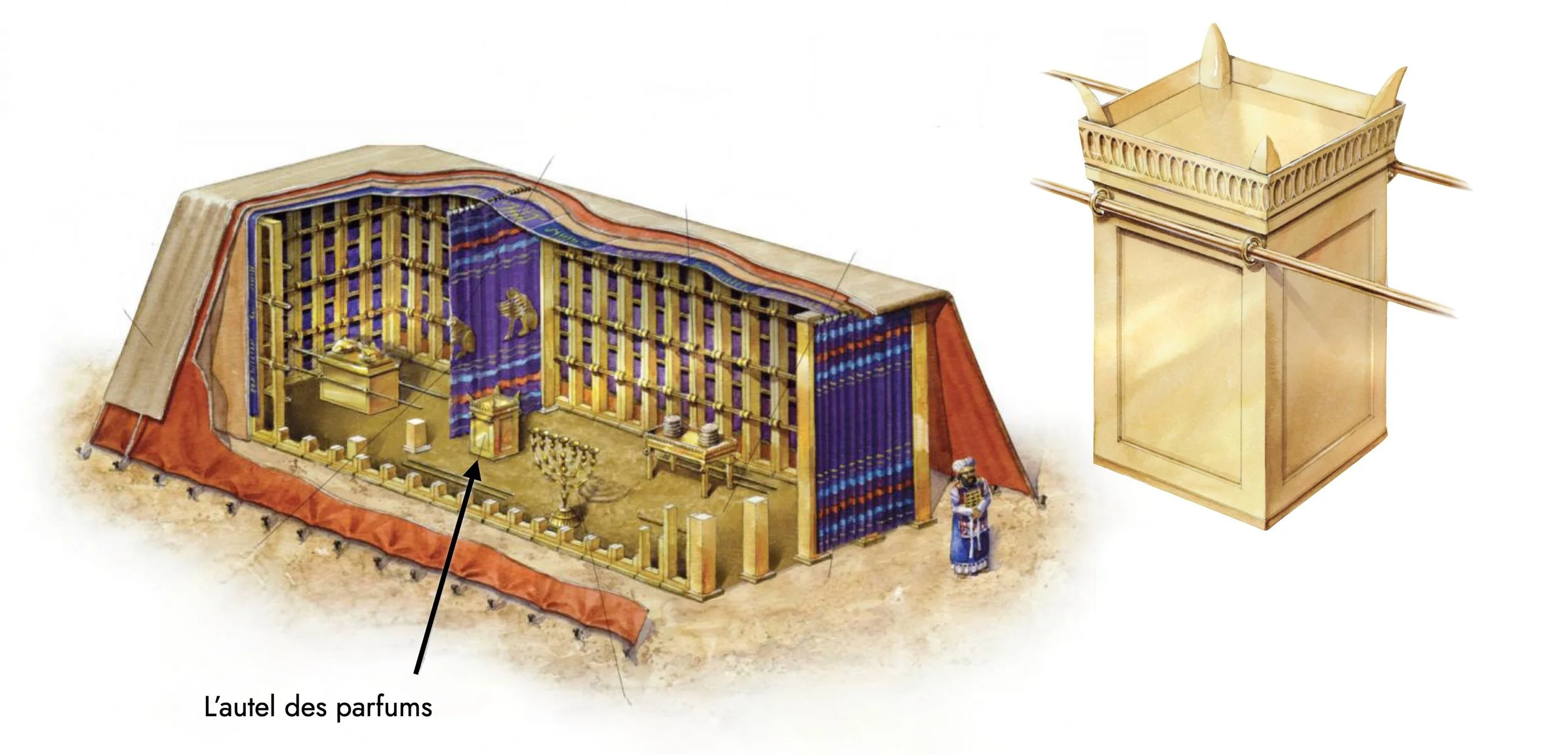
Image credit: ESV Study Bible
We read in Exodus 30.6-8:
And you shall put it in front of the veil that is above the ark of the testimony, in front of the mercy seat that is above the testimony, where I will meet with you. 7 And Aaron shall burn fragrant incense on it. Every morning when he dresses the lamps he shall burn it, 8 and when Aaron sets up the lamps at twilight, he shall burn it, a regular incense offering before the Lord throughout your generations.
Now we’re not told explicitly in the text what this altar of incense symbolizes; there are several theories about it. But one in particular stands out as the most likely, I think.
What happens when you burn incense? First of all, the whole room is filled with the smell of it; it’s a very thick smell. Your opinion will vary on that smell; I think incense of almost any kind smells wonderful, but it’s very strong. The point is, if someone is burning incense, you can’t get away from the smell as long as you stay in that place.
And the reason the smell is so thick is because incense makes smoke. You can see it rising from the incense as it burns, and it fills the whole room.
The incense burnt on this altar wasn’t a single stick or a cone; it created a significant amount of smoke, enveloping the veil of the Most Holy Place like a cloud.
One thing you see multiple times in this book is the glory of God being made visible to the people of Israel in the form of a cloud. We saw it in the pillar of cloud that guided the Israelites by day in chapter 14; we saw it when the glory of God descended on Mount Sinai in chapter 19; and we’ll see it again later, in chapter 40, when the tabernacle is finally erected: the glory of God will descend on the tabernacle in the form of a cloud.
The burning of the incense before the Most Holy Place is, I think, God’s way of getting our senses involved in the realization that God is in this place. Every time the priests entered the tabernacle and saw that smoke and smelled that incense, they would be reminded of God’s glory—that this is no ordinary place.
The reality that this is no ordinary place can be seen all over the tabernacle—even down to the way in which the different elements are built.
At the beginning of chapter 31, we see God tell Moses to call on two specific people: Bezalel, from the tribe of Judah, and Oholiab, from the tribe of Dan. They were craftsmen, and God says in v. 3 that he has filled them with his Spirit, and given them the ability to design and build all of the things God has been describing to Moses. So it wasn’t just Moses and the priests who needed to be wise and knowledgeable to do what God wanted done here; even the craftsmen needed God’s help to build the tabernacle.
And then finally, we come to the end of God’s instructions for his tabernacle. So it is very telling that it ends like this. Exodus 31.12-17:
12 And the Lord said to Moses, 13 “You are to speak to the people of Israel and say, ‘Above all you shall keep my Sabbaths, for this is a sign between me and you throughout your generations, that you may know that I, the Lord, sanctify you. 14 You shall keep the Sabbath, because it is holy for you. Everyone who profanes it shall be put to death. Whoever does any work on it, that soul shall be cut off from among his people. 15 Six days shall work be done, but the seventh day is a Sabbath of solemn rest, holy to the Lord. Whoever does any work on the Sabbath day shall be put to death. 16 Therefore the people of Israel shall keep the Sabbath, observing the Sabbath throughout their generations, as a covenant forever. 17 It is a sign forever between me and the people of Israel that in six days the Lord made heaven and earth, and on the seventh day he rested and was refreshed.’ ”
Why is this question of rest so serious that it is the one commandment God gave before that is reiterated here? And why is it so serious that to not rest properly on the Sabbath was punishable by death?
First of all, just to clear up one common misconception: the law of Moses likely didn’t apply this commandment as strongly as the Pharisees did in the gospels. You probably wouldn’t be put to death for picking up a mat. The kind of work it has in mind would be someone consciously rejecting the Sabbath day and choosing to go out and do his ordinary work (tilling his field, or building something in his workshop).
The first reason this question of the Sabbath is so serious is because working on the Sabbath was a conscious rejection of God himself; it would be like, if on your wedding anniversary, not only did you not celebrate with your wife in any way, but you took another woman out on a date.
The second reason is because the Sabbath is not only a picture of the rest God took after creating the world (as we see here); it is also a picture of the eternal rest promised to God’s people (as we see in the book of Hebrews). The Sabbath is a reminder of what we have when we belong to God—it was a collective and personal affirmation of the goodness of God. The Sabbath is what all the worship in the tabernacle is pointing toward.
And so with all these instructions, God’s time with Moses on the mountain ends in Exodus 31.18:
18 And he gave to Moses, when he had finished speaking with him on Mount Sinai, the two tablets of the testimony, tablets of stone, written with the finger of God.
It’s a powerful image, and a rather ominous foreshadowing of what’s going to come right afterwards, which we’ll see next week.
Pictures of Real Things
Now I’m sure you’ve noticed that these chapters are full of pictures. The incense creating the cloud that’s a picture of God’s glory. The sacrifices that are a picture of God’s wrath against sin. The anointing that is a picture of God’s purification. The clothing of the high priest, a picture of his holy office. And the names graven on these clothes, a picture of the entire people, brought before God.
This can all be a little frustrating if you don’t know where it’s going, because after seeing all these pictures (and sometimes pictures of pictures), what we want to know is, What are these pictures, taken together, supposed to show us?
It’s not immediately evident if you only read the book of Exodus, because this book (and all the books of the Bible) was never meant to be taken on its own. The Bible is one story, told over the course of many books.
So one of the best analyses of this section of Exodus is actually found much, much later, in the book of Hebrews. In Hebrews 9, the author talks about the tabernacle—he talks about its architecture and the different elements in it, and he talks about the sacrificial system, how sacrifices had to be made over and over. So in v. 1-10, the author is highlighting the limitations of the tabernacle.
But then we come to v. 11, and this is where, when I saw it for the first time, God blew my mind.
11 But when Christ appeared as a high priest of the good things that have come, then through the greater and more perfect tent (not made with hands, that is, not of this creation) 12 he entered once for all into the holy places, not by means of the blood of goats and calves but by means of his own blood, thus securing an eternal redemption.
And he says later in v. 24:
For Christ has entered, not into holy places made with hands, which are copies of the true things, but into heaven itself, now to appear in the presence of God on our behalf.
The tabernacle is a “copy of the true things.” it’s not the true thing, but a copy of the true thing. The high priest offered sacrifices for the people’s sins and brought them into God’s presence, yes—but he couldn’t stay there. He could only come into the Most Holy Place once a year. His work is a copy.
The true thing is Jesus. We read in Hebrew 9.15:
15 Therefore [Christ] is the mediator of a new covenant, so that those who are called may receive the promised eternal inheritance…
Jesus Christ gave himself up as a perfect sacrifice. He paid the price once and for all for our sin. And then he took on the role of High Priest; he carried us into God’s presence—and he’s still there. Which means, so are we, because he brought us in.
That’s what Jesus has done with us, and that is what he is still doing. How often do we sing the song?
My name is graven on his hand.
My name is written on his heart.
I know that while in heav’n he stands,
No tongue can bid me thence depart.
These are not just words. It’s not just a song we sing. It is the reality into which God has brought us. God’s Son is our tabernacle, he is our high priest and mediator, and he is our sacrifice. He carries us into God’s presence, and as long as he is there, nothing can tear us out of it.
These descriptions of the tasks of the priests, their clothing, their consecration, the sacrifices, and the tabernacle—all of it—are pictures of this much greater reality of what Christ has done for us, what he is still doing for us.
But a long time has passed since the tabernacle. A long time has passed even since the time of Christ. So it’s really easy for us to read about these pictures and feel distanced from them. It’s easy for us to read them without benefiting from them.
So let’s just think about that for a minute. Why do we take pictures? Why do we look at them? We do it for three main reasons. We look at pictures to remember; we look at pictures to recognize; and we look at pictures to rejoice.
Loanne and I were married in the U.S. and moved to France not long after. But when we came to France, our marriage still hadn’t been validated by the French government (the process took a lot longer than expected), so I had to enter the country as a tourist. That meant that I could only legally stay in France for three months, after which I had to go back to America and stay there for another three months before entering the country again.
So I had to go to the U.S. and not see my wife for three months, which is a very long time for newlyweds.
This is going to age us both, but this was before Zoom, before Skype, before Facebook. Neither of us even had a cell phone. I could call Loanne on the landline, but it was expensive. So we spoke once a week, and we could send emails, but I didn’t actually see her for three months.
All I had of her were pictures.
For three months, those pictures were my lifeline. I kept them in my wallet and I pulled them out every five minutes. I looked at those pictures constantly.
And when I came back to France after three months, I got off the plane and saw her waiting for me at the airport. It was very strange, because for a second I didn’t quite recognize her. I’d been looking at her face in those pictures for three months, but her real face, the real person she is, was so much fuller and more beautiful than the pictures.
I’d spent those three months remembering Loanne’s face, but when I finally recognized her, she was so much more than those pictures. So my response was joy: I came to her and I hugged her and I kissed her, and I was home.
It’s the same thing with the pictures we see in the tabernacle, the pictures we see with the priests.
God gives us these pictures so that we might remember. When we read about the instructions for tabernacle and the priests, which were so incredibly detailed, we remember that from the very beginning, God had a plan for the world he created. We see hints of it in Genesis and earlier in Exodus, but we see detail after detail, compounding, when we get to these pictures in the tabernacle. When we read these passages, we remember that this was no accident. God had a very specific plan, and because he loved his people he made a way for us to be reconciled to him, even though we had rejected him.
God gives us these pictures so that we might recognize. The work that Christ did on the cross is a spiritual work, so it’s necessarily a little abstract for us. Our minds have a hard time grasping what he did. So God gave us pictures. He knows that it’s helpful for us to have visual hooks, to help us understand things we’d have difficulty understanding on our own. He gave us these pictures so that, after reading Exodus, when we arrive at the gospels, and the book of Hebrews, we might understand what it is that Christ did. So that we might understand that Christ is our sacrifice, and our high priest, and our tabernacle, that he is the means by which we are made holy, and the mediator who brings us into God’s presence, and that we might grasp what that means.
And finally—perhaps most importantly—God gives us these pictures so that we might rejoice. We look at the pictures, a shadow of what was to come. Then we look at Christ, at what he has done, what he is still doing for us. And we rest in the joy of our assurance, that we’re not the ones who bring ourselves into God’s presence. He is the one who carries us before God—and he is still there. So our salvation is absolutely secure.
Some of you need to hear this. If you have placed your faith in Christ and trusted in his work and repented of your sin, then no matter how imperfect you still are, he’s still at the right hand of God, and he brought you with him. He’s not just carrying you before God; your name is graven on his hand. He lives in you now, by his Spirit, and you are a part of his body.
So you can be happy. You can let go of your doubt, because it’s unfounded. If it was up to you, then you’d have ample reason for doubt; but he is your Mediator. He won’t fail you.
And because he won’t fail you, or any of us, we can rejoice. We can rejoice in what he has done, what he is doing for us still, and what he is still going to do. He has already come to deal with sin; but one day he will come again to bring us home.
The end of Hebrews 9 says this:
27 And just as it is appointed for man to die once, and after that comes judgment, 28 so Christ, having been offered once to bear the sins of many, will appear a second time, not to deal with sin but to save those who are eagerly waiting for him.
These chapters, though they may feel dry and distanced from us, are anything but. When we read them, we are reminded of the incredible work God put forward to save us; we recognize the perfect work of our High Priest and Mediator; and we rejoice in the knowledge that if he has saved us, he will not let us go.
He will bring us home.
Our True Home
Exodus 25.1-27.19
I often talk to people who have a real attachment to the place they grew up. I love that idea, but I don’t totally understand it, because I never had a real home. We moved to a new state in the U.S. ever four or five years when I was a kid. I was born in North Dakota, then we moved to Michigan, then Oklahoma, then Washington, then Tennessee, and then Florida.
I say I’m from Florida because it’s easier, my family is still there and I like it there, but I have no real attachment to any particular place.
For me, home is where my people are. Growing up, home was wherever Mom, Dad, Jeremy and Jared were. And now, it’s wherever Loanne, Jack and Zadie are.
When we meet God’s people in the book of Exodus, it was the same thing. They’ve never really had a home. Abraham started off one place, then went to another, and within a couple generations they ended up in Egypt. They were in Egypt for several centuries, but it wasn’t their place—they were guests at first, and then slaves.
So in the first half of this book, in Exodus 1-24 (which we saw over the spring), God came and rescued them from slavery, took them out of Egypt, made a covenant with them, and promised them a land which would truly be theirs. It was a promise that would have meant so much for them: a place where they could finally put down roots.
But before that, God wants them to understand that even this Promised Land is not the home they’re looking for. Just like my home is wherever my family is, the home of God’s people is wherever he is.
That is what we see in the tabernacle.
Just to give us a bit of context: at the very end of chapter 24, we read:
Moses entered the cloud and went up on the mountain. And Moses was on the mountain forty days and forty nights.
That’s where we are now. God’s given Moses a number of laws already, but now Moses is on the mountain, in the cloud of the presence of God. From here on out, all these questions of the Covenant and how the Israelites are meant to keep it are front and center. It is, so to speak, the “fine print” of the Covenant.
And that is why it’s significant that, when God gets into the “fine print”, he starts with the tabernacle.And the question we want to ask while looking at these instructions for how to build this tabernacle: What is the main idea? What is the story these instructions are telling?
I’ll go ahead and spoil it for you—here’s the story the tabernacle is telling: God dwells with his people. God makes a home for himself amongst his people. And consequently, his people find their home in him.
He tells Moses, in 25.8:
“And let them make me a sanctuary, that I may dwell in their midst.”
If you write in your Bible (which is totally fine), you should underline the second half of that verse: that I may dwell in their midst. Exodus 25.8 is the entire story of the Bible, in miniature.
The Tabernacle: Layout
So as quickly as we can, let’s just look at the layout of this “sanctuary”, this tabernacle that God is commanding the people to build.
First of all, we see in 25.1-9 that Moses is to take up a collection—of gold, silver, bronze, blue and purple and scarlet yarns, goats’ hair, rams’ skins, acacia wood, oil and spices, onyx stones and stones for setting. As Joe said last week, this is the most expensive tent in history.
Now, how did the people of Israel—who were, after all, slaves in Egypt—have all of these things to contribute to the building of the tabernacle? Remember, we saw this in chapter 12. Before the people left Egypt, they did as God asked and went around asking the Egyptians for silver and gold jewelry and fine clothing. And we read in 12.36:
And the Lord had given the people favor in the sight of the Egyptians, so that they let them have what they asked. Thus they plundered the Egyptians.
God made it so that the people would have all these riches when they left Egypt. But the riches weren’t for the Israelites personally. They were for the building of the tabernacle.
Now, after this, he starts to describe the tabernacle itself. He starts in the center, and works his way outward.
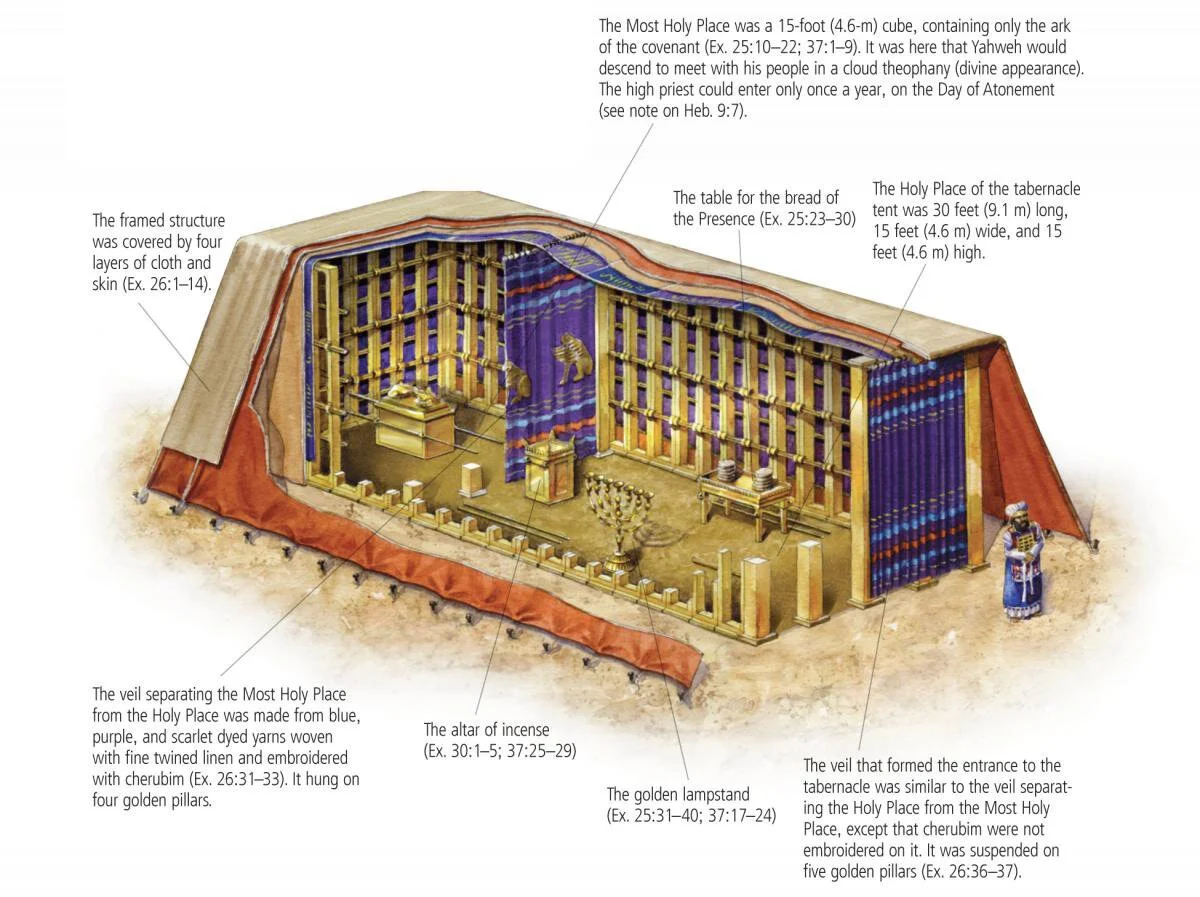
Image taken from the ESV Study Bible, Crossway.
First, we see the Ark of the Covenant. It was basically a box made of wood that they would cover in gold and ornate carvings. (If you want to know what it looks like, watch Raiders of the Lost Ark, the first Indiana Jones movie; their rendering of the Ark of the Covenant is actually extremely faithful to what we see in the Bible. Plus, the movie’s fantastic.)
The Ark of the Covenant will act as a kind of throne for God; this is where his presence would sit and from which he would speak. It would be kept in a kind of room called the Most Holy Place, separated from the rest of the tabernacle by a very thick curtain. It’s the only object in this room.
In the next room out, we find a number of items, everything either made of gold or overlaid with gold. (We see them described in the rest of chapter 25.) We have a table for bread, a golden lampstand and an altar for incense.
Then, in chapter 26 we see a description of the tent itself—the wooden frame overlaid in gold, and the various coverings that will cover it (and there are several).
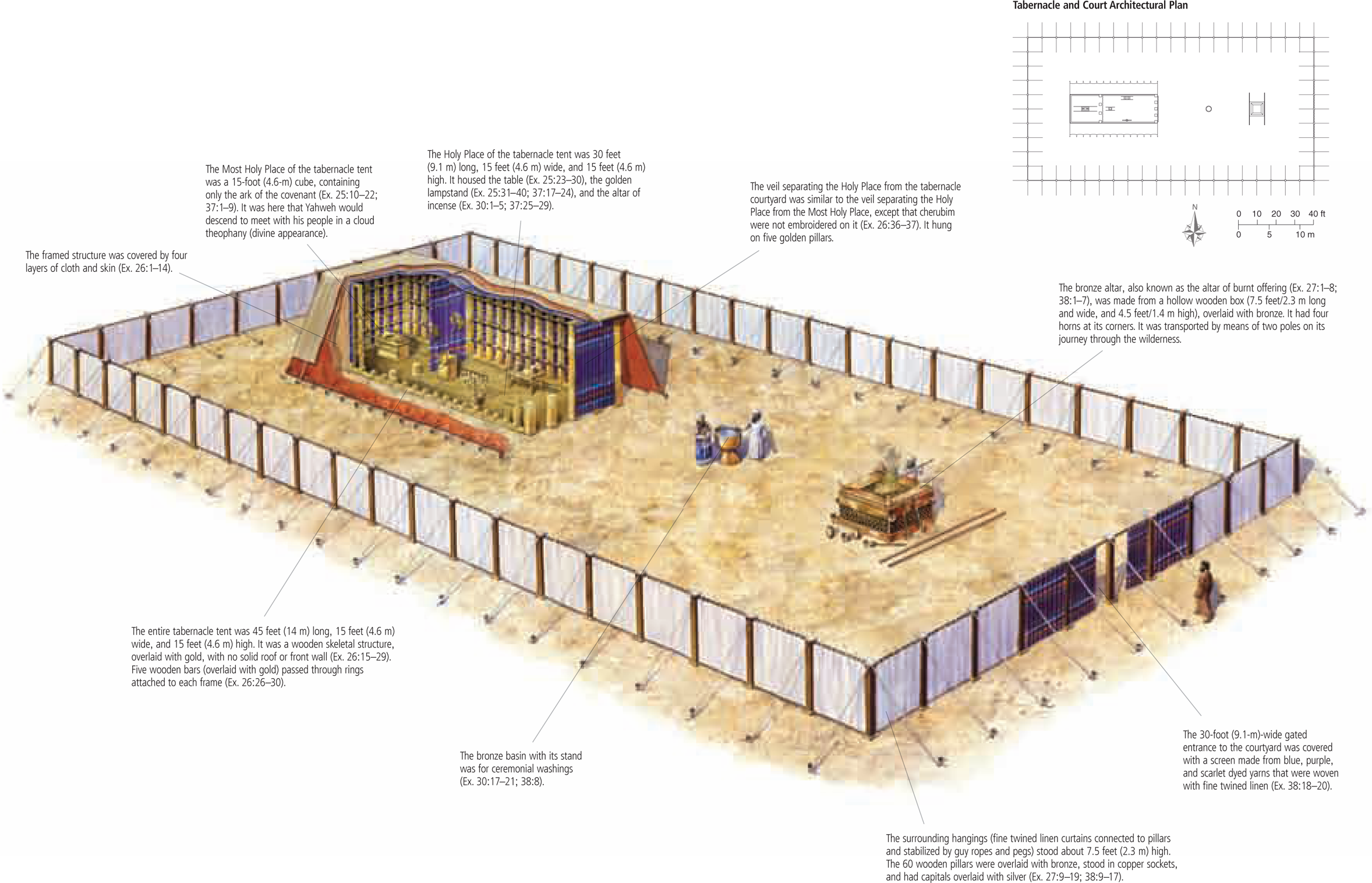
Image taken from the ESV Study Bible, Crossway
Then, chapter 27 describes the outer court—a fenced-in courtyard outside the tabernacle. In the courtyard you no longer have things made of gold, but rather made of bronze, a much more ordinary material. You have a basin for washing, and a bronze altar for offering sacrifices to God.
Now it’s easy to think that all this is a bit much. The Israelites are a desert people now, and yet they have this incredibly lavish center of worship. It seems like a lot of senseless spending.
But it’s not. The lavishness of the sanctuary is not for reasons of vanity, but for reasons of storytelling.
This has always been one of my favorite things about God as he’s described in the Bible: God is always telling stories. In his public ministry, Jesus is constantly telling stories. God tells stories by giving us the Bible itself, by inspiring these men to keep a record of Israel’s history; but God also tells stories by the way he chooses to do things.
These very detailed instructions for this very ornate tent are not for nothing. The tabernacle is telling a story.
The question is, what story is the tabernacle telling?
What Story is the Tabernacle Telling?
To put it very simply, the tabernacle is telling the story of home.
First, it tells the story of the home humanity has lost. There are echoes of Eden all over this place. I’ll mention just a couple.
If you look back at the list of materials gathered for the tabernacle, the list begins with gold and ends with onyx. Now if we look at Genesis 2.12, part of a description of the garden of Eden:
And the gold of that land is good; bdellium and onyx stone are there.
It’s also no accident that the lampstand, with its buds and flowers, looks like a tree that gives light, reminiscent of the tree of life in the garden of Eden.
Before sin entered the world, God gave Adam the task of “working and keeping” the creation (Genesis 2.15). Adam in the garden is described in similar ways to the priests in the tabernacle.
The most important thing, of course, is that God is present. The garden was a place where God walked with man, where he dwelt with man. In the tabernacle, God’s presence would return amongst his people.
The elements we see in the tabernacle are a kind of visual callback to the garden of Eden, the home that humanity had lost. (We’ll come back to this in a minute.)
But the tabernacle isn’t only a look back at the home the people had lost. It is also pointing forward to the home they will gain. It is telling the story, not only of where the people have been, but where they are going.
Look again at the furnishings in the tabernacle.
First, the Ark. The Ark of the Covenant is the place where God will reign over his people. Exodus 25.22:
There I will meet with you, and from above the mercy seat, from between the two cherubim that are on the ark of the testimony, I will speak with you about all that I will give you in commandment for the people of Israel.
Tim Chester writes: “In Eden humanity rejected the authority of our heavenly Father. The result has been chaos, conflict and condemnation. But in God’s new home he will restore his life-giving rule of love.”
It’s wonderful, but it’s only the beginning—it’s an anticipation of what is to come.
In Revelation 22.3, in John’s glorious vision of the new heavens and the new earth, he says that in that place, in that perfect garden,
3 No longer will there be anything accursed, but the throne of God and of the Lamb will be in it, and his servants will worship him.
After the Ark, we have the Table for bread.
Nothing symbolizes home like a dinner table. This table for bread shouldn’t be surprising if you’ve been following Exodus, because the first big challenge the people faced after leaving Egypt was their need for food. And what did God provide for them? Bread, meat and water.
It was a commandment of God that every time the tabernacle is set up, bread must always be on the table. It is a reminder to the people that their God is a God who provides: as he has in the past, giving them manna in the desert, he will in the future, when he brings them into the blessings of the Promised Land of Canaan.
And it is also a promise of his eternal provision, far beyond the Promised Land. Again, Revelation 22, this time in v. 1:
Then the angel showed me the river of the water of life, bright as crystal, flowing from the throne of God and of the Lamb 2 through the middle of the street of the city; also, on either side of the river, the tree of life with its twelve kinds of fruit, yielding its fruit each month. The leaves of the tree were for the healing of the nations.
In the new heavens and the new earth, there will be perfect provision, for all of God’s people, for all eternity—food not only for nourishment, but for eternal health.
Likewise, the lampstand. The tent was covered with so many layers of such thick material that it would have been pitch black inside. The lamp gives light in the darkness. The God of Israel is the God who gives light where there is no light—he exposes to his people who they are, who he is, what is right, what is wrong.
This, too, looks forward to what is to come. Revelation 21.23-25:
23 And the city has no need of sun or moon to shine on it, for the glory of God gives it light, and its lamp is the Lamb. 24 By its light will the nations walk, and the kings of the earth will bring their glory into it, 25 and its gates will never be shut by day—and there will be no night there.
You see, the tabernacle is telling the story of home—the home that humanity has lost, and the home that God promises for his people for all eternity.
However, there is something we haven’t talked about yet, that is absolutely part of the story. The architecture of the tabernacle itself adds a layer of complexity.
When you look at the design of the tabernacle, you can see several barriers between the people and God. The Most Holy Place, where we have the Ark of the Covenant, is separated from the rest of the tabernacle by a thick curtain. Only the High Priest could go in there, and he could only enter once a year.
Inside the Most Holy Place, above the Ark, were two golden cherubim—a reminder of the cherubim guarding the way back into the Garden of Eden, once God had banished the man and the woman. The cherubim were there to keep man out of the garden.
Then there is the outer room of the tabernacle, cut off from the outside world by its thick coverings. And then there’s the outer court, outside the tabernacle, which was again cut off from access by the hangings all around.
I said before that the tabernacle told the story of the home humanity had lost. Why did we lose it? We lost it because we rebelled against our Creator, and wanted to be our own masters. Our good and gracious King made humanity and placed us in paradise, and we wanted to build a kingdom of our own.
That desire is what we mean when we talk about sin, and sin is a cancer that has corrupted all of humanity. It has made it impossible for us to be united with God, because God is a holy God, and cannot be united to sin.
The point here is that although God desires to dwell with his people, his people cannot dwell with him, because they are sinful people, and God is a holy God.
So in order for this to work, their sin had to be removed.
That’s what the bronze altar was for. Sacrifices had to be offered in the court of the tabernacle, on the altar. And even before we see all the details of how and when these sacrifices are made, we see one important detail. There was a grating on the altar, so the ashes could fall underneath and be removed. The altar was built to be cleaned and reused. These sacrifices would have to be repeated, over and over. It was not a perfect or a permanent solution to the problem of sin.
And that’s kind of the point. The tabernacle was never meant to be God’s ultimate solution for sin, or his ultimate dwelling place, or the ultimate home for God’s people. The tabernacle was telling a story, of the home we lost, the home we’ve gained, and the home we will have one day, for all eternity.
We see this most clearly in the fact that the tabernacle itself is not a building made of bricks or wood. It is a tent—designed to be taken down, carried to another place, and put back up again.
And if you know the story of the people of Israel over the rest of the Bible, you know that this is what the people kept forgetting. Their “home”—the place where they found their identity, to which they were profoundly attached—became their rituals, their rites, their history, their habits. It became their temple, in Jerusalem. These things were good things…but they were never meant to be the main thing. They were pointers, signposts, storytelling devices, to get the people ready for their real home.
Home for God’s people was never meant to be a static place, or a fixed set of rituals. Home for God’s people is wherever God is.
Our True Home
That is the message of the tabernacle. That is the point.
And several thousand years later, the true home that the tabernacle pointed toward began to take shape. We read in John 1.14:
14 And the Word became flesh and dwelt among us, and we have seen his glory, glory as of the only Son from the Father, full of grace and truth.
John says that this “Word” was Jesus Christ, God himself, made flesh. And when he says that Jesus “dwelt among us”, the word he uses there has the same root as the word for tabernacle. Literally, he’s saying that Jesus “pitched his tent” among us. Right from the beginning, when we think of Jesus, John wants us to remember the tabernacle.
And every element of the tabernacle is reflected in Jesus. The sacrifice on the altar; the priest who serves as intermediary between God and the people; the lampstand, giving light in the tabernacle; the bread of the presence; the Ark of the Covenant—all of these point to Jesus.
Jesus is the true High Priest. God himself stands as intermediary now, the Son of God bringing us into the presence of the Father, presenting us as God’s perfect, spotless children.
And not only is he the true High Priest, Jesus is the true sacrifice. The Son of God, given up for us, a perfect sacrifice for our sin—past, present and future. All of the sin of God’s people is removed by the sacrifice of Christ.
Hebrews 9.11-12 says:
11 But when Christ appeared as a high priest of the good things that have come, then through the greater and more perfect tent (not made with hands, that is, not of this creation) 12 he entered once for all into the holy places, not by means of the blood of goats and calves but by means of his own blood, thus securing an eternal redemption.
Jesus is the true High Priest, and the true sacrifice for our sins.
In addition, Jesus is the true Ark—he is where we live under God’s reign, because he is not only our Savior and our Brother, he is our King.
3 [Jesus Christ] is the radiance of the glory of God and the exact imprint of his nature, and he upholds the universe by the word of his power. After making purification for sins, he sat down at the right hand of the Majesty on high…
Jesus is the true Holy of Holies—through him, we have ultimate access to God, the Holy of Holies now accessible to all of God’s people.
17 And he came and preached peace to you who were far off and peace to those who were near. 18 For through him we both have access in one Spirit to the Father.
Jesus is the true bread. He said in John 6.35:
“I am the bread of life; whoever comes to me shall not hunger, and whoever believes in me shall never thirst.”
He is our ultimate provision, our ultimate satisfaction.
And Jesus is the true light. John 8.12:
“I am the light of the world. Whoever follows me will not walk in darkness, but will have the light of life.”
You see, the tabernacle, for all of its ornate beauty—the gold and the precious stones and the carefully woven linen—is just a shadow. If the tabernacle is designed so ornately, how much greater are the blessings we find in Christ? If the tabernacle is in itself so beautiful, how much more beautiful is Christ himself?
This is one reason why Christ’s coming to earth was so incredible. Thousands of years after the tabernacle, Jesus came and, in totally ordinary places far from the temple in Jerusalem, declared that the kingdom of God is here. He said, “I am your temple”. I am your home.
And when he promised heaven, the defining characteristic of heaven was that he would be there. He said in John 14.2-3:
2 In my Father’s house are many rooms. If it were not so, would I have told you that I go to prepare a place for you? 3 And if I go and prepare a place for you, I will come again and will take you to myself, that where I am you may be also.
What is it that characterizes and defines heaven, the “place” that Christ is preparing for us? It is that where he is, there we will be also.
Even in heaven, heaven itself isn’t our home. He is our home.
Application
Now I know that’s a lot of information to take in, so let me bring us back down to earth, so to speak.
All of us are looking for home. This is why people want to get married and have kids. This is why we look for careers and leisure activities we love. We’re all looking for a place where we can truly belong and find out why we’re here.
The problem: it never quite works the way we think it will.
Finding a community, one where we really feel at home, is difficult. Marriage is difficult. Raising children is really hard. Relating to your parents is often a challenge. Our careers may be wonderful, but they never quite produce the results we were hoping. (And sometimes we can’t even find a career!) Even our leisure activities aren’t perfect—we often come back from vacation more exhausted than we were before.
We’re all looking for home, and we can never quite find it on our own. Which is why this quote from C. S. Lewis has become so well-known: “If we find ourselves with a desire that nothing in this world can satisfy, the most probable explanation is that we were made for another world.”
If you feel like you’ve been looking for home all your life but you’ve never found it, it’s because you were never meant to find it here. You were created to find your home in Christ. If you thought you had found a home for yourself, but it’s not everything you hoped it would be, that’s normal: what you thought was your home is only a pale reflection of the home you were made for.
And if you’ve found your home in Christ, but you’re still struggling with doubt because living for him is difficult, that’s normal too. Our home isn’t perfect—not yet. We are still here in this fallen world, with weak bodies that are still accustomed to sinning.
But home is coming, and we already have a foretaste of what it will be like, because even today, we have him.
So let me leave you with this simple challenge.
Even in heaven, home is not a place. It’s where he is. All of the glorious promises of heaven would be worthless if he wasn’t there. And the beautiful reality is that if we are in Christ, and if home is wherever he is, we are home. Now. It’s not all it will be, but it is real, and glorious, even now.
As tempting as it may be to see our friends or our families as our home—for me to see Loanne, Jack and Zadie as my true home—they’re not, at least not because they’re my wife and kids. They are my home because if they belong to Christ, they’ll be there celebrating him with me for all eternity. And that’s true of every person in this room who has placed their faith in Christ. If you want to have a foretaste of heaven, look at the faces of those around you. They are the faces you’ll be seeing for all eternity.
So dig in to your home. Learn to love Christ together. Worship Christ together. Glorify Christ together. The tabernacle was adorned with gold and precious stones and fine linen. Our home—the church—is adorned with love of God, love for one another, and the good works that flow out of it. Live with God in the home he has given you.
And if you don’t know Christ today, let me just say this. I know that you are looking for a home, and no matter how satisfied you feel, it’s never going to be quite right, because you were created to find your home in him.
The good news for you is that Christ has taken away all of the barriers between God and ourselves. All we have to do in order to be forgiven of our sin and united to God is to repent of our sin and place our faith in him. We’ll give you an opportunity to do that in a minute, and when that time comes, I plead with you to do it.
Find your home in him.
Vision: Train disciples (2 Timothy 3)
We’re currently in a series on the vision of our church—the way we feel God calls us to live in his plan for this world. Just as a reminder, these are the three points of our church vision. We exist to:
1. Embody the gospel for the residents of Paris;
2. Train disciples who make disciples;
3. Send out Christians equipped to serve the gospel in France and beyond.
Last week we talked about what it looks like to embody the gospel for the people of our city; this week we’re moving on to our next point: training disciples who make disciples. It is the logical next step: once we meet Christ, we need to learn to live like him. It’s exactly what Jesus commands his disciples to do in Matthew 28: Go and make disciples of all nations, baptizing them in the name of the Father, the Son and the Holy Spirit, and teaching them to obey all that I have commanded you.
To talk about this, we’re going to look at a very well-known passage, chapter 3 of Paul’s second letter to Timothy.
In case you don’t know what’s going on in this letter: the apostle Paul had a protégé, a young man named Timothy. Timothy traveled with Paul, he listened to Paul teach and he watched him live.
Eventually, when Timothy was mature enough, Paul left him in Ephesus to pastor the church there. And then, Paul was imprisoned by the Romans.
He writes this letter from prison, a short time before his death. He wrote it as a final exhortation to Timothy, a farewell to his son in the faith. And it really is a kind of final exhortation to Timothy to keep central what is truly central—to remain focused on what is truly important.
He does this by first expressing his gratitude for Timothy’s faith, and exhorting him to endure in the gospel; and then he puts his exhortation into context by talking about false teachings that have been showing up in Timothy’s church and elsewhere. These false teachings aren’t coming from Timothy; they’re coming from other Christians.
And that’s where the danger lies.
The Danger of False Discipleship (v. 1-9)
That’s where we’ll start in chapter 3, verse 1.
But understand this, that in the last days there will come times of difficulty. 2 For people will be lovers of self, lovers of money, proud, arrogant, abusive, disobedient to their parents, ungrateful, unholy, 3 heartless, unappeasable, slanderous, without self-control, brutal, not loving good, 4 treacherous, reckless, swollen with conceit, lovers of pleasure rather than lovers of God, 5 having the appearance of godliness, but denying its power. Avoid such people. 6 For among them are those who creep into households and capture weak women, burdened with sins and led astray by various passions, 7 always learning and never able to arrive at a knowledge of the truth. 8 Just as Jannes and Jambres opposed Moses, so these men also oppose the truth, men corrupted in mind and disqualified regarding the faith. 9 But they will not get very far, for their folly will be plain to all, as was that of those two men.
So this is what happens when true discipleship is not pursued. This is the counterexample Paul gives to Timothy.
In v. 1-5, Paul lists a number of characteristics that seem fairly obvious if you’ve read Paul’s other letters. But here, he seems to cast his net wider than usual. He talks about people who are self-centered, greedy, arrogant, disrespectful, liars, brutal, “lovers of pleasure rather than lovers of God.” It’s almost a caricature of what most of us would consider an “evil” person.
But one thing sets them apart that we wouldn’t necessarily expect to see here, and it’s the most important. We see it in v. 5: having the appearance of godliness, but denying its power.
These people have the appearance of godliness. That is, despite all the awful things Paul just said about them, if you saw these people in church, you’d probably never notice anything strange about them. These are people who claim to be Christians, and who even seem to be exemplary Christians. They have the appearance of godliness.
There’s a reason why Paul says “Avoid such people” at the end of v. 5, and that is that these people are particularly dangerous. don’t think I’m overstating when I say this: someone who calls themself a Christian, but who does not live as a disciple of Christ, is far more dangerous than a sinful unbeliever. They’re dangerous because, since they seem so godly, people will trust them. But since they’re guided by their own selfish desires instead of God, these men aren’t trustworthy.
Paul says that they prey on the weak—that’s what he means when he talks about “creeping into households and capturing weak women”. He’s not saying they prey on all women, but given the power dynamics between men and women at the time, a particular type of woman would have been an easy target: women who were “burdened with sins—who had sinned in the past and couldn’t get out from under the guilt of it, and who, consequently, continued to be led astray by various passions, always learning and never able to arrive at a knowledge of the truth.
This can happen to men too, of course, but given the power dynamics between men and women naturally the time, this type of woman would have been an easy target. (A good example of the kind of woman Paul’s describing here is the Samaritan woman at the well, in John 4. She was in exactly this type of situation in her life, except that she met Jesus at that well, and not the kind of man Paul describes here.)
What do these men do? They “capture” these weak women—they convince them of a false gospel, which has all the bells and whistles of piety, but no truth.
Paul says in v. 8 that these men are like Jannes and Jambres. Who were they? These names don’t appear in the Old Testament, but they are the names that early Jewish writings gave to the magicians who opposed Moses in Exodus 7. Just like people use Napoleon’s name as shorthand for a self-aggrandizing character, Jannes and Jambres were shorthand for the Jews to represent opposition to God’s truth. These men, Paul says, have had their minds twisted by sin. Eventually their folly will be plain to all, he says, but in the meantime, they do damage to themselves and to others.
Paul’s goal in telling all of this to Timothy isn’t to freak him out. He’s not trying to make Timothy paranoid and afraid of opening up. He’s trying to do things: first, he wants to put him on his guard, so he can have his eyes open for signs of this type of person, because they’re dangerous for themselves, but especially, they’re dangerous for the church.
The Life of True Discipleship (v. 10-13)
The second thing he wants to do is encourage Timothy in true discipleship. When true godliness is at work, its power will show itself in the way other people are pointed to Christ through the life of the godly Christian. And this is what we see in the following verses, when Paul talks about himself. V. 10:
10 You, however, have followed my teaching, my conduct, my aim in life, my faith, my patience, my love, my steadfastness, 11 my persecutions and sufferings that happened to me at Antioch, at Iconium, and at Lystra—which persecutions I endured; yet from them all the Lord rescued me.
Now I know that the way Paul starts v. 10 sounds awfully self-aggrandizing. He reminds Timothy of what Timothy saw when he was following Paul. He talks about “my teaching, my conduct, my aim in life, my faith, my patience, my love, my steadfastness.”
My instinct is to go, “Wow, Paul, you sure have a high opinion of yourself. Maybe a little humility is in order.”
But Paul’s not praising himself. Paul draws Timothy’s attention, not to Paul himself, but to the way Timothy has followed in his footsteps. In v. 10, he’s saying, “Timothy, you have learned well. You conduct yourself well. You have a good aim in life. You have grown in patience. You have grown in love. You have grown in steadfastness.” Timothy saw all this in Paul, and he followed in his footsteps. Paul is commending Timothy here, not himself.
Now, Paul says that in addition to following in his footsteps in terms of godliness, Timothy has also seen how Paul suffered in the different cities where he ministered. Paul reminds him that true discipleship is costly, and often humiliating. V. 12:
12 Indeed, all who desire to live a godly life in Christ Jesus will be persecuted, 13 while evil people and impostors will go on from bad to worse, deceiving and being deceived.
For the disciple of Christ, persecution and hardship are part of the package. As Jesus said, “If they persecuted me, they will persecute you” (John 15.20).
Why is he talking about persecution? Because it is another clear indicator of true godliness, of true discipleship. He’s contrasting the false disciples he described in v. 1-9 with his own experience, an experience that Timothy has witnessed and participated in.
When we were on vacation in the south of France, we went to a lake with another family. At the center of this lake, there was a platform you could climb onto and jump off of, into the water. Zadie was absolutely determined to jump off of the platform into the water. So she swam out there with the others, climbed up, and jumped off, like a champ.
I wanted to jump off too, because I like the water, I like swimming, and I like jumping off things.
The thing is, the water was really cold. Unpleasantly cold. I wanted to go in and swim and jump off the platform, but I didn’t want it that bad. So I got in up to my knees, and then said, “You know, I’m good.” And I stayed out.
This is the dynamic we see when Christians are exposed to hardships or persecution for their faith. Paul and Timothy are all in. They’re determined to follow him. They’ll take the persecution for Christ, they’ll take the hardships for Christ, because they have Christ. They’ll brave the waters, because they know what’s waiting for them at the end, and it’s infinitely better than whatever they may suffer for it.
The people Paul described in v. 1-9 will never get that far. They will never accept persecution for what they say they believe, because they don’t fully believe it. They’re lovers of pleasure rather than lovers of God. They’ve learned a lot, but they haven’t arrived at a knowledge of the truth. When the Christian life becomes costly to them, they will show their hand; they’ll bow out. And, as Paul says in v. 9, their folly will be plain to all.
The question is, how did Timothy, this young Greek man who grew to know Christ, come to the point where he would be able, not only to manifest faith, patience, love and steadfastness, but to remain firm in that character, even in the midst of the hardship he endured?
The answer is, he followed Paul. He lived with Paul. He learned from Paul.
He followed him in godly character, and in the persecutions and sufferings Paul endured.
The important thing to see is that he didn’t do it on his own. Timothy learned how to faithfully live the Christian life, in good times, and bad, by watching Paul do it.
Of course, not all Christians have this same opportunity. And in those cases, God has consistently showed himself faithful to help us grow in the faith. But we have to see that this kind of discipleship model (the “desert island” model where a guy is marooned on a desert island with nothing but his Bible and still grows in his faith because God is good and gracious) is the exception rather than the rule in the Bible.
Jesus’s disciples learned to follow him…by following him. And they took on disciples of their own. Paul trained Timothy.
The norm for the Christian life is that we learn to live faithfully for Christ by observing and imitating others who live faithfully for Christ.
There are two things we have to see here. The first is pretty obvious, but it should be said anyway:
Firstly, if you have any access to the local church, you can’t live separated from it.
Some people are like me—they have a hard time in social situations. Some people have a hard time opening up. Some people have been wounded by the church in the past. There are lots of excuses we can find to remain isolated from a local church, and a lot of people will do that; they’ll say, “I love Jesus, I love the Bible, but I don’t really need the church, because God will speak to me and build me up himself.”
That’s not how it works. It’s a dangerous thing to presume on God’s grace, and choose to remain isolated from the church because you don’t want to open yourself up to it. So if you have access to a local church—like all of us here do—then the norm the Bible gives us for Christian life is for us to grow in Christ by living out our faith together, letting one another see what it looks like, and then imitating one another in faithfulness.
If we have access to a local church, we cannot live separated from it. That’s the first thing.
The second thing we need to see here is that the stakes are enormous. The life of discipleship that Paul models for us with Timothy is the means by which we avoid becoming the type of Christians he described in v. 1-9.
He gives this long description of these people who call themselves Christians, but who are actually serving their appetite for pleasure.
Paul makes a contrast here between what these so-called Christians did, and what Timothy did, saying these false believers are disqualified regarding the faith.
And then he tells Timothy, “But that’s not the case for you. You haven’t lived like they live. You haven’t done what they’ve done.”
What did Timothy do instead? He followed Paul. He learned from Paul. He grew to live faithfully by watching Paul.
We can tend to think of discipleship as an add-on to the Christian life: something we can do if we have time, but that’s not strictly necessary for our salvation. So really, it’s optional.
It’s true that we are not saved by living a life of discipleship; we’re saved by the grace of Christ alone. However, we have to see that the Christian life is a life of discipleship. That’s what Christianity is. As Dietrich Bonhoeffer said, “Only he who believes is obedient. Only he who is obedient believes.”
This isn’t optional; this is what life with Christ looks like. So we must invest ourselves in this life.
So we see the first means of discipleship in v. 10-13: we live as disciples by living our lives in Christ together, observing one another, imitating one another when we live faithfully, finding younger Christians and letting them observe us, finding more mature Christians and watching how they live and learning from them. The first means of our discipleship is our life together.
But it’s not the last.
The Fuel for True Discipleship (v. 14-17)
The second means of discipleship Paul gives to Timothy is the most basic, the simplest, and the most important: it is God’s Word. V. 14:
14 But as for you, continue in what you have learned and have firmly believed, knowing from whom you learned it 15 and how from childhood you have been acquainted with the sacred writings, which are able to make you wise for salvation through faith in Christ Jesus. 16 All Scripture is breathed out by God and profitable for teaching, for reproof, for correction, and for training in righteousness, 17 that the man of God may be complete, equipped for every good work.
V. 16-17 are the famous verses of this passage; these are the verses you see on t-shirts, this is the part we memorize.
For good reason. This is the clearest description in the entire Bible of what exactly happened when the Bible was written. All Scripture, all 66 books of the Old and New Testaments, are “breathed out by God”. The words we have in the Bible are exactly the words God wanted written, all while maintaining the styles and the personalities and the particularities of the people holding the pen.
Now I know that some of you may have questions about the Bible itself: Do we have all the books of the Bible? Are there any in here that shouldn’t be in here? How do we know that these books in particular were really inspired by God, and not modified over time by someone with other agendas? Those are big questions, and good ones, and we’ve talked about them: way back in 2015, we did a workshop on exactly these questions, and I’ll put the link in Slack tonight if you’re interested in digging further.
For now, we’ll be content to affirm as a church that the books contained in the Old and New Testaments are the Word of God, the main means by which God speaks to us today.
And because all Scripture is breathed out by God, it is profitable for us—it is the motor of our growth, that the man of God may be complete, equipped for every good work.
The breathed-out Word of God is profitable to us because God is still breathing. Every time we sit in front of an open Bible, and we ask God for help to understand and integrate and live it, the same Holy Spirit who inspired these words animates them in us and feeds us.
It’s just incredible: every time we come to God’s Word in faith, God himself speaks to us through that Word.
This is why the Bible is the center of everything that we do as a church. The Bible is God’s Word, given to us in order that we might hear God’s voice, learn God’s will, and grow to love what God loves. All Scripture is breathed out by God and profitable for teaching, for reproof, for correction, and for training in righteousness, that the man of God may be complete, equipped for every good work.
However, our insistance on v. 16-17, while very good, is often missing something. It’s often missing its context.
The context of v. 16-17 is v. 14-15, in which Paul tells Timothy to remember what he has learned, and to remember from whom he learned it.
Timothy wasn’t sitting in a library all by himself, studying the Bible. He was taught the Bible. In chapter 1, Paul thanks God for how Timothy’s faith got its start: by listening to and observing his grandmother Lois and his mother Eunice. Their work was picked up by Paul later on.
This is how Timothy came to know the Scriptures and live out the Scriptures. He didn’t do it alone. It was through faithful men and women, coming alongside him and helping him understand Scripture, and modeling Scripture for him, that he grew to know and love and live Scripture himself.
Application
It’s pretty easy to see how God calls us to respond to what he says through Paul here.
Firstly, keep a close eye on your life.
Paul wasn’t worried about Timothy, but God knew what he was doing when he inspired Paul to write this. In v. 1-9, he gives us a clear warning of the dangers of not following Christ, of being lovers of pleasure rather than lovers of God. And he also gives us indicators to look out for in others, because he tells Timothy: “Avoid these people.” Of course we want to be very careful before making a decision like that (it’s only happened a couple of times in our ten years as a church), but we can’t miss Paul’s bigger point—that calling yourself a Christian and neglecting true discipleship causes ravages in the church, and we need to be on our guard against such ravages.
Secondly, follow Christ together.
The example of Paul and Timothy is so precious, because it shows us how much we can benefit from simply being together. Timothy went where Paul went, he listened to what he said, he watched how he lived, and he did the same. Just like a little kid learning to walk or talk; it’s not easy, but it is simple.
What’s not so simple is the question, Whom do I follow? If you look around, you may notice that there are quite a few young people here. There are more people over forty than there used to be (and thank the Lord for that, because we need you), but we are still in the minority. All of you young folks just can’t closely follow someone over forty, because there aren’t enough of us to go around.
So whom do you follow, if most of you are about the same age, and in the same stage of life?
The answer is simple: You still have models to follow. Even if everyone around you is the same age as you, in the same basic life situation as you, you still have models to follow.
Age isn’t everything. Spiritual maturity varies at all ages. I know it’s tempting to feel inadequate or illegitimate, to feel like you need to be trained in order to walk in discipleship with someone. There is definitely value in that kind of training, and we want to get something up and running in this area in the coming year.
But can you do it, with just your Bible and your presence together? Absolutely.
There are people around you who know Christ better than you, and follow Christ better than you, and are more mature in Christ than you are. Find those people, and stick to them. Read the Bible with them. Pray with them. Watch how they live.
Single people, hang out with married people. Married people, hang out with single people. Parents, disciple your kids. Make sure the gospel is present in your home. We read it earlier, in Deuteronomy 6—talk about it, memorize it, show your kids what it looks like when talking about the gospel is natural.
Older people (and I’m including myself in this group), seek out your younger brothers and sisters, because we learn from them just as much as they learn from us. Paul said this to Timothy in his first letter, in 1 Timothy 4.12: Let no one despise you for your youth, but set the believers an example in speech, in conduct, in love, in faith, in purity. Timothy was the young one, and yet he was the model.
You all have things the people around you lack, and you build each other up. We learn to follow Christ by following Christ, together.
And finally: listen to God speak through his Word.
Paul is writing this last letter to Timothy, and he knows he’s going to die soon. In a short time, Timothy will be deprived of his mentor.
But ultimately, Timothy doesn’t need Paul; he needs Christ. Paul was a tool in God’s hand, to train Timothy in the Word, and God’s Word, the witness of Christ, come alive through the power of the Holy Spirit, is what truly transforms.
Don’t follow someone so much that Jesus becomes eclipsed. Dig deep into God’s Word, when you’re together and when you’re alone. Pray that God would speak to you through his Word. Listen to what he says in his Word. And when you hear it, obey.
All Scripture is breathed out by God and profitable for teaching, for reproof, for correction, and for training in righteousness, that the man of God may be complete, equipped for every good work.
We have everything we need to grow, right here.
Vision: Embody the Gospel (2 Corinthians 5.17-6.13)
Last week we began a series on the vision of our church. We started by looking at the big-picture view of what God is doing in this world—how his plan for this world is to save a people for himself, to save the creation itself, and to receive the glory for his grace.
We have to keep this huge picture in mind, of God’s glory, manifested in the grace he has shown us in Christ, because if we aren’t keeping our eyes fixed on this God, the vision of our church will be reduced to a list of things for us to do, rather than what we hope it is: the means God gives us to work together with him for his glory in Paris.
But once that goal is established, we do need to move from the why to the how. So here is the vision of our church: we’ll be taking one week for each point.
Eglise Connexion exists to:
1. Embody the gospel for the residents of Paris;
2. Train disciples who make disciples;
3. Send out Christians equipped to serve the church of Christ in France and beyond.
Today we’ll be looking at the first point—our desire to embody the gospel for the residents of Paris. And we see a really good example of what this looks like in Paul’s second letter to the Corinthians.
In order to understand what Paul’s getting at in this passage we need a bit of context.
The church in the city of Corinth was profoundly messed up. Paul planted this church with fellow workers Priscilla and Aquila; they spent eighteen months there, and eventually moved on to Ephesus. (We see this in Acts 18.) At some point after this, Paul received word that the church in Corinth had gone totally off the rails—false teaching, unhindered sin of all kinds… They were a mess.
So he wrote them a letter. We don’t have this letter, but he mentions it in 1 Corinthians 5—and apparently the Corinthian church completely misunderstood it, and their problems worsened. So he wrote another letter, which we have in our Bible as 1 Corinthians. In this letter, he corrects a good number of doctrinal errors and calls them out very bluntly on their sin.
And good news: a large number of people in the church were convinced and convicted of their sin. They repented, they accepted Paul’s gospel—they were getting back on the rails.
But some people in this church still resisted Paul, still refused to accept his leadership, still refused to repent. So Paul writes another letter, 2 Corinthians, both to encourage those who have repented and to defend his apostolic ministry before his opponents.
But he’s not just speaking on his own behalf; he’s speaking on behalf of everyone who has served the Corinthian church with him—people like Priscilla and Aquilas. It’s really important to see that he’s not giving a single isolated example of what he did, but he speaks of how “we”, those who have served the church in Corinth, have lived.
He’s describing a pattern of group behavior, not just one man’s example.
Ambassadors for the Gospel (5.17-6.2)
Leading up to this, Paul has been talking about the suffering he and his co-laborers have endured for the gospel, and especially why they are doing it. In chapter 4 he talks about the fact that because they know where they are going—because they know that their work is not merely temporary—they can be in the midst of the most brutal circumstances and still not lose their hope.
And on this note, he starts to speak about what motivates him and his fellow workers. Chapter 5, verse 17:
17 Therefore, if anyone is in Christ, he is a new creation. The old has passed away; behold, the new has come. 18 All this is from God, who through Christ reconciled us to himself and gave us the ministry of reconciliation; 19 that is, in Christ God was reconciling the world to himself, not counting their trespasses against them, and entrusting to us the message of reconciliation. 20 Therefore, we are ambassadors for Christ, God making his appeal through us. We implore you on behalf of Christ, be reconciled to God. 21 For our sake he made him to be sin who knew no sin, so that in him we might become the righteousness of God.
Paul tells us two things here that are essential. First, he tells us the gospel. Nearly the totality of the gospel is summed up in v. 21: For our sake he made him to be sin who knew no sin, so that in him we might become the righteousness of God.
Jesus Christ, the Son of God, came to earth as a human being, fully God and fully man, and he is the only human being in history who “knew no sin.” All of us have sinned and are naturally separated from God; Jesus, although he shared in our human nature, never sinned. Though he was tempted like us, he never gave in to temptation like us. He was and is perfectly innocent, perfectly just, perfectly righteous.
And yet, God made him who knew no sin to be sin. That is, he took all of the rebellion of all of his people throughout all of human history, and placed that sin on Christ—so completely that it was as if Christ himself was the sin which made us guilty before God. And carrying that sin on his shoulders, Christ went to the cross, and was punished. God poured out every drop of his wrath against our sin, and he poured it on Christ.
That’s half the equation. The other half is in these words: so that in him we might become the righteousness of God. Just as Christ took on our sin so completely that it was as if he had become our sin, he gives us his perfect life so completely that it is as if we have become his righteousness.
This is how, as Paul says in v. 18, God has reconciled us to himself.
God cannot be reconciled to sin. It’s oil and water: sin and holiness cannot cohabitate. So how can God reconcile himself to sinful people? By killing their sin in the person of Christ, and by giving them the sinless life that Christ lived.
Think about what this means; I’ll use myself as an example. I have placed my faith in Christ. I have repented of my sin. So God preactively killed my sin when he poured out his wrath on Christ. That is, two thousand years ago, God killed all of the sin I have committed over the last forty-three years, and all of the sin I will commit for the rest of my life. Two thousand years ago, God killed the sin I will commit tomorrow.
And in the same way, God preactively gave us Christ’s righteousness, in order that we might grow in righteousness. Two thousand years ago, Christ lived the perfect life that I will show to God when I die. I will stand before him, and he will examine me, and he will see the perfect life of Christ that was given to me, and he’ll declare me innocent and holy—innocent because my sin is covered, and holy because Christ gave me his righteousness.
You will undergo a lot of pain, a lot of trial, in your lifetimes. But if you have placed your faith in Christ, one thing you never have to worry about again is being punished by God for your sin. He’s already done that. And he’s placed Christ’s perfect life on you, so you never need to worry about being guilty before God. You are guilty before God, and so am I. But Christ isn’t—and it is his life we’re carrying now. We’ll have plenty of worries in our lifetime, but this is one thing we never have to worry about again.
That is the gospel. That’s the first thing Paul tells us.
The second thing is as surprising as the first (at least it is to me).
If God has made a way to reconcile people with himself, people have to know about it. Now of course, he’s God. He could easily appear to us in a vision, or just make it so that the truth miraculously appears in our minds. He does that occasionally: he can easily proclaim the message of the gospel to people on his own.
But most of the time, that’s not how he does it. Most of the time, he gives that responsibility to other people. That’s what Paul says in v. 18-20: God has given us the ministry of reconciliation; he has entrusted to us the message of reconciliation; he has made us ambassadors for Christ; he makes his appeal through us.
This is crazy. This seems like such a risky way to go about it. Because I know me, and I know that 90% of the time, I don’t speak very well. I’ve prepared this sermon ahead of time, and I’m the only one talking; I can do this. But I can’t prepare for a conversation, because the other person isn’t going to do what I imagine they will.
And apparently (we find out later on in this letter, in chapter 11) Paul had the same struggle. He says he is “an unskilled speaker.” He was a great writer, not a great speaker.
Even so, God chooses to make his people ambassadors of the gospel, to give us the ministry of reconciliation. Why? Because when we minister in our weakness, that’s when Christ’s strength comes out. It’s an amazing thing when a fumbling, imperfect conversation about the gospel results in faith being born in someone else, because we can never kid ourselves that this person came to Christ because I did such a good job. No—clearly that was God’s doing.
And so, as imperfect as we are, we make our appeal; we implore people on behalf of Christ, “be reconciled to God.”
And that is what we see Paul do at the beginning of chapter 6:
Working together with him, then, we appeal to you not to receive the grace of God in vain. 2 For he says,
“In a favorable time I listened to you,
and in a day of salvation I have helped you.”
Behold, now is the favorable time; behold, now is the day of salvation.
He says what needs to be said. He puts it plainly to these people in Corinth who call themselves Christians but are rejecting the true gospel: Don’t say you’ve received God’s grace and then live as if you haven’t. Don’t wait for tomorrow to live reconciled to God. Now is the favorable time; now is the day of salvation. Don’t wait to understand everything, don’t wait to have it all figured out. Turn to him now, while it’s still today.
This is Paul’s job as an apostle, this is Priscila and Aquila’s job as his fellow workers, this is our job as Christians. This is the mission Christ gave us: to call people to repentance and faith in Christ in order to be reconciled to God. For that to happen, the good news of the gospel needs to be shared.
Living Examples of the Gospel (6.3-10)
But one thing we see consistently in the Bible is that the proclamation of the good news rarely if ever comes on its own; it is accompanied by a living example of what it looks like. And that’s where Paul goes next: he spends eight verses simply reminding the Corinthians of how Paul and his fellow workers live. 6.3:
3 We put no obstacle in anyone’s way, so that no fault may be found with our ministry, 4 but as servants of God we commend ourselves in every way: by great endurance, in afflictions, hardships, calamities, 5 beatings, imprisonments, riots, labors, sleepless nights, hunger; 6 by purity, knowledge, patience, kindness, the Holy Spirit, genuine love; 7 by truthful speech, and the power of God; with the weapons of righteousness for the right hand and for the left; 8 through honor and dishonor, through slander and praise. We are treated as impostors, and yet are true; 9 as unknown, and yet well known; as dying, and behold, we live; as punished, and yet not killed; 10 as sorrowful, yet always rejoicing; as poor, yet making many rich; as having nothing, yet possessing everything
In this passage Paul gives two arguments for why his opponents should listen to him. The first is in 5.20-21, which we saw earlier. He says, “Listen to what I’m saying because it’s what Christ is saying: God is making his appeal through us, and that appeal is to believe in what Christ did for you. Listen to what I’m saying because it’s the truth.”
That should be enough. But Paul doesn’t stop there. The second argument Paul gives as to why his opponents should listen to him is the example he and his fellow workers set in their lives. The way they live, the way they serve, the way they suffer. His second argument is entirely behavioral, experiential, and visible.
And the point is this: the gospel of Jesus Christ changes us. He said it earlier. We used to consider one another according to the flesh, we used to consider Christ according to the flesh. But not anymore. If anyone is in Christ, he is a new creation.
Those aren’t just words. It’s not a sentimental statement. It is the literal truth. If we are in Christ, we are no longer what we used to be.
Now, I want to be careful here, because a lot of us will read Paul’s list in these verses and go, “Well, I’m not that good, so I must not be a Christian then.”
That’s not what Paul’s saying. Go read Romans 7—he freely acknowledges that there are some changes in us that are immediate and others that take an entire lifetime; we have to learn to observe all that Christ commanded. It’s not automatic. So if you’re still not up to the level Paul describes here, don’t worry; neither am I.
But if we are in Christ, by definition, as new creations, there will be change. And we will be growing in that change. Paul gives the example here of what mature, seasoned Christians look like—or to put it another way, what it looks like to be living examples of the gospel.
He gives positive examples—endurance (v. 4), purity, knowledge, patience, kindness, the Holy Spirit, love (v. 6), truthful speech, the power of God, and righteousness for all situations (v. 7), in all circumstances (v. 8). This is the part of the Christian life that other people will look at, and say, “I want to be like that.”
I don’t know if you’ve ever thought about this. A lot of people will find problems with Christian doctrine and Christian ethics if they want to; those are the areas where people debate, where they try to poke holes in what we believe in order to discount it. That’s what Paul’s opponents are doing in Corinth.
But no one ever has a word to say against Christian character—not a credible word, at any rate. No one says, “I hate patient people. I hate kind people. I hate loving people. I hate honest people.” These are characteristics that are almost universally appealing.
And that’s normal, because every human being is made in the image of God, and we are created to respond positively to godly character.
However, some people will persist in resisting such character in themselves, because while it is appealing, it is also costly. And that is why Paul’s negative examples—or rather, examples most of us would consider negative. It’s easy to be patient and kind and loving and truthful when everything is going well.
But the true nature of our character shows itself when the world turns against us. And that’s what Paul says—not only is their character exemplary, it is exemplary in the hardest of situations. In afflictions, hardships, calamities (v. 4), beatings, imprisonments, riots, labors, sleepless nights, hunger (v. 5), dishonor and slander (v. 8).
James K. A. Smith gave this great measuring rod; I’ve mentioned it many times in the past. He said, if you really want to know someone—what makes them who they are, down at the core of their being—the question you need to ask is not, “What do you believe?” or “What do you think?” but rather, “What do you want?”
What do you love? What do you desire?
If what you desire is comfort and ease and superficial happiness, then you’ll drop your patience at the slightest obstacle to those goals. We can really tell the value of your character when your character continues even in the midst of difficult circumstances.
And the reason why the Christian’s character is able to continue in the midst of suffering is because Christ transforms every circumstance into a grace for us. Paul says (at the end of v. 8):
Et la raison pour laquelle le caractère du chrétien peut continuer de se manifester et de grandir au milieu l’épreuve, c’est que Christ transforme toute circonstance pour en faire une occasion de grâce.
Paul dit (à la fin du v. 8) :
We are treated as impostors, and yet are true; 9 as unknown, and yet well known; as dying, and behold, we live; as punished, and yet not killed; 10 as sorrowful, yet always rejoicing; as poor, yet making many rich; as having nothing, yet possessing everything.
Now in part, these things are true. They were often punished and dying (Paul himself was killed in Rome some time later). But they knew what was waiting for them after their death. They were poor, but their poverty wasn’t an obstacle to the spiritual enrichment of others. They were often sorrowful, but there was a joy in the Lord that didn’t disappear in their sorrow, because it didn’t depend on their circumstances.
They really did have very little—they left everything behind to follow Christ. And yet they possessed everything.
If anyone is in Christ, he is a new creation. For anyone who is in Christ, a trial becomes a grace. For anyone who is in Christ, a failure becomes a stepping-stone.
The Appeal of the Gospel (6.11-13)
Because when it is, the appeal God calls us to make as his ambassadors cannot be easily discarded. Paul says in v. 11:
11 We have spoken freely to you, Corinthians; our heart is wide open. 12 You are not restricted by us, but you are restricted in your own affections. 13 In return (I speak as to children) widen your hearts also.
Here’s what he’s saying to the unbelieving Corinthians who are listening to this letter. No matter what you may have heard from other sources, we are not burdening you, and we are not living falsely. Our heart is wide open. We are not holding you back, and the gospel is not holding you back; what’s holding you back is you.
So just as we’ve widened our hearts to the gospel and to you, widen your hearts also. We are living proof that it is possible to live for Christ, in good times and in bad—to be called liars and yet tell the truth, to be sorrowful and yet always rejoicing, to have nothing and yet possess everything.
And if we can do it, you can do it, because we’re not the ones who did it—this is what God has done in us. And he can do it in you too.
At this point, the Corinthians have no more credible ammunition to throw at Paul and his fellow workers. They can debate theology if they want, but they cannot speak against the faithful Christians they know with any seriousness.
And if what Paul says about his own character is verifiably true…might it not also be true that what he and his fellow workers believe might be true also?
You see, God uses the gospel to bring us to faith, but he does it in more than one way. Sometimes people hear the gospel and are fully convinced by the Holy Spirit—right away. That happens, and it’s marvelous when it does.
Other times, though, they hear the gospel and go, “Okaaaaaay…” And they remain doubtful.
But over time, they see what the lives of their Christian friends look like, they see the practical application of the gospel, and they come to believe that what they used to think is crazy, might actually be true. That’s the Holy Spirit at work as well.
We can’t know what means the Holy Spirit will use. So we always have to have all our tools at the ready.
Conclusion
And here are the tools Paul gives us.
The first is the gospel. It sounds silly to say it, but there is no salvation, for anyone, without the gospel. That means we need to know what the gospel is—everything we talked about earlier. We need to study it, to think about it, to consider it, pray about it and meditate on it. We need to grow in our knowledge of the gospel, because getting the gospel right matters.
That shouldn’t be controversial, but it is, so I’ll say it again: getting the gospel right matters.
If you ever go to Madame Tussaud’s wax museum, it’s sort of scary, because the statues they make of celebrities are really good. So good that occasionally a celebrity will come in and stand next to their statue, and as long as they don’t move, you can’t tell the difference.
Here’s the thing though: only one of those is actually the real person.
When we get the gospel wrong, we run the risk of sending someone to a wax statue of Jesus instead of Jesus himself. We run the risk of pointing to someone who looks a lot like Jesus and even sounds a lot like Jesus, but who isn’t Jesus, and who cannot save them.
Now I don’t want to alarm anyone—God is very gracious. And thankfully, all too often when he sees someone heading towards the wax statue of Jesus, he grabs them by the shoulders and says, “No no, he’s this way.” It isn’t up to us to get it perfectly.
But this is the Savior we love. I want to know him—him, not an alternate version of him. And when I talk about him, I want to say true things about him.
The gospel is the first tool God gives us, and we should do everything we can to know it as well as we can.
The second tool he gives us is our lives. Paul’s life, and the life of his fellow workers, legitimized the gospel for the Corinthians. As they say, the proof is in the pudding—the Corinthians had a harder time doubting the gospel when they saw what the gospel did in Paul.
Now this means something that will make a lot of us uncomfortable. It means that we need to give people access to ourselves, and our community, in such a way that they can see the gospel lived out in various circumstances among us. When we’re doing stuff together—whether it’s going to church or home group, or bowling—unbelievers should be included whenever possible. Because they need to not only hear the gospel; they need to see what it looks like.
This takes a lot of time, it’s not easy, and it’s risky, because it means being able to say what Paul says to the Corinthians: our heart is wide open. A lot of us don’t want to open our hearts to others, because that will mean letting others have access to parts of us we want to keep for ourselves.
But that is what it looks like to be an ambassador for Christ. It’s risky, but it’s incredibly freeing. There is nothing more freeing than having nothing to hide. People need to see the gospel.
And when we do it, we can use the last tool Paul gives us here, which is the appeal. We need to make appeals for the gospel. Paul says, “Our hearts are wide open… Widen your hearts also.”
We need to be unafraid to not stop with a presentation of the gospel, but to say, “I implore you on behalf of Christ: be reconciled to God. Please believe this. Accept it. Put your trust in it.” No appeal you will ever make is more important than this one.
Now if we live this way, if we use all the tools God gives us, will it be effective every time? No—at least not in the way we think of the word.
But every time a disciple of Christ is made, every time a person comes to Christ in faith and then proceeds through a life of discipleship, this visible presence of the gospel, manifested in the lives of his people, will be there. And you never know what God will do after these conversations, after these periods of friendship where unbelievers see what the gospel looks like in practice. God saves, and he does it in his timing. He calls us to be faithful with what he’s given us.
So we want to be a church that embodies the gospel for the people of our city. We want the people Paris to hear the gospel, to see the gospel, and to accept the gospel. This is our prayer, and God is faithful.
Vision: To the praise of his glorious grace (Ephesians 1.1-14)
The next few months are going to be critical for us as a church. As we said earlier, we have plans to purchase a building. Many of you have put in so much time over the last eight months or so on this project. I can’t overstate how grateful I am for you. And for those of you who haven’t been working, I trust that you’ve been praying, and I’m incredibly grateful for that as well.
But I feel like we need to get real for a minute and say things as plainly as possible. Over the next few months, one of two things will happen.
Scenario 1: God will miraculously give us what we need to sign the commitment to purchase at the end of September. At this point, the team who has been working hard to raise funds will go into overdrive, trying to raise the rest of the money, contact partners, get everything ready for the purchase. And if God makes that happen, then we will need to go to work getting the building ready.
That scenario is really exciting; but we’ll be working so hard that the risk of a burnout for many or all of us will be very high.
Scenario 2: We won’t be able to get what we need to sign the commitment to purchase, and the project will be dead in the waters. In one sense that will at least be clear: when we’ve prayed, we’ve said, “Lord, if you don’t want this to go through, please don’t let it go through.” So if it doesn’t, at least that’s a clear indication that this building isn’t the place for us. And all the work that’s been put into the project can go to another building a little further down the road; nothing will be lost.
On the other hand, we’ve put so much work into this, and we’ve dreamed about it and wished for it for so long, that if it doesn’t work we’ll have to navigate a kind of withdrawal as a church. What will church life look like if we have to stay in this building for longer than we’d hoped? What will service look like for many of you, if you’re no longer working on the building project?
One of these two scenarios, or a variation of them, will happen in the next few weeks. And in either case, we need to remember the point. Why we’re doing any of this in the first place, and who our God is.
So this week we’re going to go really big, and see a very broad overview of God’s plan for the world he created—and by extension, the direction we want to go as a church. And then starting next week, we’ll be taking three weeks to talk about how we believe God calls us to act in his plan for the world.
We’re going to be in the first fourteen verses of Paul’s letter to the Ephesians today. And here is God’s plan, in two sentences that these verses hit again and again (and which Paul spends the rest of the letter fleshing out):
1. In Christ, God saved his family.
2. In Christ, God will save all creation.
3. In Christ, God will be glorified.
In Christ, God has made a family for himself (v. 3-6, 11-14).
V. 3:
3 Blessed be the God and Father of our Lord Jesus Christ, who has blessed us in Christ with every spiritual blessing in the heavenly places, 4 even as he chose us in him before the foundation of the world, that we should be holy and blameless before him. In love 5 he predestined us for adoption as sons through Jesus Christ, according to the purpose of his will, 6 to the praise of his glorious grace, with which he has blessed us in the Beloved. … 11 In [Christ] we have obtained an inheritance, having been predestined according to the purpose of him who works all things according to the counsel of his will, 12 so that we who were the first to hope in Christ might be to the praise of his glory. 13 In him you also, when you heard the word of truth, the gospel of your salvation, and believed in him, were sealed with the promised Holy Spirit, 14 who is the guarantee of our inheritance until we acquire possession of it, to the praise of his glory.
Now I know that people always get hung up on the word “predestined” in verses 5 and 11, and it’s a really important word we’ll come back to in a bit. But there are other two key words here: adoption and inheritance.
The Ephesian church was likely made up of mostly Gentile believers, so unlike Jewish believers, they didn’t have any claim to the God of the Jews based on their ethnicity. And yet, they have been adopted by this God; they have received an inheritance from him, just as if they were natural-born members of his people.
Paul’s saying that Christ came and lived and died on the cross and rose again to reconcile people to himself, and out of those people to build a family. And as we saw before, God’s plan was to unite people to himself from all nations, all people groups, all socioeconomic backgrounds, and from these really disparate groups to make one huge, global community. A community not based on mutual advancement or on nationalism, but on God’s incredible grace to us in Jesus Christ.
I hope you see that if this is the goal of the gospel—to take people from all countries and nationalities and backgrounds and social groups and make them one new family—then Paris is the ideal place for the gospel to take root. In essence, the gospel allows us to take the good of community living (that we’ve more or less left behind in our modern culture) and splice it into the good of the multiculturalism we have in our city. That unity and diversity that our society so badly wants today? The only thing that can actually make it happen is the gospel. The gospel allows us to be different people, from different backgrounds, and yet still be rooted and anchored into one community, with a common faith, a common ethic, and a common love.
It’s really easy to read these verses and to be personally, individually encouraged by them—I am every time I read them. But we should never miss one really important truth: every first-person pronoun we see here is plural, never singular. It’s never “I”; it’s always “we”. God has blessed us in Christ with every spiritual blessing. He chose us in him before the foundation of the world. He adopted us; he redeemed us; he forgave our trespasses; we were sealed with the promised Holy Spirit.
Christ did not come just to save “people”; he came to save a people. He came to save a family. His plan is not individualistic. He pours out his love on us as individuals, yes; but he never does it to the exclusion of all the other people he has saved.
Look around you. Look at your brothers and sisters in Christ. If they have placed their faith in Christ, there is no Christian faith for YOU, without THEM. The Christian faith comes with the luggage of all the Christians around you, along with everything packed inside.
In Christ, God has reconciled his people to himself. Now there may be some people here today who don’t know Christ, and who aren’t following him today…but who will know him, and who will follow him soon. God knows who you are, and he knows what he is planning for you. If you will come to him in faith, your salvation is every bit as sure as ours; it is so sure that Paul can refer to your salvation, and ours, in the past tense. God has already done this, even if we don’t believe it yet. And the day that you believe in him after hearing the gospel, you will be sealed with the Holy Spirit—what God has planned for you will be made official. Your adoption papers will be stamped, and your inheritance—which we’ll see in a minute—will be waiting.
So the first part of God’s plan is to reconcile his people to himself. The second part of his plan is to reconcile all of creation to himself.
Christ will reconcile all of creation to God (v. 7-10).
V. 7:
In [Christ] we have redemption through his blood, the forgiveness of our trespasses, according to the riches of his grace, 8 which he lavished upon us, in all wisdom and insight 9 making known to us the mystery of his will, according to his purpose, which he set forth in Christ 10 as a plan for the fullness of time, to unite all things in him, things in heaven and things on earth.
It’s one of the central truths of the Bible: God created the world perfect and unified. His creation was perfect—no sickness, no disease, no suffering or death. It was a place where heaven and earth overlapped, in a sense. The perfect God was united to his perfect image, man and woman, in this perfect creation. But man rebelled against God, and that rebellion is called sin. Sin is like a cancer that came into the world with that first rebellion and corrupted everything. It essentially separated heaven from earth, and the universe became a place of suffering and sickness and death.
You know how a lot of kids draw on the walls when they’re little? They think they’re redecorating and it’s pretty, but in fact they’re just ruining a perfectly good paint job? My kids never did that, thank goodness; but if they had, I would definitely have sat them down and dealt with the problem; I would try to get them to change, to help them become the kind of kids who don’t draw on the walls. But does that mean I’m just going to leave my walls unpainted and scribbled on? Of course not—after dealing with the kids, I’ll repaint the walls to get them to look the way they did before!
Now, put yourself in God’s shoes. You’ve created this beautiful, perfect world—a veritable paradise—and you’ve created man in your image to live in this world. And man screws it all up. Man corrupts everything, and the entire creation is broken. If you were God, and you saw this, would you really just save man and throw away the rest of your creation? Would you not also want to take your creation that man had broken and corrupted…and make it new again too? Bring it back to its original glory and splendor? In fixing what man broke in himself, would you not also want to fix what he broke in the world you created?
Well, Paul says that’s exactly what God wants, and that’s exactly what he will do. When Christ returns, he will rid creation of sin, once and for all—and all of its effects. No more sickness, no more death, no more evil, no more sadness or guilt or disappointment. The Bible calls this renewed creation the new heavens and the new earth.
Now this isn’t just a detail; the new heavens and the new earth aren’t just an aesthetic bonus. This promise is God’s determination and power to always do what he sets out to do. His plans will never be thwarted. If he means creation to be a certain way, he will make it that way. If he plans for us to be a certain way, he will make us that way.
All this is important because so often we think of our faith as something a little unsure, like maybe there’s a chance that everything we hope for in Christ won’t work for me. For the Christian sitting next to me, sure—they’re doing really well—but I don’t think I can make it.
And you’re right. You can’t. You can’t. But he will.
I mentioned earlier that the word “predestined” is important here. It is, because it means that all of this was God’s plan all along, and it is all his doing. He chose us in him before the foundation of the world, and he’s the one who brings it to pass.
Take time this week to look at the first fourteen verses of this letter, and ask yourself what exactly we contribute to this picture. We come with our sin, we hear the gospel, we believe the gospel (which in chapter 2 Paul will say is also God’s doing!)…and then we praise him. That’s it. Every substantial action in all of our salvation comes from God. He is the main actor here; he is the one who brings it to pass, which is why all of this is to the praise of his glorious grace.
In Christ, God will be glorified (v. 6, 11-12, 14).
You may have noticed that I skipped over one of our key words earlier. We talked about adoption, but we didn’t talk about “inheritance.” I skipped over it because I knew we’d be coming here.
When we talk about the new heavens and the new earth, and the firm assurance we have that God will make all things new again, it’d be easy to imagine that that is our inheritance.
But it isn’t. As wonderful as all of this will be, the beauty and wonder and joy of heaven is not the main focus of our inheritance. Our inheritance is something else.
Look at v. 11-12 one more time:
11 In him we have obtained an inheritance, having been predestined according to the purpose of him who works all things according to the counsel of his will, 12 so that we who were the first to hope in Christ might be to the praise of his glory.
What is our inheritance? That we who were the first to hope in Christ might be to the praise of his glory. You see, the focus of our salvation, the focus of our hope, and the focus of our inheritance are all one and the same: Jesus Christ. His majesty. His grace. His beauty. His glory. He is the sun around which the solar system of our faith orbits, and that is very good news for us, because we were created to see him and marvel at him and reflect his glory back to him in praise.
Three times in these verses, Paul says it. V. 6: To the praise of his glorious grace. V. 12: so that we might be to the praise of his glory. V. 14: to the praise of his glory. That’s the goal of everything God is doing in the world and in us—that is the goal of everything he is doing for us.
And it’s not an egocentric goal on his part. We’ve all heard stories of people who discover their passion—a piano prodigy starts playing for the first time, and he realizes, “This is what I’m here to do. This is what I was born for.” A couple has a baby, and as they look at that baby they’re overwhelmed with love for that baby that they think, “This is what we’re here for.”
V. 6 and v. 12 and v. 14 are God saying to us, “This is what you’re here for. To see my glory.” God’s glory is everything he is—all of his attributes—made visible. We can’t even conceive of how incredible seeing God for who he really is will be. Heaven will never be boring. It will be one marvel after another, one breathtaking scene after another, with one central focus the whole time: God himself, manifested in Jesus Christ.
And that’s huge, because every time we see Christ, we’ll be reminded that we rightly shouldn’t be there. Not only are we not divine—not only are we creatures, and he is the Creator—we’re sinners who have rebelled against him. And the only reason why we’re permitted to see this unbelievable God is because Christ came and lived and died and was raised to make us holy.
Heaven will never be boring. We deserve none of it, and in Christ we receive all of it. Where else will we possibly want to look than to him?
Conclusion
This is the plan of God: to save his people and to save all things in heaven and on earth, to the praise of his glorious grace. I wanted to start this new school year with a big vision of God—as big as we could possibly get—because this vision is essential for what will follow.
After this passage, Paul is going to talk about how this plan works itself out in us as individuals and as a body, and then in chapter 4 he’s going to get super practical: since all these things are true, this is how we should live. But he started the letter the way he did, with this passage, for a very good reason. If we begin with “Here’s what you need to do,” we’ll get it wrong every time.
Oswald Chambers wrote: “The full flood of my life is not in bodily health, not in external happenings, not in seeing God’s work succeed, but in the perfect understanding of God, and in the communion with Him that Jesus Himself had… The life that is rightly related to God is as natural as breathing wherever it goes. The lives that have been of most blessing to you are those who were unconscious of it.”
We can be of little use to God, and we will find very little joy in him, if “ministry” is our focus, or even if “the Christian life” is our focus. Because there will always be something that makes the Christian life difficult; there will always be some circumstance or some sin or weakness in us that will make it less than we think it should be.
But the person who keeps their eyes firmly on God, on his work in Christ, on what he has done and who he is, is finally able to serve as he should, and rejoice as he should, because he isn’t preoccupied with “finding his place” or “using his gifts” or “being good enough”. His place is with God—and that’s where he is! Such a person is as content sweeping the floors as preaching, because as he sweeps the floors he knows that he is blessed with every spiritual blessing in the heavenly places.
And this person’s service is joyful, because he knows that God works all things according to the counsel of his will—he perfectly accomplishes his plan. So there is no pressure on us.
For the next three weeks we’re going to be looking at the vision of our church, and how we believe God calls us to work out our salvation in our specific body, in our specific context: to embody the gospel in Paris, to train disciples who make disciples, and to send out Christians equipped for the ministry. But we will never be able to fulfill that vision if that vision is our focus, and we will never be happy if we try.
Our focus has to be him. He is too good and too great to be bottled into a three-point vision statement, or in a list of items in our calendar. He is our vision; he is our heart; he is our joy.
This is the plan of God: to save his people and to save all things in heaven and on earth, to the praise of his glorious grace.