

Work According to the Bible
Genesis 2-3
We’re beginning a three-week series today on work according to the gospel. One of the questions I get asked the most frequently is, How do I know that I’m doing what God wants me to do, professionally? How can I know God’s will for my career? That question doesn’t bother me, because the answer’s easy: I have no idea. The Bible doesn’t really talk about that. The Bible focuses much more on our holiness than on what particular career we should go into. It says to obey God’s commands, to pray for wisdom, and to make the best decisions you can, that are in line with God’s character.
So the Bible’s not going to tell you whether or not you should be an auditor. Or a teacher. Or an architect. It just doesn’t talk about that.
But it does talk about work in general, and how we should go about thinking about work. And we need to think about it.
We never say it like this out loud, but we often live our lives as if we have our professional lives on one side, and our Christian lives on the other. And I don’t think it’s because we never ask ourselves how our faith should interact with our careers, but rather that we don’t know how to answer that question. We’d like to work heartily at whatever we do, as for the Lord and not for men (as Paul says in Colossians 3.23-24), but we just have a hard time understanding what that looks like.
That’s what we’ll be taking the next three weeks talking about.
Today, we’re going to remain fairly broad, to cover the basics. Next week Joe is going to talk more specifically about how the gospel should change our interaction with our work. But before we can begin to consider that question, we need to have a certain framework in mind; before we can build up a biblical vision of work, we need to tear down the unbiblical vision of work we already have.
The foundation for a biblical vision of work is found in Genesis 2-3, and in these passages we see two very simple truths.
Work Is Good (Genesis 2.15-20)
The first thing we see in the Bible on the subject of work comes in right at the beginning—and that is that work is good.
If we read Genesis 1, we see that God creates the world. I won’t go into detail, but almost every day of the seven days he spends creating the world, at some point God looks at what he’s created and we read, And God saw that it was good. In v. 10, v. 12, v. 18, v. 21, v. 25—And God saw that it was good.
Then he creates the man and the woman—the last thing he creates—and he takes a step back and in v. 31 we read, And God saw everything that he had made, and behold, it was very good.
So what we should take from all of this is pretty simple: God created everything, and everything he created is good. That’s how the earth starts out: everything is good. There is nothing bad here.
And it’s in the context of all this good creation that we pick up the thread in chapter 2. Now, chapter 2 isn’t the chronological follow-up of chapter 1; it’s more of a step back. In chapter 2, the author (Moses) takes a look at the creation of the man, called Adam (which literally just means “man”) and goes into more detail about how that happened and what it looked like.
We’re going to read starting at v. 15, and at this point God hasn’t created the woman yet.
Genesis 2:15–20 (ESV)
The Lord God took the man and put him in the garden of Eden to work it and keep it. And the Lord God commanded the man, saying, “You may surely eat of every tree of the garden, but of the tree of the knowledge of good and evil you shall not eat, for in the day that you eat of it you shall surely die.”
Then the Lord God said, “It is not good that the man should be alone; I will make him a helper fit for him.” Now out of the ground the Lord God had formed every beast of the field and every bird of the heavens and brought them to the man to see what he would call them. And whatever the man called every living creature, that was its name. The man gave names to all livestock and to the birds of the heavens and to every beast of the field. But for Adam there was not found a helper fit for him.
Now there are a couple of different things we see in these verses, but for today let’s look at one aspect in particular: the fact that before sin came into the world and messed everything up—while everything that God created was still fundamentally good—God gave Adam a job.
V. 15: The Lord God took the man and put him in the garden of Eden to work it and keep it.
I’ll be honest: my instinct is to think that this might have spoiled things a bit for me. Adam’s in this perfect paradise, where everything is just as it should be…and God says, “You see that shovel? Get to it, we need to put a trench right here.”
If I were Adam, I’d respond, “Can’t you just create a trench, like you just created everything else out of thin air?”
To which God would respond, “Trust me—work is good.”
And then God gives him another job, which is to name all the animals. Can you imagine how hard that job would have been? Zadie asks me to make up bedtime stories for her sometimes—my brain hurts after five minutes of that. How exhausted must Adam have been at the end of that day?
Again, if I were Adam, I’d point at the hedgehog and say, “God—come on, surely you know what this thing is called.”
To which God would respond, “You give it a go—trust me, work is good.”
The reason work is good is because God is a God who works. God is never inactive; he is always working. God is constantly active, and that is just as much a part of who he is as love, or holiness, or wrath. He upholds the universe by the word of his power (Hebrews 1.3). The only time he didn’t work was on the seventh day, during which he rested. (But we’ll get to that in a couple weeks.)
Work is fundamentally a good thing: it is a part of God’s intention for humanity that we work. And anyone who has ever done a good job at something knows that work is good. We live in an apartment now, but one of the great pleasures I had when we lived in a house was to mow the grass. I loved mowing the grass—there was something about the fact of working with my hands to make the lawn look nice that made me feel like I was doing the right thing.
It’s weird to say it like this, but that’s exactly the job God gave Adam to do: to work and keep the garden. It was manual labor, and that work is good.
A lot of us need to realize this—need to realize that work is a gift that God has given to humanity—because a lot of us run away from even the suggestion of work. That’s me: every time I have a day off, Loanne has a job for me to do. Or rather, she wants me to find a job to do. Wash the windows, or organize the bookshelves (which I still haven’t done), or go to the dump to drop off things. And I can’t complain about it, because she’s right—it needs to be done, and at least according to Genesis 2, work is a good thing.
So I get to washing the windows, and I’m never happy about it. But when I’m done, every single time, I’m happy I did it, because God gave me work to make me more like him. When I wash the windows because they need washing, I’m acting like our God who always works; I’m fulfilling his command to work and keep what he has given me.
In Genesis 2, God’s command that Adam work and keep the garden wasn’t a chore. He wasn’t saying, “This is going to be terrible, but you’ve got to do it anyway.” No—he was saying, “Look Adam, there’s a lot to do here. And you get to do it.” That’s the resounding theme of these verses: we get to work! Work is good.
Work Is Hard (Genesis 3.16-19)
But of course this doesn’t last long. The first thing we learn about work in the Bible is that work is good; the second thing we learn is that work is grim. Not in itself—it wasn’t grim before, but it’s grim now.
In chapter 3, we see that God gives Adam and his wife Eve one commandment, in the passage we read earlier. And they disobeyed anyway. They didn’t trust God who’d given them all these amazing things, and wanted the one thing he said not to go near.
That was the first appearance of sin in the Bible. Sin is rebellion against God, and rebellion against God poisons everything—all of creation.
But especially the man and the woman. God came down, he called Adam to come out, and he told them what the consequence of their rebellion would be: because they rebelled against God, everything would rebel against them—their bodies, and their work.
Genesis 3:16–19 (ESV)
To the woman [God] said,
“I will surely multiply your pain in childbearing;
in pain you shall bring forth children.
Your desire shall be contrary to your husband,
but he shall rule over you.”
And to Adam he said,
“Because you have listened to the voice of your wife
and have eaten of the tree
of which I commanded you,
‘You shall not eat of it,’
cursed is the ground because of you;
in pain you shall eat of it all the days of your life;
thorns and thistles it shall bring forth for you;
and you shall eat the plants of the field.
By the sweat of your face
you shall eat bread,
till you return to the ground,
for out of it you were taken;
for you are dust,
and to dust you shall return.”
Because of sin, work is now really, really difficult. For the woman first, God says that she has one particular job that the man can’t do—and that is to bear children. Obviously, that’s not the only work a woman can do—don’t go on Facebook and say that I said a woman’s only job is to have babies. That’s not true.
But I think we can all agree that having babies is one job you women can do that we men cannot.
So God says, this is one particular job you have, and it’s going to be very painful. Having babies is going to hurt. And everyone in here who has kids knows that God was correct.
In addition, working at your marriage is going to be difficult. Of course, that goes for both the man and the woman, but I think he says it to the woman here because he knows it will often be harder for her. Before, the man was a sinless leader—the exact kind of leader you’d want to follow. Now, he’s selfish and childish—Adam already showed that, when God came down and asked what happened, and he said, “It was her fault. She made me do it.” Husbands will now tend to be selfish; and if they decide to be violent, it will be hard for you to protect yourself because most of the time, he’ll be bigger than you.
To the man, God’s statement is more global. He says that everything you try to do is going to fight you. The man’s one job was to work and keep the garden; now, the ground is cursed. In order to eat, you’re going to have to work for it, and that work is going to be miserable. You’ll plant tomatoes, and thorns will grow instead. You’ll have the pressure of providing food for your family, and you won’t be able to produce enough to feed them. They’ll sometimes go hungry because of you. They’ll sometimes suffer because of you. You will let down the people who depend on you, because your work will be hard.
And it will be like that until you die—as long as you are on this earth, if you want to eat, you’ll have to sweat. If you want to provide for your family, you’ll have to work until you bleed.
If the message of Genesis 2 was, “You get to work!”, the message of Genesis 3 is, “You have to work.”
Now I don’t believe that the difficulty of work negates the goodness of work we saw before. We see it elsewhere: the world God created is still good and beautiful, still shows signs of God’s creative power. We are still created in God’s image; that didn’t go away because of sin. And work didn’t become fundamentally bad because of sin.
Sin didn’t change everything about creation, but it did add a lot of pain to the mix.
Work is still good, but it’s really hard now.
That’s the situation. And if you’re thinking it sounds a bit paradoxical, you’re absolutely right. In some ways, it would have been easier if sin had totally ruined work, to the point where God tells us not to do it anymore. But that’s not what happened.
In the book of Ecclesiastes, Solomon laments over the futility of work—at the end of chapter 2, he says:
Ecclesiastes 2:18–19 (ESV)
I hated all my toil in which I toil under the sun, seeing that I must leave it to the man who will come after me, and who knows whether he will be wise or a fool? Yet he will be master of all for which I toiled and used my wisdom under the sun. This also is vanity.
Work is hard.
But just a few verses later, he recognizes that work is also good. And the good in work isn’t necessarily what you get out of it, but rather, the good in work is found in work itself.
Ecclesiastes 3:9–13 (ESV)
What gain has the worker from his toil? I have seen the business that God has given to the children of man to be busy with. He has made everything beautiful in its time. Also, he has put eternity into man’s heart, yet so that he cannot find out what God has done from the beginning to the end. I perceived that there is nothing better for them than to be joyful and to do good as long as they live; also that everyone should eat and drink and take pleasure in all his toil—this is God’s gift to man.
It’s not one or the other; it’s both. And as long as your job isn’t openly sinful, this applies to whatever job we end up doing. Whether you’re a pastor, or a teacher, or an auditor, or a risk analyst, or a wedding planner, or a graphic designer, or a stay-at-home mom—whatever your work is, it will be really, really difficult; but it’s also really, really good.
And we need to keep both of those ideas in our minds at all times, because we’ll almost always tend to drift toward one of two extremes—or even both, depending on what stage of life we’re in.
On the one hand, because work is hard, we’ll tend to abandon it.
I started working when I was sixteen; I’ve had a lot of different jobs in my life. Some of those jobs were awesome—being a projectionist at a cinema, especially in the late 90s or early 2000s, was probably the most fun I’ve ever had at a job, ever. But some of them were way less fun. I was a janitor for a few years. Cleaning toilets isn’t fun.
And even when it’s a job you love, you don’t always love it. I’ve never loved a job more than the job I have right now. I can’t imagine doing anything else. But I’ll be honest with you: there have been some days over the past couple years where I’d honestly rather be doing something else. Anything else. Some days, going back to being a janitor sounds pretty good.
Because of sin, work is now very hard.
Our spontaneous reaction, when work is hard, is going to be to abandon it.
And by that I don’t just mean that we’ll quit. We’ll abandon it in our hearts first.
We’ll become like every other French person complaining about their jobs around the water cooler. We’ll grit our teeth while we work, constantly weighed down by stress. We’ll find ourselves cutting corners in order to make it feel better; we’ll do a sub-par job because really, what does it matter? We’ll become defeatist in our thinking, and we’ll start to look for something else—because it just feels too hard.
Of course there are good reasons to leave a job. But statistically at least, people born over the last three decades don’t leave their jobs because they have to; they leave because they just want something better. They leave because they’re bored. They leave because they’re stressed. They leave because it just feels like too much work.
But work is hard. Difficulty is baked into the DNA of work in this fallen world. And the fact that your job is hard does not in itself mean that it’s not good for you to be doing it. The fact that you don’t like the work doesn’t in itself mean that the work isn’t good for you, or that God isn’t glorified when you do it well.
The apostle Paul says:
Colossians 3:23–24 (ESV)
Whatever you do, work heartily, as for the Lord and not for men, knowing that from the Lord you will receive the inheritance as your reward. You are serving the Lord Christ.
Do you know what the context of that verse is? He’s talking to families—wives and how they interact with their husbands, husbands and how they interact with their wives, children and how they obey their parents—and he’s talking to slaves and their masters. If you are a slave, that’s not a good place to be in, but if you are in that situation, how are you going to work? Masters, how are you going to treat the slaves who work for you?
Whatever you do, he says, do it as if you’re doing it for God, because in reality, you are. You’re serving the Lord Christ. Don’t abandon the work because it’s hard—don’t abandon it in your hearts or in your actions. Whatever you do, do it well, because you’re doing it for him.
That’s the first problem the Bible corrects for us: because work is grim, we’ll tend to abandon it.
The second problem—the second extreme we can fall into—is this: because work is good, we’ll tend to worship it.
Worship is not fundamentally what we do on Sunday morning when we sing songs. Worship is what we do when we give our lives to something. It’s what happens when we decide what is most important to us.
If we worship our work, that doesn’t mean we’ll sing songs of praises about our jobs. Rather, worshiping our work means that we’ll place our hope in it: our hope for fulfillment, our hope for meaning, our hope for satisfaction.
Now that may sound perfectly reasonable: who doesn’t want to find meaning in their work? Who doesn’t want to be satisfied in their career?
Here’s why it’s dangerous, though: no matter how much you love your job, no matter how meaningful and important it is, it will not satisfy you.
Like I said, I love my job. I kind of can’t believe that I get to do what I do for a living. But my job does not satisfy me, in the ultimate sense of the word. It does not fulfill me. I love it, but it’s not enough. Just like I love my wife, but she’s not enough. I love my kids, but they’re not enough.
Solomon talked about this in Ecclesiastes as well. He was wealthiest king Israel ever knew, with absolutely everything at his disposal. He boasted of everything he had done, and all the wealth he accumulated. And then he said:
Ecclesiastes 2:9–11 (ESV)
So I became great and surpassed all who were before me in Jerusalem. Also my wisdom remained with me. And whatever my eyes desired I did not keep from them. I kept my heart from no pleasure, for my heart found pleasure in all my toil, and this was my reward for all my toil. Then I considered all that my hands had done and the toil I had expended in doing it, and behold, all was vanity and a striving after wind, and there was nothing to be gained under the sun.
It’s not as if we’ve never heard this: stories of people getting everything they always wanted, and still being unsatisfied with it.
There’s a reason why that’s the case. As C. S. Lewis famously said, “If we find ourselves with a desire that nothing in this world can satisfy, the most probable explanation is that we were made for another world.”
Your work will not satisfy you; it can’t satisfy you. Nothing on earth can, because we weren’t made to be satisfied by anything created; we were made to be satisfied by the Creator.
God alone will satisfy us. He alone can bear the weight of our desires. Of course, that doesn’t mean we shouldn’t desire anything else. But it does mean that those other desires we have are not ends in themselves—they are means by which we come to know God better and see God more clearly. God should be the goal of every other desire.
To paraphrase A.W. Tozer, if there is anything in your life more demanding than your longing after God, then you need to rethink your priorities.
So one last question: given these are the two extremes we can fall into, how are we to approach work instead of those two extremes?
We’re going to spend the next two weeks answering that question, but we can sum it up for now in one sentence:
Work hard to know the God who is good. In whatever work you undertake, even if you don’t like it, work with one goal in mind: to know God better through the way that you work.
Let me give you an example of what I mean—and I’m going to use a non-professional example, because not all our work has to do with our jobs. Most of you know that the first six years of my marriage to Loanne was an absolute nightmare. Turning the corner on that was incredibly difficult. It wasn’t fun, it wasn’t fulfilling, and we didn’t understand why God had put us in this position where we had to work this hard at something that was supposed to be a joy.
But we learned far more in the hard years of our marriage than in the good years. Without that experience, my understanding of grace would be lacking; my understanding of what it means to sacrifice for another would be lacking; and we wouldn’t be able to do a lot of what we do today. We speak to so many couples who are going through hard times, and we are able to do it because we’ve been there. Those awful years over a decade ago were God’s way of preparing us for today. And as hard as it was, I wouldn’t change it.
So we thank God for the hard work he gave us during that time. It was hard work, but it was good work, because God was building something in us, through it.
Now I know that may seem like a lot for God to ask: it may feel like that’s a lot to throw on us.
But we need to remember that he’s not asking us to do anything he hasn’t done himself.
Go back and look at Genesis 3 this week, when God tells Adam what the consequences of his sin would be. He said the ground would be cursed because of him, that when man worked, his work would sometimes produce thorns and thistles; he said that the man would see the fruit of his labor by the sweat of his brow, and that this would go on until he died.
I’m speculating here, but it’s not a crazy speculation, I don’t think. I wonder how often Jesus thought about Genesis 3. My guess is, quite often—it is, after all, the story of why he was doing what he was doing. In his ministry, although he brought forth incredible “fruit”, there were quite a lot of thorns and thistles that came up too. He suffered persecution, and ridicule, and ultimately a false condemnation by his own people.
When he was carrying the cross to Golgotha on his wounded shoulders, dehydrated under the sun, the sweat and blood dripping down into his eyes, I can’t help but wonder if he thought of Genesis 3.19: By the sweat of your face you shall eat bread, till you return to the ground, for out of it you were taken; for you are dust, and to dust you shall return.
I think it’s pretty likely; it was to rectify that consequence of sin that he was carrying the cross on his back.
When God asks us to persevere and to work diligently, as if we’re working for him, despite how unpleasant or painful or hard our work might be, he is not asking us to do anything he didn’t do first. He knows how hard it is. And he’ll give us what we need to keep going.
Covenant, Christ and Assurance
Exodus 24
Today we’re arriving at our final message in our series in Exodus, at least for now—we’re going to take an extended break before continuing on from chapter 25. If you remember, God brought the people of Israel to Mount Sinai to make a covenant with them. He told them the terms of the covenant—that if they would obey his commands, they would be his precious possession among the nations, a kingdom of priests and a holy nation.
Then they came to the foot of the mountain, and the glory of God came down on the mountaintop, with thunder and lightning and fire and smoke.
Moses receives the first set of laws that God gives him (which Eduardo and Joe preached on the last two weeks—I have to say, I don’t envy the task they had). Then Moses comes back down from the mountaintop, and that’s where we pick them up today.
In Exodus 24, what we essentially see is the ratification of the covenant God is making with his people. It’s the final step in the process, like the official stamp on a birth certificate.
And the steps of this ratification are unbelievably dense with meaning.
The Blood (v. 1-8)
When I was a kid I remember being struck by something I’d heard a thousand times before but never thought of. We often sang a song that we still sing today:
What can wash away my sin? / Nothing but the blood of Jesus
What can make me whole again? / Nothing but the blood of Jesus
Oh, precious is the flow / That makes me white as snow
No other fount I know / Nothing but the blood of Jesus
I was about eight years old when it really hit me for the first time. I remember singing that song and church and thinking, Hold on—that’s disgusting!
There’s a lot of blood in the Bible, and the first thing we see in this chapter, that we haven’t seen before in the context of this particular covenant, is the shedding of blood.
Moses comes down from the mountain and writes down everything God told him while he was there (the Book of the Covenant, which is the Ten Commandments and the various other laws we saw last week). Remember, Joe spoke about how these laws were a prototype for heaven on earth—a place in which God is central, where the vulnerable are protected, and where human life is valued.
At this point, the terms of the covenant are clear: God tells the people, if you do these things, then you will be my people, a kingdom of priests and a holy nation. Now it’s time to make it official.
But the way they do that is a bit surprising.
Exodus 24:3–8 (ESV)
Moses came and told the people all the words of the Lord and all the rules. And all the people answered with one voice and said, “All the words that the Lord has spoken we will do.” And Moses wrote down all the words of the Lord. He rose early in the morning and built an altar at the foot of the mountain, and twelve pillars, according to the twelve tribes of Israel. And he sent young men of the people of Israel, who offered burnt offerings and sacrificed peace offerings of oxen to the Lord. And Moses took half of the blood and put it in basins, and half of the blood he threw against the altar. Then he took the Book of the Covenant and read it in the hearing of the people. And they said, “All that the Lord has spoken we will do, and we will be obedient.” And Moses took the blood and threw it on the people and said, “Behold the blood of the covenant that the Lord has made with you in accordance with all these words.”
Think of what this must have been like. First Moses builds an altar, with twelve pillars, one for each tribe of Israel. That would have taken a good while. Then they offer a bunch of sacrifices—they slaughter a lot of oxen. Moses drains the animals of their blood—and it would have been a lot of blood—and throws half of the blood against the altar.
Then he reads the people the Book of the Covenant—chapters 20 through 23. He reads it out loud, so that everyone can hear. And all the people verbally commit to obeying these laws, like the bride and groom making their vows at a wedding ceremony before the mayor declares them husband and wife.
And then—here’s the fun part—Moses takes the other half of the blood (and again, it’s a lot of blood), and he throws it on the people. (Can you imagine me doing that on a Sunday morning?)
And after throwing the blood on the people, he makes a formal declaration: “Behold the blood of the covenant that the Lord has made with you in accordance with all these words.”
Why all the blood? It can seem like we’re obsessed with blood in church; we’re always talking about blood, we sing about it, we see it in the Bible all over the place. Why did the covenant have to be ratified by blood?
There are a couple of reasons, and the first is purely visual, I think: Moses throws the blood on the altar, and then throws the blood on the people.
Romuald, Liz and I recently went to a conference in Latvia with Acts 29, the church-planting network we’re members of. When we arrived we saw a big banner with the Acts 29 logo printed in huge letters; at the same time, they gave us wristbands with the same logo printed on it. They were the most annoying things, because once you tightened them around your wrist, you couldn’t loosen them; you had to cut them off. Those wristbands were there to identify us: we belong to this network; we were attending this conference—and we know it because we see the same logo on our wrists as we see on the conference banners.
That’s what’s happening here. The altar, representing God, and the people, are both sprinkled with the same blood. It’s a way to see that these two are united to one another.
But that’s not the only thing, or even the main thing. The main reason for all this blood was that the people were a sinful people, and God is a holy God. In order for God to be united with them, blood had to be shed.
Look quickly at Genesis 2.15-17:
The Lord God took the man and put him in the garden of Eden to work it and keep it. And the Lord God commanded the man, saying, “You may surely eat of every tree of the garden, but of the tree of the knowledge of good and evil you shall not eat, for in the day that you eat of it you shall surely die.”
So that’s the basic info we need to remember: the consequence of disobeying God is death.
At the time, death that wasn’t natural—especially death that was punitive—almost always included the shedding of blood. Blood has always been the most potent picture of death we have.
To say this another way, because the people are sinners, and God is holy, it shouldn’t be possible for them to be united to God. The only way for that to be possible would be for them to suffer the consequence of their sin—to die—because that’s the only way God can consider the sin eradicated.
So God provides another way: he lets animals take the place of the people. The animals’ blood is shed in the place of the people—and in that way, God considers their sin covered and cleansed, and he can enter into covenant with them.
We’ve seen something like this once before in the Bible, but it was a little different. In Genesis 15, we see God tell Abraham to get several different animals, cut them in half and lay them down with the two halves facing each other, making a kind of bloody path. And God is the one who comes down this path; God is the one who passes through the blood, in order to make a covenant with Abraham.
The covenant that God makes with Israel here isn’t totally different from the covenant he made with Abraham, but it’s not exactly the same either. Rather, we can say that the second is the continuation of the first. It’s what we call progressive revelation: the fact that God doesn’t reveal everything about himself all at once. He does it in stages.
In the covenant with Abraham, God takes the initiative to pass through the blood; in the covenant with Israel, the people are brought in to that passage—the blood is thrown on the altar and on the people. Through this sprinkling of blood, the people participate in what God is doing; they’re showing that this sacrifice was given for them, and they are now united to God.
The fact that God has human beings participate in the shedding of blood for the forgiveness of sin is important. When we see this is what he’s doing, it starts to make sense that when God made good on his promise to Abraham, on his promise to Israel, he did it by coming to earth himself, as a human man. A man who was both fully human and divine. A man who bridges the gap between the altar and the people, because he’s both.
Jesus, the God who passed through the bloody path, becomes the sacrifice who takes the punishment for his people, in their place; he sheds his blood on the cross in our place.
This is why what Jesus said at the Last Supper is so shocking and extraordinary.
Look back at v. 8. When Moses sprinkles the blood of these animals on the people (and every time afterwards that the practice is repeated), he says, “This is the blood of the covenant that God has made with you.”
When Jesus holds up the cup at the Last Supper, he personalizes it: he says in Matthew 26.28, “This is MY blood of the covenant, which is poured out for the forgiveness of sins.” Every disciple sharing this meal with Jesus would have recognized his use of that quote, and the way he changed the “the” to “my”.
Jesus is saying he is the fulfillment of the sacrifices made in Exodus 24; he is both the God who took the burden of blood on himself, and the sacrifice who provides the blood to purify his people.
The Vision and the Meal (v. 9-11)
After the covenant is ratified by the sacrifice of the animals, and Moses’s sprinkling the blood on the altars and the people, there is one final step in the process. The last step in the ratification of ancient covenants was almost always a meal. We see this elsewhere in the Bible, and there are still modern forms of it today: what do we do after a wedding celebration? We eat with the bride and the groom.
Then Moses and Aaron, Nadab, and Abihu, and seventy of the elders of Israel went up, and they saw the God of Israel. There was under his feet as it were a pavement of sapphire stone, like the very heaven for clearness. And he did not lay his hand on the chief men of the people of Israel; they beheld God, and ate and drank.
Can you imagine being at that meal on the mountain? Only Moses, Aaron, Aaron’s sons, and the seventy elders of the people were allowed to attend, and they got to see something they shouldn’t have been able to see: they were allowed to contemplate a vision of God himself. Not all of God, but only his feet. In the vision, God’s feet are resting on some sort of precious stone, indicating his royalty. We see in v. 11 an important precision: that God did not lay his hand on them. It’s important because they shouldn’t have been able to come that far up the mountain; they shouldn’t have been able to see God.
But this was the covenant ratification meal; the leaders of the people needed to be present.
There are several interpretations about what exactly is happening here; whether this was just a mass vision they all had (since God at this point is a spirit and doesn’t literally have feet), or if it’s what’s called a “Christophany” (an Old Testament appearance of God the Son). Or maybe it’s something totally different, for which “feet” would be the closest possible way to describe it.
There’s one interpretation I like, though, and it has to do with the Last Supper we mentioned earlier. (This was put on my radar by a pastor named J.T. English; it’s not totally conclusive, but it is very interesting.)
God finishes ratifying his covenant with the people of Israel through a meal. And Jesus does the same thing with his disciples, but it’s reversed: in Exodus, God is present at a meal with his people after the shedding of blood; in the gospels, Jesus is present with his people before the shedding of blood (his own). It’s a covenant ratification meal in anticipation of a coming sacrifice.
This meal is described in all three synoptic gospels: Matthew, Mark and Luke. In those gospels, we see Christ give them the bread and saying, “This is my body”, and the cup, saying, “This is my blood.”
This is not, however, described in the gospel of John. In John 13, we see something else—we see Jesus, getting on his hands and knees, and washing his disciples’ feet. Later on in the evening, Jesus would say, “This is my blood of the covenant,” and an astute disciple would have remembered Exodus 24.
The parallels are easy to notice. In Exodus 24, we have the meal; we have the blood of the covenant; and we have the feet of God.
That’s what we see at the Last Supper too—except it’s reversed. We have the meal, but the blood of the covenant is Christ’s blood, which would be shed just a few hours later. And we have feet—except it’s not God’s feet the disciples are beholding, but the disciples’ feet that God is washing.
We no longer have to go up the mountain to see God; now God has come down to us.
The Ascent (v. 12-18)
Now that the covenant is ratified, the real work begins. Moses receives instructions to come up on the mountain to receive the stone tablets with the Book of the Covenant that God himself has written down for the people’s instruction, so they wouldn’t forget. So he puts Aaron and Hur in charge, and brings his assistant Joshua with him.
Then Moses went up on the mountain, and the cloud covered the mountain. The glory of the Lord dwelt on Mount Sinai, and the cloud covered it six days. And on the seventh day he called to Moses out of the midst of the cloud. Now the appearance of the glory of the Lord was like a devouring fire on the top of the mountain in the sight of the people of Israel. Moses entered the cloud and went up on the mountain. And Moses was on the mountain forty days and forty nights.
We see here a reminder of the incredible sight we see in chapter 19—it hasn’t changed. God’s glory rests on the mountain like a cloud of fire, and Moses goes into the cloud to be in the presence of God and receive further instructions (which we see in the following chapters), instructions Moses will communicate to the people of Israel, so that they can know how to live as God’s people. He’s there for forty days and forty nights.
Once again, let’s go back to the Last Supper, and what came after.
The new covenant is ratified by a meal with his disciples. It is sealed with the blood of the covenant—Christ’s blood, poured out on the cross for the sins of his people. And after his resurrection, what does Christ do? He ascends into heaven, where he now sits at the right hand of the Father.
What is Christ doing in heaven right now?
He is interceding with the Father for us, and he is communicating God’s Word to his people through the Holy Spirit, so that we might know how to live as God’s people.
Step by step, God is showing us in Exodus 24, in a partial way, what he will fully accomplish through Christ later on.
The Assurance of the Covenant
Now all of this might seem interesting, but sort of theoretical, and pretty removed from our day-to-day experience.
Nothing could be further from the truth.
The central message of this text is very simple: God is infinitely great, and he is faithful to the covenant he made with his people. That’s easy to see from this passage.
What’s not so easy to see is what difference it makes.
In a word, the difference is assurance. And nothing could be more current, or more necessary, than that.
For a huge number of people in this church, in the rest of our country, and across the Western world in particular, one of the biggest struggles we face in our Christian lives is the struggle with doubt. And while people struggle with doubt in lots of different areas, there is one particular thing that characterizes a Christian’s doubt, almost every time.
Most Christians don’t necessarily doubt that God exists—at least not to the point where they stop wanting to follow Christ. No, the more common thing is for a Christian to doubt that God is truthful.
We doubt that God is telling the truth when he tells us that certain things are right, other things are wrong, that sin is sinful and that holiness is desirable.
We doubt that he is telling the truth when he says that everything he did in Christ actually applies to me. I don’t doubt it for the person sitting next to me—but I read a text like Psalm 103, which says that the Lord is merciful and gracious, slow to anger and abounding in steadfast love, and I think there should be a footnote at the bottom of the page that says, “Except for you.”
That is why this text is so important. In my opinion, Exodus 24 is one of several passages in the Old Testament that are absolutely key for the assurance we have in him.
The first thing we see here is that God’s covenant with his people is a concrete, legal matter. It has steps; it has things the people must do, and things that God commits to doing. It is a binding arrangement between both of them.
Under our legal system today, if the courts judge someone innocent of a crime, that person can not be tried again for the same crime. The judgment of innocence, at least in regards to that offense, is binding. It is absolute. And that’s how it is in human courts, which are far from perfect.
God’s judgments, God’s commitments, are infinitely more trustworthy than our own. If God makes a covenant with his people, he will keep it. He has kept it. He kept the first covenant with his people in Christ, who fulfilled the law for them; and when he established the new covenant with his people, he ratified it with his own blood. This is what we remind ourselves of every time we celebrate the Lord’s Supper together: we remind ourselves that if Christ has established a covenant with us, ratified in his own blood, he will never back out of it.
Think back to all the parallels we saw between Exodus 24 and the gospels. The reason why we spent so much time looking at them is because those parallels show us that God told the truth. He told the truth in his words, and he told the truth in history—he laid out his entire plan of salvation right here. The people didn’t understand it at the time, but after his resurrection, Jesus appeared to his disciples. And (we see in Luke 24.27):
And beginning with Moses and all the Prophets, he interpreted to them in all the Scriptures the things concerning himself.
This would have been the point at which the disciples looked at Exodus 24 (and several other passages) in one hand, and the Last Supper and Christ’s crucifixion in the other hand. And they would have seen that everything that had happened during Christ’s ministry, trial, death and resurrection was exactly what God had planned from the very beginning.
There is simply no better foundation I know of for the assurance we have. God did what he planned to do. He did what he promised he would do. He stayed faithful to his word; he stayed faithful to his covenant.
I will fail, but he will never fail. I will be unfaithful, but he will never be unfaithful.
Our assurance is iron-clad.
The second thing we see here is much simpler, but it’s really easy for us to forget: God is a lot bigger than us.
Think about how doubt works. You never doubt the things you can see, objectively. You never doubt that you’re sitting in a chair, or that I’m actually talking to you now. Or even things less concrete: you don’t doubt that you’re thinking about what I’m saying. If you don’t know whether or not you agree with me, you don’t doubt that you don’t know. If you’re feeling hot or cold or anxious or happy, you don’t doubt that you’re feeling those things, because they’re within your range of experience. They’re things you can see.
This might sound a little simplistic, but this chapter is pushing us in that direction. God is so much bigger than us. Infinitely bigger. When he comes down, he covers the entire mountain in a cloud like a devouring fire. When the elders of Israel look up to see God, all they can see is his feet.
And these things—the fire, the cloud, the feet—are just little glimpses. God is infinite—he is omnipresent, he is omniscient. He sees everything, and he knows everything. We see the tiny things around us and in us, and even that, we don’t even see very clearly; he sees everything, and he sees it perfectly.
Isn’t it normal, then, that God might sometimes say things we don’t understand? Isn’t it normal that he might command things we don’t like, because we don’t understand why they would be good things? Isn’t it normal that God can grasp things we can’t?
Let’s be hyper-practical for just a minute. This is what we often have a hard time seeing: doubt has more to do with accepting than with understanding.
Unless you’re a doctor, when you go in for a complicated medical procedure, you won’t understand everything aspect of what the doctor’s going to do to you. You don’t understand all the complexities of the procedure, and you don’t need to, because the doctor knows. So you accept it, not because you understand it, but because the doctor knows more than you do.
And this is how it always works—even for very unscientific things like relationships.
I don’t understand why my wife married me. I look back at who I was back then—even the part of me I was projecting, the part I was letting her see—and I don’t get it. What was she thinking? I sincerely don’t understand why she chose to do that. And I definitely don’t understand why she still loves me today, twenty-one years later.
Now if I don’t understand why she loves me, there are two directions I can take. (And every couple, at one time or another, will have to make this choice.)
On the one hand, I can doubt her love. Since I don’t understand what’s going on in her mind, I can choose not to take her word for it when she tells me she loves me—or even when she shows me she loves me. I can decide not to accept that, because I don’t get it. And I can constantly worry that she’s going to leave me, because no way she would want to stay with me, given how unlovable I am.
But there’s another option: I can make the decision to accept what she says, and trust her. I still don’t understand why she loves me, but I recognize that she’s able to see things that I’m not, that she thinks differently than I do. So I accept that somewhere in that part of her I cannot see is something that explains her love for me. I accept to trust her—that she loves me, and that she’ll be with me until one of us dies.
I understand why people have doubts; I’ve got them too. But at a certain point we’ve got to make a decision. It’s a hard decision, but every one of us, at some point, will have to make the decision even when we don’t feel it.
We have to decide to accept what God says about himself, and what he says about us, even if we don’t understand it. We have to decide to trust him, to take him at his word—even if we don’t understand how or why that word is good.
He has given us every reason to trust him. He is infinitely greater than us; he sees infinitely further. And he is always, perpetually, faithful to the commitments he makes. That is what we see here, and that is the basis for all of our assurance.
So next time you doubt, I’d encourage you to come back to Exodus 24. Contemplate this massive God who appeared on the mountain. Contemplate the cloud; contemplate the fire; contemplate the vision. See how God ratifies the covenant with his people, and remember the words of Christ, much later on: This is my blood of the covenant, which is shed for you.
See your God, and accept what he says. You won’t fully understand him, but you can trust him.
Heaven on Earth
A few years ago I came across the book "The year I lived by the Bible".
Author A J Jacobs is a New Yorker, not very religious.
Listen to his presentation of the book:
"The year I lived by the Bible" is my quest to live the ultimate biblical life. To follow every rule of the Bible as literally as possible. I obey the best-known rules:
The Ten Commandments
Loving your neighbor
Be fruitful and multiply
But also the hundreds of rules that are often ignored.
Do not wear clothing made of mixed fibers.
Don't shave your beard
Stone sinners ... concretely, he threw small pebbles at someone who confessed to him that he had cheated on his wife.
This book is written with great humor.
But it does raise a serious question.
For what kind of life ... does God ... save us?
Connexion Church was delighted to celebrate dozens of baptisms. Baptism is when someone publicly testifies that they have begun to believe in Jesus.
Imagine this scenario. After a baptism, one of the baptized comes to you and asks: what happens now? What will my life be like? I believed in Jesus. I know what I've been saved from. From my sin.
Tell me, what was I saved for? ... What kind of life?
Am I living the way I want? Do I follow my desires, knowing that whatever happens, I'll go to heaven?
Or do I have to spend all my time in church?
Should I try to follow all the rules of the Bible, even if it means never shaving my beard again and walking down the street with a sheep on a leash?
What kind of life did God save me for?
The question arises at the beginning of the Christian life. It also arises throughout the Christian life, as individuals and as a church.
When we set up the project to buy premises for Connexion, we had to ask ourselves: what are we here for?
What is God calling us to? What should our church life look like?
We know what he saved us all from.
But what did he save us for? For what kind of life?
We've reached the point in Exodus where God was in the process of answering this question for the Israelites.
He had rescued them from Egypt, led them to Mount Sinai and invited them to enter into a relationship with him.
Last Sunday, we began to see what it meant to have this relationship - to obey the 10 Commandments.
The challenge this morning is to know what God wants to tell us, through his rules on how to cook a kid, what to do if your ox kills the neighbor's, and, let's not be afraid to quote the elephant in the room, how to treat his slaves!
The answer may come as a surprise.
We'll see that what God saves us for is to lead a life that anticipates heaven.
That's the message behind these commandments.
To invite us to lead a life that anticipates heaven.
In all areas, including the most mundane, anticipate by the way we live the life of heaven - of the kingdom of God.
Three points
The prototype of heaven on earth
The problem of heaven on earth
The promise of heaven on earth
The prototype of heaven on earth
It's election time. Leaflets are arriving in our mailboxes for the European elections.
These are the elections the French are least interested in. I encourage you to vote anyway.
But even in these elections, in which many take little interest, political parties try to present their vision of what needs to be done to move towards a model society.
We need to change the law in this area. You have to add laws in this area. You have to regulate this, liberalize that and so on. If we do that, we'll have the society we want.
Exodus 20 verse 22 to Exodus 23 verse 19 contains what is known as the book of the covenant, which presents nothing less than a prototype of society as God desires it.
A prototype of heaven on earth.
If you've read this passage in your community group, some of the rules may have struck you as odd. So did I.
But taken together, they present a society in which God reigns over all areas of life.
There is no separation between the religious sphere on the one hand and the rest on the other. There is no 1905 law in Israel. God reigns over everything.
Let's take a look at the structure. It's a sandwich structure.
The text begins and ends - the slices of bread - talking about the worship of God - how to build an altar and the great religious feasts.
Just inside, the salad leaves, it talks about protecting vulnerable people - slaves, foreigners and the poor.
In the middle - the meat - are penalties for personal injury (homicide, assault) and property damage (theft).
So here are the essential ingredients of the heaven on earth that Israel was to be:
The Lord is at the center
Vulnerable people are protected
Life is valued X 2
The Lord is at the center
Look at Exodus 20.22
"The Lord announced to Moses, "This is what you shall say to the Israelites: 'You have seen that I have spoken to you from heaven. You shall not make gods of silver and gold to associate with me; you shall not make them for yourselves."
God is unique!
He's not like the false gods of other peoples, he's a God who deserves exclusive love. The one and only central place in life.
It gives concrete instructions to guarantee it.
Verse 25
"If you build me an altar of stone, you shall not make it of hewn stone, for by passing your chisel over the stone you would make it profane. You shall not ascend to my altar by steps so as not to reveal your nakedness.'
The reason for not cutting the stones was no doubt so that we wouldn't focus on the craftsman's talent, but on God alone.
The absence of steps to prevent the priest's robe from being seen from underneath was probably a way of distinguishing himself from pagan religions, where sex and religion were mixed.
Your God is different! He's holy and he doesn't accept rivals!
Is that intolerant, someone might ask? Only as intolerant as a man who doesn't tolerate his wife sleeping with other men!
God saved Israel for a relationship with him. It's only natural that he should demand exclusivity.
Let's skip to the end of the passage
Exodus 23 and verse 14
"Three times a year, you will celebrate feasts in my honor."
The Israelite calendar revolved around three major feasts: unleavened bread to remember liberation from slavery, and the harvest and reaping feasts to thank God for putting food on their plates.
They were a reminder of God's goodness. He is not an indifferent or capricious master, but a generous one to whom we owe everything.
So Israel's whole life was to be one gigantic cult of praise.
Their whole lives revolved around the worship of God.
///
And all their lives had to revolve around loving their fellow man.
Starting with the most vulnerable
Look at chapter 22 verse 20
"You shall not mistreat the stranger or oppress him, for you were strangers in Egypt. You shall not harm the widow or the orphan. If you harm them and they come to me, I will hear their cries."
The compassion they themselves had received by being saved was to be imitated towards the vulnerable.
It was written into the equivalent of their labor code
Chapter 23 verse 10
"For six years you shall sow the land and reap its harvest. But in the seventh year, you will give it respite and let it rest. The poor of your people will enjoy it, and the beasts of the field will eat what remains. You will do the same for your vineyards and olive groves.
Six days you shall do your work, but on the seventh day you shall rest, so that your ox and your donkey may have rest, so that your slave's son and the stranger may catch their breath."
Protecting vulnerable people.
There were to be no beggars in Israel.
No abuse.
No second-class citizens.
No unsanitary migrant camps.
No need for social services or shelters for battered women.
No employees pushed to the point of exhaustion.
In this prototype of heaven on earth, the vulnerable had to be protected.
And finally, in this prototype of heaven on earth, life is valued.
Exodus 21 verse 12
"Whoever strikes a man dead will be punished by death. If he has not set a trap for him, and God has caused him to fall into his hands, I will designate a place where he can take refuge. But if anyone acts wickedly against his neighbor, using cunning to kill him, you will go so far as to tear him from my altar to put him to death."
The practice of the death penalty can shock us. In France, it has been abolished for forty years.
But let's remember the situation. The Egyptians had killed Israelites with impunity, drowning their babies in the Nile.
It wasn't sanctioned by the authorities; it was encouraged!
Behold, God declares that from now on, if you kill intentionally, you will receive the most severe punishment.
Why is this so? Because God places great value on human life.
She's precious to him. Blood is not shed with impunity.
It's striking to compare these laws with those of other peoples of the time, who practiced the death penalty for offences against property, such as theft. Less so for crimes against the person, such as homicide.
Not in Israel. In the prototype of God's heaven, life was valued.
So maybe you hear all this and you think: I'm not convinced this fits my image of heaven on earth.
And it's true that these laws are specific to a particular time and place. We'll see that they no longer apply to us as they are.
But once again, let's remember the context. The Israelites were emerging from generations of slavery. Their God had been ignored, their people had been oppressed and their lives had been worthless to the Egyptians.
These laws were a huge leap forward.
It's a bit like a child growing up on the street surrounded by crime.
His parents neglect him. He sees the worst crimes as normal. The only law he knows is the law of the strongest.
Then one day he's adopted by a family with rules.
We don't tolerate violence here.
We don't insult each other.
We respect each other.
The setting may seem harsh at first
But if he has eyes to see, he'll understand that all his rules are good, that they show that his adoptive parents love him and want to give him a better life.
This was the Israel experience. Out of oppression, to live a prototype of heaven on earth.
What about us? The first thing to understand is that when God saves us, he has life in that kind of world in mind for us. That's what he saves us for.
A world where the Lord is at the center, the vulnerable are protected and life is valued
I don't know about you; I dream of a world like that.
I'd like my daughters to have nothing to fear walking down the street at night because their lives are valued.
I wish the ladies sitting on the floor begging in front of my bakery didn't have to, because society no longer lets anyone fall through the cracks.
Above all, I'd like everyone I come into contact with - my neighbors, my friends, my family - to know, thank and adore the living God, to whom they owe everything.
I dream about it. Maybe you do too.
When God saves us, he does so with life in that kind of world in mind.
He doesn't just save us from our past and then go wherever we want. He saves us for a future. A future that looks like what we described.
But how? Clearly we don't live in that kind of society! Does this mean we have to campaign for these laws to be passed in France? Should we try to follow them on an individual level like A J Jacobs? What should we do?
I said it's a prototype, and the purpose of a prototype is not to be used. The purpose of a prototype is to give a glimpse of what is intended, and to identify flaws that need to be addressed.
These laws are the prototype of heaven on earth.
But they also reveal the problem of human attempts to build a heaven on earth.
The problem of heaven on earth
The problem is sin, which these rules highlight.
Look at Exodus 21:2
"If you buy a Hebrew slave, he will serve six years, but on the seventh he will go out free, without paying anything."
Let's face it, these verses, which seem to authorize slavery, have been exploited by Christians to justify the most atrocious practices over the centuries.
Let's face it, this verse is also problematic because the Old Testament seems to contradict itself.
The book of Leviticus forbids Israelites to own Hebrew slaves.
How come Exodus seems to allow it?
The answer that convinces me is that God is not naive.
God knew the hearts of the Israelites. He knew they would have slaves. These rules are there to limit the damage.
Free release after 6 years
Prohibition on selling a female slave to foreigners.
If a female slave marries the master's son, she receives the same rights as his daughters.
If you kill your slave, you're punished.
If you hurt your slave, you must set him free.
Safeguards to limit evil.
Still, these laws in Exodus are based on the premise that we fish.
They recognize and reveal the hardness of the human heart.
It's the same everywhere.
22.15
"Whoever strikes his father or mother will be punished by death.""Whoever abducts a man, whether he has sold him or he has been found in his hands, shall be punished by death."
"Whoever curses his father or mother will be punished by death."
Sin is everywhere in these chapters. It is not eradicated. It is exposed. All these laws could do against sin was try to frame it.
That's why, for me, these texts have a bitter-sweet taste.
On the one hand, we see how good Moses' law was, and how good life in Israel must have been - at least better than in Egypt.
But at the same time, as we read, we think of another country, at the beginning of the Bible, that we haven't yet found - Eden.
The sinless heaven God had intended in the first place.
These laws try to turn us in this direction while knowing that sin stands in the way.
It's very good to have laws against murder. It's even better not to have murder.
It's all very well to frame slavery. It's even better not to have slavery.
As long as sin is present, heaven will always be out of reach.
This is why any human attempt, whether religious or secular, to build a heaven on earth is doomed to failure.
The communists discovered it. The capitalists discovered it. Christians who have tried to build a Christian society have discovered it.
When people try to build a utopia, it usually ends up as a dystopia. Because we're still sinners.
This is also why any attempt to live for God by rules is doomed to frustration.
A J Jacobs, the author of "The Year I Lived by the Bible", who is not a Christian, says in an interview that the more he tried to follow the rules of the Bible, the more he realized it was impossible.
It just showed him how sinful he was. He recognized that he couldn't try to live up to them all or he'd go crazy.
This is why the answer to the question "what kind of life did God save me for?" cannot be, a life under Old Testament law.
Because this law can't change us.
Some Christians are gravely mistaken on this point, believing that we live for God by following the Law of Moses, just by adding Jesus.
This can't work.
The law aims for the right things, but is incapable of giving us those right things.
It offers a prototype of heaven on earth. It also shows the problem with this heaven on earth.
God gave it, not for us to practice today - A J Jacobs beg to differ - but to lead us to his true solution.
This is our 3rd point
The prospect of heaven on earth
What kind of life does God save us for?
What is the Christian life supposed to look like?
The answer is a life that awaits and anticipates ... the arrival of the true heaven on earth ... that Jesus makes possible.
There will be a place where the Lord is at the center, the vulnerable are protected, and life is valued.
There will be a place where a woman will have nothing to fear when she returns home.
Where no longer will anyone panhandle in front of a bakery, and where God will be worshipped unceasingly.
Please go to the end of your Bible - Revelation chapter 21
"Then I saw a new heaven and a new earth, for the first heaven and the first earth had passed away, and the sea was no more. I saw the holy city, the new Jerusalem, coming down from God out of heaven, prepared as a bride made beautiful for her husband. I heard a loud voice from heaven saying, "Behold, the tabernacle of God among men! He will dwell with them, they will be his people and God himself will be with them, [he will be their God]. He will wipe away every tear from their eyes, death will be no more and there will be no more mourning, nor crying, nor pain, for what existed before has passed away.""
Israel was the prototype. The finished product is the new creation.
God will be at the center of everything.
The cry of the oppressed will no longer be heard.
Life will definitely replace death.
There will be a day when heaven arrives on earth
We're not going to establish it through legislation.
Look at verse 5
He who sat on the throne said, "Behold, I make all things new."
Jesus will create it.
Jesus, through his perfect life on earth, fully fulfilled the law. A God-centered life, compassionate for the vulnerable and valuing life, he lived it perfectly!
Jesus, by his death on the cross, paid for the problem of our sin. The obstacle to heaven has been removed. So everyone who believes in him receives the promise of being able to live there.
When Jesus returns, he will judge the evil that plagues our world. Revelation says that nothing unclean will enter.
Jesus offers the prospect of heaven on earth.
So back to our conversation with the newly baptized. What happens now? Okay, I'm no longer a slave. I've crossed the water. I have a relationship with God. What happens now? What is he calling me to?
It can be summed up in three words: faith, hope, love.
(It would be a good name for a church - already taken)
Faith.
A J Jacobs was right to find the law impossible for a sinful man to follow.
We don't need to do it anymore.
We look to Jesus, who fulfilled the law for us, who obeyed even unto death, we rejoice ... and we trust ... him.
Quite simply. We trust him to give us the right to enter his heaven.
Maybe there are people here who haven't figured that out yet. Who believe that what matters is our own efforts to be right.
Let me disabuse you of that notion.
Faith, simple faith in Jesus, who has accomplished everything for us.
Have you discovered this Jesus?
Hope - living in joyful expectation of the heaven to come.
Speaking of heaven, it's possible we're imagining all kinds of nonsense.
Maybe we've been looking at too many medieval paintings and imagine ourselves dressed in white togas, sitting in the clouds playing the harp - that's not it!
Our passage from Exodus helps us much more.
It's life on earth as God wants it, without all the things that spoil it.
Every morning I try to meditate and pray around some aspect of the new creation.
The end of wars. We won't have to read the death toll in Ukraine or Gaza every day. Human life will be protected forever.
The end of poverty - no more stories of people drowning while crossing the sea. No more people in precarious situations. No more begging on public transport.
The end of crime - I won't have to worry about my daughters being out alone.
The centrality of God - the God to whom everything is owed - will no longer be ignored or rejected. All will worship him.
Another idea - take a leaflet for the European elections, look at the themes mentioned - security, economy, ecology etc. - and then meditate on what it's like to have the hope of the new creation. - then meditate on what it means to have the hope of the new creation.
Friends, we live in a world full of beautiful things, but also full of trials and disappointments.
I'm sure that for many people here, there's something that's weighing you down or weighing on your morale right now.
Think about this and ask yourself: how will the new creation be different?
What will make it better?
Maybe it's bad choices from the past that are chasing you.
A painful situation.
What does this hope change? It should change something.
Faith, hope ... and love.
Whenever the New Testament summarizes the Law of Moses, the word that always comes up is love.
A little disagreement among Christians about the place of the Law of Moses for us. No orthodox Christian believes that we are obliged to keep all the commandments of the OT. My personal conviction from reading the Bible is that not being under the Law of Moses means that none of its rules bind us... unless they are repeated in the New Testament. You want to eat a kid cooked in its mother's milk for lunch, knock yourself out!
The commandment that binds us today and sums up all the others is love.
Love was to be at the heart of life in Israel. Love for God, love for the vulnerable, love for human life.
He will be at the heart of life in the new creation.
But that means that the life God saves us for is a life we can already anticipate here and now!
Not in the sense that you can have health or prosperity from heaven
No, we simply anticipate it by loving.
The new creation will breathe love.
So the person who seeks here and now through concrete acts to do good to his neighbor offers a foretaste of the new creation! :-)
It happens first and foremost in the local church - the outpost in this world of the new creation.
That's why a community like Connexion should be a context where vulnerable or precarious people, for example, are safe.
I won't list all the implications.
But it's worth asking ourselves who are the people around us who are going through a difficult time and could use a gesture of love.
Maybe a phone call to ask for news.
An invitation to eat.
Babysitting to take their mind off things.
I was in an assembly where we had several paid church weekends a year. If someone wanted to come but couldn't afford it, his or her Bible study group would first be generous enough to help.
We had another example with the men's conference yesterday. Erwan generously offered to help those who were hesitating because of money.
Faith, hope, love - this is the life for which God saves us.
It's possible that some people this morning are struggling with this question: what's the point of my life? I don't know where I'm going. I feel like I have no perspective.
If that's you, go back to Exodus. God doesn't just save us from our past; he saves us for a future.
He invites us to a life that awaits and anticipates his promised heaven.
The Ten Commandments and the Two Covenants
Genesis 20.1-21
Then God spoke all these words: 2 “I am the LORD your God, who brought you out of Egypt, out of the house of slavery.
3 “You shall have no other gods before me.
4 “You shall not make for yourself any sacred sculpture or representation of anything in heaven above, on the earth below, or in the water below the earth. 5 You shall not bow down to them or serve them, for I, the LORD your God, am a jealous God. I punish the sin of the fathers on the children to the third and fourth generation of those who hate me, 6 and I show kindness to a thousand generations to those who love me and keep my commandments.
7 “You shall not use the name of the LORD your God lightly, for the LORD will not leave anyone unpunished who uses his name lightly.
8 “Remember to make the day of rest holy. 9 For six days you will work and do everything you need to do. 10 But the seventh day is the sabbath of the LORD your God. You shall not do any work, neither you, nor your son, nor your daughter, nor your male slave, nor your maidservant, nor your cattle, nor the stranger who lives with you. 11 For in six days the LORD *made heaven and earth and the sea and all that is therein[a], and *he rested on the seventh day[b]. This is why the Lord blessed the Sabbath and made it holy.
12 *"Honor your father and your mother that you may live long in the land that the Lord your God gives you.
13 “You shall not commit murder.
14 “You shall not commit adultery.
15 “You shall not steal.
16 “You shall not bear false witness against your neighbor.
17 “You shall not covet your neighbor’s house; you shall not covet your neighbor’s wife, nor his male slave, nor his maidservant, nor his ox, nor his donkey, nor anything that belongs to him.”
18 All the people heard the thunder and the sound of the trumpet and saw the flames of the smoking mountain. At this spectacle, the people trembled and kept at a good distance. 19 They said to Moses, “Speak to us, and we will listen; but let God not speak to us, otherwise we would die.” 20 Moses said to the people, “Do not be afraid, for God has come to test you, so that you may have his fear before your eyes so that you do not sin.” 21 The people remained at a good distance, but Moses approached the cloud where God was.
We have arrived at the Ten Commandments!
Along with the crossing of the Red Sea, these are certainly the two very well-known scenes from the book of Exodus in popular culture.
And I don't know if it's just me, but I tended in the past to imagine the Ten Commandments like this:
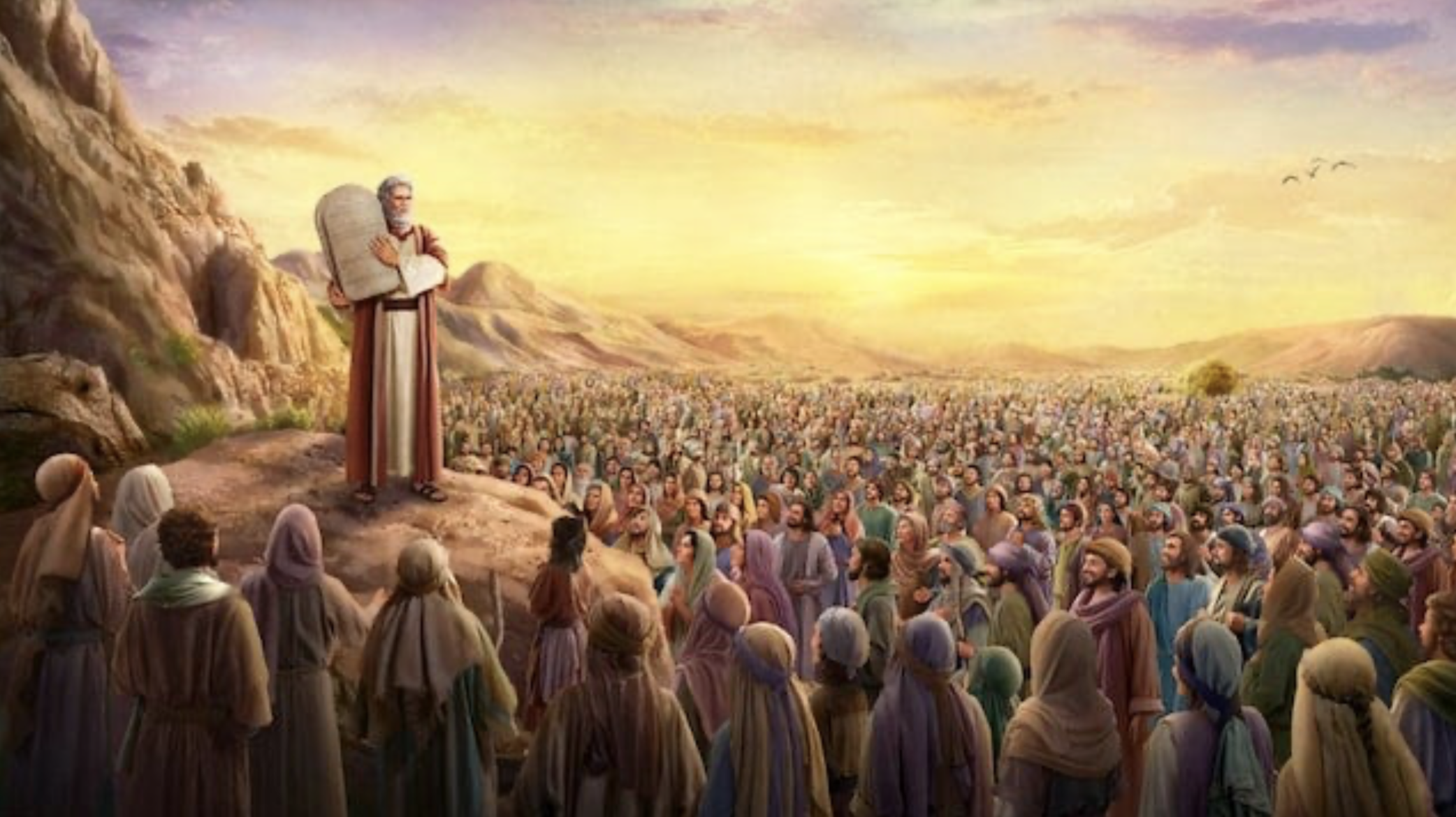
With a Moses with the tables of the ten commandments, who quietly explains to the people the rules for living well in society. And maybe that's how some of you imagined it too.
We agree, that is not at all what was read.
We can play the game of seven differences:
In the text, it is not Moses who is speaking to the people, it is God himself. Moses is at the bottom, with the people (perhaps a little closer to the mountain but still at the bottom).
There are no tables. That will come later, but for now, the ten commandments are the voice of God and that's it.
It's not nice. The weather in this text is more of a mix of eruption and storm.
And, above all, people are not calm at all! They are rather in a state of panic, close to syncope!
Well, four differences is already enough. Enough to see that the atmosphere was much more impressive, frightening, threatening.
If I invite you to imagine the scene, it is also because imagining it according to the description of the Bible helps us to dispel certain false impressions that we have of the Ten Commandments.
Sometimes we see them as a series of ethical principles for a dignified life, or a set of rules for a just society. We would almost put the Ten Commandments next to these books which present us with a limited number of rules for living well.
The 7 habits of effective people. The 12 rules for life. The 8 values of judo. We like lists of principles.
But without even talking about the content, just by paying attention to the setting of this chapter - the thunder, the fire, the people in panic - we see that the ten commandments are not a list of nice principles for living well .
Nor are they a treatise on political philosophy, or legislation defined in detail, or a list of tasks for being accepted by God.
And we could go on listing things that the Ten Commandments are not. But I would like to look with you today at the Ten Commandments from a perspective that, in my opinion, does justice to the nature of this text: the Ten Commandments in the context of God's Covenant with his people.
The beginning of the Covenant
We have already talked a little about the narrative side of this text: the ten commandments in the Bible are not an isolated list of principles, but they are stated by God at a given moment, in the middle of a story which is in the process of unfold.
This is a good time to give a short summary of this story so far: At the beginning of Exodus, God freed the people of Israel from slavery in Egypt (which he says in verse 2).
God leads them through the red sea, through the desert, through trials, until they arrive at Mount Sinai. And after having done all this, God proposes a Covenant to the Israelites:
You have seen what I did to Egypt and how I carried you on eagles' wings and brought you to me. Now if you will listen to my voice and keep my covenant, you will be mine personally among all people, for all the earth is mine. You will be for me a kingdom of priests and a holy nation. (Ex 19:4-6)
This is the proposed exchange: the people listen to the voice of God (that means, obey the voice of God), and God makes them a kingdom of priests that belongs to him personally.
This is not an arbitrary exchange. The two things are totally linked. It is by listening to the voice of God that Israel can be a kingdom of priests. The priest is the one who represents the divinity, who makes the link between one god and the others. It is therefore normal that the priest, to be a good representative, a good banner bearer, must behave in the image of the values of his god.
God therefore proposes that the people of Israel be a people of priests. And the people accept. Alright. To seal this Covenant, there will be a meeting between the two parties: God and the people.
God says he is going to manifest his presence on Mount Sinai, and the people are going to see it from the bottom of the mountain. Moses has the task of organizing this meeting, with instructions for the people to prepare and especially instructions for the people not to come too close to the mountain.
The presence of God arrives on the mountain. Fire, smoke, tremor, thunder. Moses goes down to the people. And there, for the first time, God speaks in a way where all the people hear - not just Moses!
It is the meeting of the people and their God. This is the high point of the Covenant.
It is therefore quite normal that God begins his speech with a presentation:
“I am YHWH your God, who brought you out of Egypt, out of the house of slavery.” (v1)
Then God will describe in a very summary manner the nature of this Covenant that he concluded with the people of Israel. And we can see the ten commandments like that: a summary of the covenant. Almost like a table of contents - each of the themes discussed here will be developed in detail later in the Torah.
An Exclusive Covenant
So, what do the Ten Commandments tell us about the covenant?
First, that it is a relationship of exclusivity - the first commandment.
To be a people of priests, they must have one god. Having others would be totally contradictory with their mission of representation. It's like a monogamous marriage.
The most natural way to try to circumvent this exclusivity is prohibited by the second commandment. To identify the Eternal, the true God, with something created, an idol, is ultimately to have another god and to try poorly to say that it is YHWH. Because if we create an image that does not correspond to God, then it is not God.
Besides, it's interesting to see that we can do this every time we are not faithful to the revelation that God makes about himself. From the moment we shape an image of God inspired by something other than God - an animal, a person, a political idea, an ideology, etc. - and make this image the object of my praise …It’s idolatry. Diverted idolatry, because we still tried to give the name of the true God to this thing we created.
The description of God as a "jealous God" may seem very bizarre. Especially for us today. But a god who is not jealous, especially in this context of Covenant, is an indifferent god. A god who does not act if his people move away from him. A god who doesn't want to make himself known.
It is not an indifferent god that we see in the ten commandments. He is committed to this Covenant, with his severity against idolatry, but also with his goodness and his faithfulness which do not run out. 1000 generations... that's much more than the number of generations between Moses and us.
As priests who represent God, the people therefore receive the privilege of being God's banner bearers. They bear the name of God, YHWH, and therefore are commanded to bear that name with honor – and not as if it were something mundane.
We also see that this people of priests must honor the acts of the Lord by keeping the holy days. Days are dedicated to commemorating God and his deeds. In the case of the Sabbath, which is presented here, God is commemorated as creator. When the ten commandments are repeated in Deuteronomy, we see instead the commemoration of God as the deliverer from slavery.
If the second commandment forbids Israel from identifying God with what He is not, the fourth commandment commands Israel to commemorate what God is.
A Collective Covenant
In the commandments that follow, which deal more with interpersonal behavior, we see that it is an exhaustively collective Covenant.
What I mean by exhaustively collective: the people, collectively, are committed to this Covenant - it is first of all a collective reality - but each individual of the people is committed to this Covenant.
They therefore owe each other mutual respect. Of honor itself, in the case of relations of authority.
An individual cannot arbitrarily harm the life, property, marriage or reputation of another, because that other person is also in the Covenant.
Often a distinction is made between the first four commandments which deal with duties towards God; and the other six commandments which deal with duties towards one's neighbor. We could even see this distinction in the structure of the text: the first four commandments are developed and explained. While the next six are stated very quickly. Probably because they are easier to understand.
But they are not necessarily easier to put into practice, since the last commandment goes to the inner root of our behaviors - the way our desires develop as latent aggression.
If the exclusive aspect of the Covenant shows us a God who is jealous - that is, not indifferent to our relationship with him - the collective aspect shows us a God who is not indifferent to any person of his people. The behavior of others concerns him.
Behavior that is not aligned with one's character misrepresents the true God. Or represent a false god. Which brings us back to idolatry.
Generally speaking, all these commandments are relatively brief. A table of contents of the Act. Through Moses, God will give more detailed instructions on how to put these commandments into practice.
They will also have prescriptions for what to do when someone breaks these commandments - sacrifices, punishments, etc. And that's important too: these commandments will highlight the gap between the holiness of God and the sin of human beings (not just the Israelites).
This gap, highlighted not only by the content of the ten commandments, but also (and perhaps above all) by the impact of the voice of God which spoke directly to the people, is what will bring them into a state of panic, almost despair.
Moses reassures them in a very paradoxical way: he tells them not to be afraid, but that this manifestation of God is done on purpose to inspire fear in them. In French, we tend to make the difference between fear and dread but… In reality, in Hebrew, the word used is the same (in verse 20). The feeling is very close.
I wonder if this is when they are already beginning to understand that being representatives of a holy God is a task far beyond their abilities. They implore Moses to be their mediator, so that when they hear God's commands, it will not provoke a similar level of fear.
The New Covenant
We've talked a lot about how the Ten Commandments fit into the mission of the people of Israel to be a kingdom of priests. And if we continue to read the Old Testament, we see that the people of Israel systematically failed to keep this Covenant.
And, as Christians, we believe that Jesus fully fulfilled this Covenant. He was faithful in his behavior, in his words, in his desires. He was the high priest, who was the only perfect human representative of God.
So that means it's okay, the Ten Commandments aren't really important to us anymore?
Not so fast...
The apostle Peter said to Jesus' disciples,
“You are a chosen people, royal priests, a holy nation, a redeemed people, to proclaim the praises of him who called you out of darkness into his marvelous light” (1 Pet 2:9).
Just as the people of Israel are called to be a kingdom of priests AFTER being saved from slavery in Egypt, we are called to be a kingdom of priests AFTER being saved from sin through the sacrifice of Jesus.
The First Covenant points to our New Covenant with God in Jesus.
The commandments of the First Covenant highlight the gap between God's holy character and man's sin. This gap finds its resolution in the work and sacrifice of Jesus, the New Covenant.
We can be these representatives of God among the people without the fear of judgment, because Jesus took the judgment of His people upon Himself. This is always our calling: to be a chosen people, royal priests, a holy nation.
And by being a kingdom of priests, we know and make God known by following his commandments.
I come back to my image from the beginning.
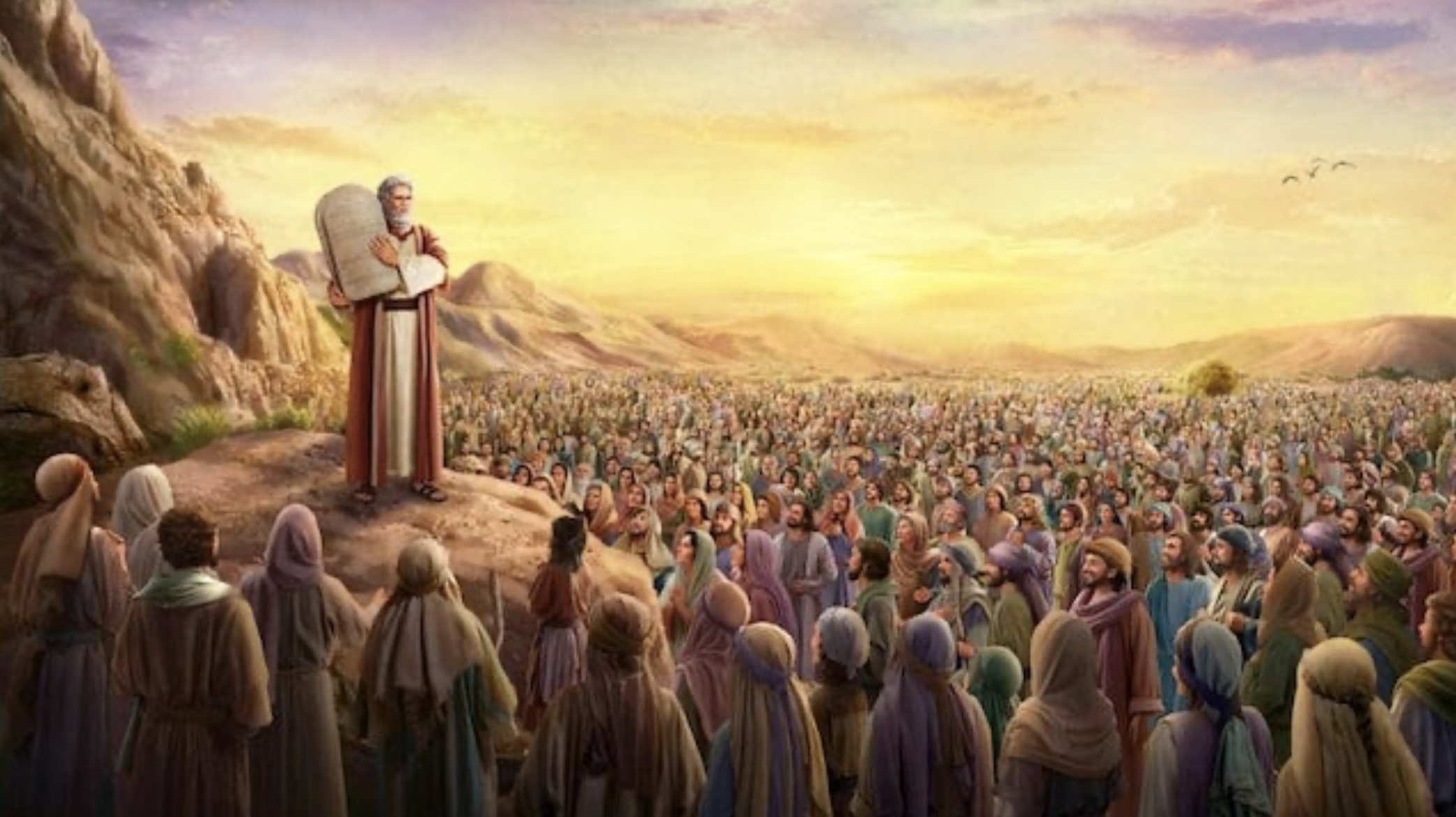
We have seen that this image does not correspond at all to Exodus 20. But if we remove the stone tables, this image can really remind us of the Sermon on the Mount. Where Jesus tells his disciples that they are the “salt of the earth”.
He said to his disciples:
“In the same way may your light shine before men so that they may see your beautiful way of acting and thus celebrate the glory of your heavenly Father.” (Mt 5:16)
On this occasion, Jesus will give a reading of the Ten Commandments in the original Spirit of the Ten Commandments - not as a checklist of tasks to do or not to do, but as an expression of the privilege of being a representative people of God's character.
No panic, paralyzing fear or trembling this time - Jesus teaches with the authority of God, but with the approachable voice of a mediator. And we are free to practice His commandments as members of the New Covenant.
What does it look like to live out His commandments as members of the New Covenant today?
I invite you to read the Sermon on the Mount, Matthew chapters 5, 6 and 7, because the examples given are very current, and they are not really difficult to transpose to our contemporary context.
Some examples :
Jesus highlights the exclusivity of the covenant we have with God, saying that we cannot serve God and riches. We cannot put all our effort and thought into amassing a large amount of money and, at the same time, put all our effort and thought into glorifying God. If we try to do that, we're going to be a kingdom of priests of money, not a kingdom of priests of God.
Jesus highlights the corporate aspect of the covenant, showing that our relationship with God has EVERYTHING to do with our relationship with others around us.
He says :
“So if you present your offering towards the altar and there you remember that your brother has something against you, leave your offering before the altar and go first to be reconciled to your brother, then come and present your offering. " (Mt 5:23-24)
So if you have a lingering dispute with a sibling or someone close to you, and you want to be faithful to the Covenant you have with the God who has already saved you, go quickly resolve it. Ask for forgiveness if necessary, give forgiveness if necessary, set things straight if necessary.
Jesus highlights the individual, comprehensive aspect of the covenant, showing that even your heart and your outlook is an area that must manifest the character of God:
"You have heard that it was said: You shall not commit adultery. But I say to you, Every man who looks at a woman to lust after her has already committed adultery with her in his heart." (Mt 5:27-28)
Perhaps as you read the Sermon on the Mount you begin to get a little of the panic of the people when they heard the voice of God. The holiness of God highlighted, the project of being part of a kingdom of priests and expressing this reality through our behavior... seems difficult.
If this is our case, rather than ignoring the call, may we remember the context of the Covenant, of a God who did in advance what was necessary for our salvation, and who he provided a mediator so that we can listen to his voice without fear.
The Miracle of the Spirit (Pentecost Sunday)
Acts 2.1-41
I’m excited, and a little nervous, to be taking a break from Exodus this week to talk about what today is, and what it represents. Today is Pentecost Sunday. For most people in France, the meaning of this day is vague at best. For most Christians in France…it might also be vague at best.
On Pentecost Sunday, we remember the day on which God sent the Holy Spirit to his people; we find this episode of the story in Acts chapter 2. But how you read this story today might vary greatly depending on how you grew up, what kind of church culture you came out of.
Let me give you a little background on myself before I go on, because I want to explain why I’m going to go about this the way I am.
I grew up in Pentecostal churches in the United States. These are churches that were born out of a movement in the early twentieth century, that placed a big emphasis on what we call the “sign gifts,” miraculous signs like speaking in tongues, prophecy, healing, and so on. And that is still the norm in most Pentecostal churches today; you’ll hear a lot about the Holy Spirit, and a lot of time will be dedicated to pursuing these miraculous gifts. (And as we’ll see in a minute, they have a reason for thinking this way.)
That’s what I grew up in. Often, the Sunday services (especially the evening services) could last for hours. There were people yelling, people falling down, people shaking. There was one guy who used to run literal laps around the sanctuary, running like his pants were on fire. I’ve been to healing services, exorcism services, one service where a pastor tried to punch cancer out of a man’s stomach in the name of Jesus…
I promise you, I’ve seen it all.
Now clearly, that’s not where I am today. But my goal today is not to defend one position or another. I’m going to have to talk about what I believe, but I’m going to do my best to show you, in the Bible, why I believe what I do.
This sermon was long in coming, because for years now we’ve had a good mix of people in Connexion. Some of you come from Pentecostal or charismatic backgrounds (I’m using those words interchangeably, by the way); some of you come from much more reserved, cessationist backgrounds; and some of you didn’t grow up in church so you come from neither one. So one of the questions we as the elders have had to ask ourselves is, how do we manage a church in which opinions or convictions might vary wildly on this subject? What common ground can we find? What on the subject of the Spirit’s activity in the world can we all affirm together?
That’s what I’d like to try to do this morning. It’s a tall order, because emotions get high when you talk about this stuff. But this is a subject we see all over the book of Acts, so we need to reckon with it. And, we’ll all be happy to know, there is quite a lot we can all agree on—and it’s really good news.
So let’s start by just looking at what happened on that day.
What Happened (Acts 2.1-13)
To give us some context: at this point in the story, Jesus has died and was raised, he appeared to his disciples and some four hundred other people, and in the previous chapter, the disciples (now called apostles, because Jesus was sending them out to preach the gospel—the word “apostle” means “sent”) saw Jesus ascend into heaven in his body. And now, they’re doing what he said: they’re waiting. We see in Acts 1.15 that about a hundred and twenty of them were gathered in the same place, praying and marveling at what had happened, and waiting for God to send the promised Holy Spirit.
Then they come to the day of Pentecost, which was the second of the annual harvest festivals for the Jews, that came fifty days after Passover (it was called the Feast of Weeks in the Old Testament). So this is about a month and a half after Jesus’s death and resurrection, and about a week after he ascended into heaven.
Let’s read from the beginning of Acts 2.
When the day of Pentecost arrived, they were all together in one place. 2 And suddenly there came from heaven a sound like a mighty rushing wind, and it filled the entire house where they were sitting. 3 And divided tongues as of fire appeared to them and rested on each one of them. 4 And they were all filled with the Holy Spirit and began to speak in other tongues as the Spirit gave them utterance.
Okay, so the first thing we need to notice here is that the Holy Spirit’s coming is very different from Jesus’s coming. The Bible teaches that there is one God, who has manifested himself for all eternity in three persons: the Father, the Son, and the Holy Spirit. One God, three persons. If that makes no sense to you, welcome to the club. No one understands it.
The Son was Jesus Christ: born of a human woman, but conceived by the Holy Spirit. So Jesus is fully God, but also fully man. He is a physical human being who is also the Son of God.
That’s not the case for the Spirit. The Holy Spirit is what his name implies: he’s a Spirit. He’s not a human being, he’s not physical. So if he’s a Spirit, and not a physical being, how would the apostles know he had come? If it was a purely internal, subjective experience—like a feeling they got—how could they prove that this had actually happened? And how would they know the same thing had happened in others?
The question is actually really important, because with Jesus gone, God had to provide continuity. He had to show the people watching the apostles that their ministry isn’t a new thing, but the continuation of what Jesus started.
So there needed to be something visible, to prove to the people around that this was really happening, that it wasn’t all in their heads.
And we get that here. First, there’s the sound of a wind in the room (already freaky); then, something like tongues of fire that comes and floats over their heads (even weirder). But those things, only those disciples who were present could see and hear, because they were inside a closed room.
The next thing is what seals the deal: they’re filled with the Holy Spirit. We see the Spirit doing a lot in the Old Testament too, giving people power for specific tasks. The language the Bible uses to talk about what happened back then is, “The Spirit of God rushed upon Saul, or rushed upon Samson, or rushed upon Shamgar (my personal favorite of the Judges).” But it’s always punctual; it’s always momentary. We see the Spirit rushing upon Saul at the beginning of his reign, and then we see the Spirit leaving Saul later on.
That’s not what it says here. It says that the Holy Spirit didn’t just come upon them; he filled them.
And that way we know this happened—the outside, objective proof that this was real—is that they began to speak in other tongues as the Spirit gave them utterance.
And after, it gets even better. V. 5:
5 Now there were dwelling in Jerusalem Jews, devout men from every nation under heaven. 6 And at this sound the multitude came together, and they were bewildered, because each one was hearing them speak in his own language. 7 And they were amazed and astonished, saying, “Are not all these who are speaking Galileans? 8 And how is it that we hear, each of us in his own native language? 9 Parthians and Medes and Elamites and residents of Mesopotamia, Judea and Cappadocia, Pontus and Asia, 10 Phrygia and Pamphylia, Egypt and the parts of Libya belonging to Cyrene, and visitors from Rome, 11 both Jews and proselytes, Cretans and Arabians—we hear them telling in our own tongues the mighty works of God.” 12 And all were amazed and perplexed, saying to one another, “What does this mean?” 13 But others mocking said, “They are filled with new wine.”
The details we see here are numerous, very specific, and very important.
These “other tongues” the apostles are speaking are actual, recognizable languages. That’s what the crowds say in v. 7-8: these guys are all from Galilee, and yet we can hear them all speaking in our native language. And these people listening came from all over the place. They were Jews from many different countries. And yet, they all hear the apostles speaking in their native languages.
And they’re saying very specific things; we see in v. 11, the apostles are telling in our own tongues the mighty works of God.
That’s what happened on this day of Pentecost. It wasn’t all that happened (we’ll talk about the rest in a little while), and it wasn’t the only incredible thing we see the Holy Spirit do. In the book of Acts, we see the apostles, through the Holy Spirit, healing people, prophesying, casting out demons, resurrecting people from the dead; and we see Christians all over the place speaking in other tongues just like the apostles did, which was the sign that the Holy Spirit wasn’t reserved for an elite few, but that all Christians had received the same gift from God the apostles had.
But if that’s what happened on the day of Pentecost, what didn’t happen?
What Didn’t Happen
I’m just going to tell you what I see when I read the Bible. And I’ll be honest: since I’m the elder who planted the church, and I was the only elder when these questions first started being asked, my view on the subject informed a lot of how we do things here. That might change as time goes on, as different elders come on board, and that’s fine. But this is how I approach it.
First of all, no matter where we land, we want to give a lot of grace to people who disagree with us on these subjects, because they’re not always easy. The Bible isn’t very specific about what some of these things looked like, so there’s definitely some room for interpretation. For that reason, I want to be careful when someone comes to me claiming they had an experience with the Holy Spirit that differs from what I see when I read the Bible. I don’t want to jump right away to saying, “No, that definitely wasn’t the Holy Spirit.” I want to listen, and consider that there may be some things about this I don’t understand.
That being said, there are a number of things that often happen in churches, particularly charismatic or Pentecostal churches, that I don’t believe we see in the book of Acts.
With the first, I know I’m going to make some people mad, but it’s what, in modern churches, people usually called speaking in tongues. But there’s another word for it, which is glossolalia. It’s what happens when someone repeats or intones random syllables or sounds that don’t seem to fit into any known language.
Glossolalia a word that exists outside of church circles, because it’s a phenomenon that exists outside the church. It happens in just about every part of the world, in many different religions, and in pagan practices as well.
Now I’m not suggesting this phenomenon is always bad, just that it’s not unique to Christianity, and that it’s not what we see in the book of Acts or elsewhere in the Bible. We already saw what was unique about that: they spoke in languages spoken by people who were listening. They were real languages, understandable by those who were present.
The other thing we often see in churches today, that we don’t see in the book of Acts or elsewhere in the Bible (at least not in a positive way), is whatever falls under the category of “loss of control.” Falling down; trembling uncontrollably. Nowhere in the Bible, nowhere in Acts, do we see God approving a loss of control.
Those are just a couple of examples. A lot of what we see happening in some churches today is not what was happening in the book of Acts or afterwards. And I don’t believe what we see in Acts was meant to continue in quite the same way after that time period.
That’s not to say I think it never happens—I’m not a cessationist. But the fact that I believe it’s possible doesn’t mean I think that’s how it should be everywhere, at all times. The time of the apostles was a completely unique period in history, in which the claims of the apostles were validated by the signs and wonders they performed.
There’s a lot more I could say about this, but that’s why, at Eglise Connexion, we tend to be more reserved than demonstrative. That’s why we don’t speak in tongues (that is, we don’t hear glossolalia) in the service; that’s why we want to maintain a certain order during the service. We do still pray for people: we pray that God would heal people, and we believe that God does heal. But we want to maintain a certain order; we want to adhere to what Paul says in 1 Corinthians 12-14, which is one long warning against disorder in the church’s gatherings.
I do think we could stand to loosen up a bit, to be a little more vocal and celebratory when we worship God—like I said, I grew up in a very different context, and seeing extremely reserved worship is weird for me: these are massive, joyful truths we’re singing about. So I think we could show that more than we do.
But we want to worship in a way that is ordered, that seeks to serve everyone here, that’s not just trying to make me feel good.
What It Means (Acts 2.22-41)
Now, if you disagree with me on the things I just said, that’s fine. This is a secondary issue, and not even all of the elders have agreed on this subject in the past. We are all brothers and sisters in Christ, and as long as we all accept to do things in a certain way when we meet, we can disagree on these things, and it makes very little difference.
And it’s not a problem because of what this event means—what unites us. It’s really easy to get distracted by what we see in Acts 2. It was spectacular, but it had a very specific goal.
And that’s one thing we see over and over again in the Bible. Every time God does something, whether it’s minor or spectacular, he always has a reason. Whenever Jesus healed someone, he had a reason. And it wasn’t only that he had compassion on those who were sick, although his compassion was real. It was in order to show the people who he was—that he was no ordinary man. But at the same time, it was also to show the people that seeing isn’t necessarily believing.
In order to believe, something else needed to happen.
Go back to Acts 2. After the text we read earlier, when the apostles were speaking in tongues and the people outside were hearing their own languages spoken, some people are amazed, while others say the apostles are drunk.
So Peter gets up and speaks to the whole crowd. And he delivers an incredible, impromptu sermon that is not at all what we’d call “seeker sensitive.” He says in v. 22:
22 “Men of Israel, hear these words: Jesus of Nazareth, a man attested to you by God with mighty works and wonders and signs that God did through him in your midst, as you yourselves know— 23 this Jesus, delivered up according to the definite plan and foreknowledge of God, you crucified and killed by the hands of lawless men. 24 God raised him up, loosing the pangs of death, because it was not possible for him to be held by it.
In other words, he tells them that they, Jewish men and women, people who up to that point thought they were saved because they were Jewish, have sinned against God, and need his forgiveness. In v. 36 he pronounces the final, climactic sentence of his sermon:
36 Let all the house of Israel therefore know for certain that God has made him both Lord and Christ, this Jesus whom you crucified.”
The Lord and Christ, whom you crucified. What incredible courage: he might have been stoned to death right then.
But how did the crowd respond?
37 Now when they heard this they were cut to the heart, and said to Peter and the rest of the apostles, “Brothers, what shall we do?” 38 And Peter said to them, “Repent and be baptized every one of you in the name of Jesus Christ for the forgiveness of your sins, and you will receive the gift of the Holy Spirit. 39 For the promise is for you and for your children and for all who are far off, everyone whom the Lord our God calls to himself.” 40 And with many other words he bore witness and continued to exhort them, saying, “Save yourselves from this crooked generation.” 41 So those who received his word were baptized, and there were added that day about three thousand souls.
These miraculous signs the apostles were able to do were spectacular. Absolutely. Part of the reason why they were able to do these things was to show that Jesus was continuing his ministry through them.
But that’s only part of it. We talked about this in Exodus: very often, we see one thing happen in the Bible, for a specific reason at a specific time, but that actually points to something even bigger, something even better, still to come. The same thing is happening here. The miraculous signs we see in the apostles, particularly the speaking in tongues we see in Acts 2, is pointing to something far better still to come.
And that is the reversal of a curse.
If you’ve read the book of Genesis, you’ll remember a particular scene early on in the book, in chapter 11: the tower of Babel. At that time, everyone on earth spoke the same language—which makes sense, because they were all descended from the same family. So they settle in a certain place and they founded a city. And they’re pretty pleased with themselves. So they decide, in v. 4:
“Come, let us build ourselves a city and a tower with its top in the heavens, and let us make a name for ourselves, lest we be dispersed over the face of the whole earth.”
So they start, and they get really high up. God sees what they’re doing, and he is not happy. He says in v. 6:
“Behold, they are one people, and they have all one language, and this is only the beginning of what they will do. And nothing that they propose to do will now be impossible for them. 7 Come, let us go down and there confuse their language, so that they may not understand one another’s speech.”
Now it might seem like God sees the people as a threat, like a petty tyrant: if they keep going, they’ll be able to do anything they want, and we can’t let that happen.
But these people aren’t a threat to God. They’re a threat to themselves. They’re starting to think they don’t need God, because they’re able to do impressive things on their own. They’re lost in their pride, and in their arrogance they imagine they can live without God.
In their arrogance, they desire to take the place of the God for whom nothing is impossible. It is idolatry in its simplest form.
So God, as a consequence, confuses their language. Suddenly, they can’t understand each other. They’re all speaking different languages, all at once. And without the ability to communicate…there’s nothing they can do together.
They quit their project, and they disperse. And from then on, we have multiple groups of people, speaking multiple languages in multiple locations.
That’s the situation for millennia. People live dispersed from one another, separated by language and culture and, quite often, animosity.
That’s the situation, until the day of Pentecost.
On this day, what do we see? We see many different people, from many different cultures, with many different languages, suddenly all able to hear the same revolutionary message, this incredible good news, spoken in their own language.
There are a couple of really important things we need to see here. These people who were in the crowd on the day of Pentecost likely didn’t need to hear these things spoken in their own language. They were from several different places, but they were all Jews, Paul says in v. 5 of Acts 2—so they all would have had at least a passing knowledge of Hebrew (and probably Greek as well). And when Peter gets up and preaches in v. 14, he’s not speaking a dozen languages at once. He’s speaking one language, and it seems like everyone in the crowd understands his sermon.
So I don’t think the apostles spoke in tongues so that the people would understand. I think they did it so that the people might be moved. Everyone who’s lived in a different country knows that it’s one thing to hear or read the Bible in the new language you’ve learned, and it’s quite another to hear it in your native language. Even if we’re perfectly bilingual, our native tongue does something to us that other languages just can’t. It hits our minds and our hearts in a particular way.
This speaking in tongues isn’t strictly necessary, but it is profoundly symbolic and meaningful. It was the signal for them that the Spirit wasn’t only coming to an elite in Jerusalem, but for everyone. And this “live translation” of the wonders of God in all these other languages was a foretaste of what was coming: the gospel, going out in power, not only to the Jews in all these various regions, but to the Gentiles there as well: many peoples, united by one single Spirit.
The second important thing to note is that God doesn’t totally reverse the curse of Babel; he doesn’t make all the people suddenly speak one language. Because, once again, the speaking in tongues isn’t an end in itself. It’s a gift that’s pointing to something greater.
And that greater thing is the Holy Spirit, taking people from various backgrounds and languages and cultures, and uniting them through the miracle he performs in their hearts. Peter gets up and preaches this really accusatory sermon, in which he says to them all, “This Son of God, whom God sent with mighty works and signs and wonders that you all saw with your own eyes—you crucified him. You killed him.”
And instead of getting defensive, what do we see in v. 37?
Now when they heard this they were cut to the heart, and said to Peter and the rest of the apostles, “Brothers, what shall we do?”
Right there—that’s the real miracle. It’s not the speaking in tongues. It’s not prophecy. It’s not healing. It’s hearing this crazy message of what Jesus Christ did, that he lived and died and was raised to save us…and being cut to the heart. That is miraculous, because it makes no sense. Paul says that “the word of the cross is folly to those who are perishing” (1 Corinthians 1.18). We can only see the gospel as not folly when the Holy Spirit gives us new hearts, and new minds, and new ears to hear and believe in him, so that we might not perish but have eternal life.
That is what it means to be “baptized in the Holy Spirit” (cf. Ephesians 4.1-6); THAT’S the point. That’s why the apostles spoke in tongues, that’s why they were able to heal, that’s why these miraculous things were happening at this time. Every miracle occurring at this time is pointing to the greater miracle: the work of the Holy Spirit to regenerate and renew people from every tribe, tongue and nation and unite them into one body, one family, under one Father—all of this leading toward the day in which God presents the church to his Son as a bride, without spot or wrinkle or blemish, to enjoy their unity with him forever.
Three thousand people met Christ that day, and that was just the beginning.
How We Move Forward
To close, let’s ask one more question—where do we go from here? How do we respond to what we see in this passage?
The answer is simple. Either we lean in to the signs, or we lean in to the message.
It’s easy to read Acts 2, and the following chapters, and wonder why we don’t still see this sort of thing today, or at least not as often. It’s easy to think that if these signs and miracles were happening all over the place today, in such a visible way, the preaching of the gospel would be much more effective.
But that’s simply not true. Even in the book of Acts, and even in Jesus’s ministry, seeing a miracle doesn’t convince everyone—because again, that’s not the point. These miracles were pointing toward the greater miracle, and that greater miracle has spent the last two thousand years taking shape.
What’s different about our situation today, and that of the apostles? A lot of things, of course, but one main thing: we have the Bible. The whole Bible: Old and New Testaments. We have the letters the apostles wrote. We have the whole of Scripture, which the Holy Spirit inspired so that we might know everything we need to know, and see everything we need to see, in order to believe.
Paul says in 2 Timothy 3.16-17:
16 All Scripture is breathed out by God and profitable for teaching, for reproof, for correction, and for training in righteousness—
To which we might say, “Sure, Scripture is profitable, but it would help an awful lot if we had the miracles too.”
Sorry, no. Paul says that God gave us Scripture for teaching, reproof, correction, training in righteousness—why?
17 ...that the man of God may be complete, equipped for every good work.
In other words: we don’t need anything else.
So do miracles still happen? Absolutely, because God is still a compassionate God. Does speaking in tongues still happen? I believe it does—not necessarily the way a lot of Christians would say it does, but I do believe these things still happen, in the right context, and if God judges them necessary.
But we don’t see these things as often here because we don’t need them here. We have something the early church didn’t have, and that is the whole of Scripture, breathed out by the Spirit, and which the Spirit uses to give us everything we need, to equip us for every good work.
So rather than lean in to the miracles, we want to lean in to the message. The message of the gospel, not miracles, is what saves us. It’s what makes us complete. It’s what equips us.
The message of the gospel is the true miracle. Even if we never see a single outward miracle in our whole life, we already have the miracle we need.