

The Ten Commandments and the Two Covenants
Genesis 20.1-21
Then God spoke all these words: 2 “I am the LORD your God, who brought you out of Egypt, out of the house of slavery.
3 “You shall have no other gods before me.
4 “You shall not make for yourself any sacred sculpture or representation of anything in heaven above, on the earth below, or in the water below the earth. 5 You shall not bow down to them or serve them, for I, the LORD your God, am a jealous God. I punish the sin of the fathers on the children to the third and fourth generation of those who hate me, 6 and I show kindness to a thousand generations to those who love me and keep my commandments.
7 “You shall not use the name of the LORD your God lightly, for the LORD will not leave anyone unpunished who uses his name lightly.
8 “Remember to make the day of rest holy. 9 For six days you will work and do everything you need to do. 10 But the seventh day is the sabbath of the LORD your God. You shall not do any work, neither you, nor your son, nor your daughter, nor your male slave, nor your maidservant, nor your cattle, nor the stranger who lives with you. 11 For in six days the LORD *made heaven and earth and the sea and all that is therein[a], and *he rested on the seventh day[b]. This is why the Lord blessed the Sabbath and made it holy.
12 *"Honor your father and your mother that you may live long in the land that the Lord your God gives you.
13 “You shall not commit murder.
14 “You shall not commit adultery.
15 “You shall not steal.
16 “You shall not bear false witness against your neighbor.
17 “You shall not covet your neighbor’s house; you shall not covet your neighbor’s wife, nor his male slave, nor his maidservant, nor his ox, nor his donkey, nor anything that belongs to him.”
18 All the people heard the thunder and the sound of the trumpet and saw the flames of the smoking mountain. At this spectacle, the people trembled and kept at a good distance. 19 They said to Moses, “Speak to us, and we will listen; but let God not speak to us, otherwise we would die.” 20 Moses said to the people, “Do not be afraid, for God has come to test you, so that you may have his fear before your eyes so that you do not sin.” 21 The people remained at a good distance, but Moses approached the cloud where God was.
We have arrived at the Ten Commandments!
Along with the crossing of the Red Sea, these are certainly the two very well-known scenes from the book of Exodus in popular culture.
And I don't know if it's just me, but I tended in the past to imagine the Ten Commandments like this:
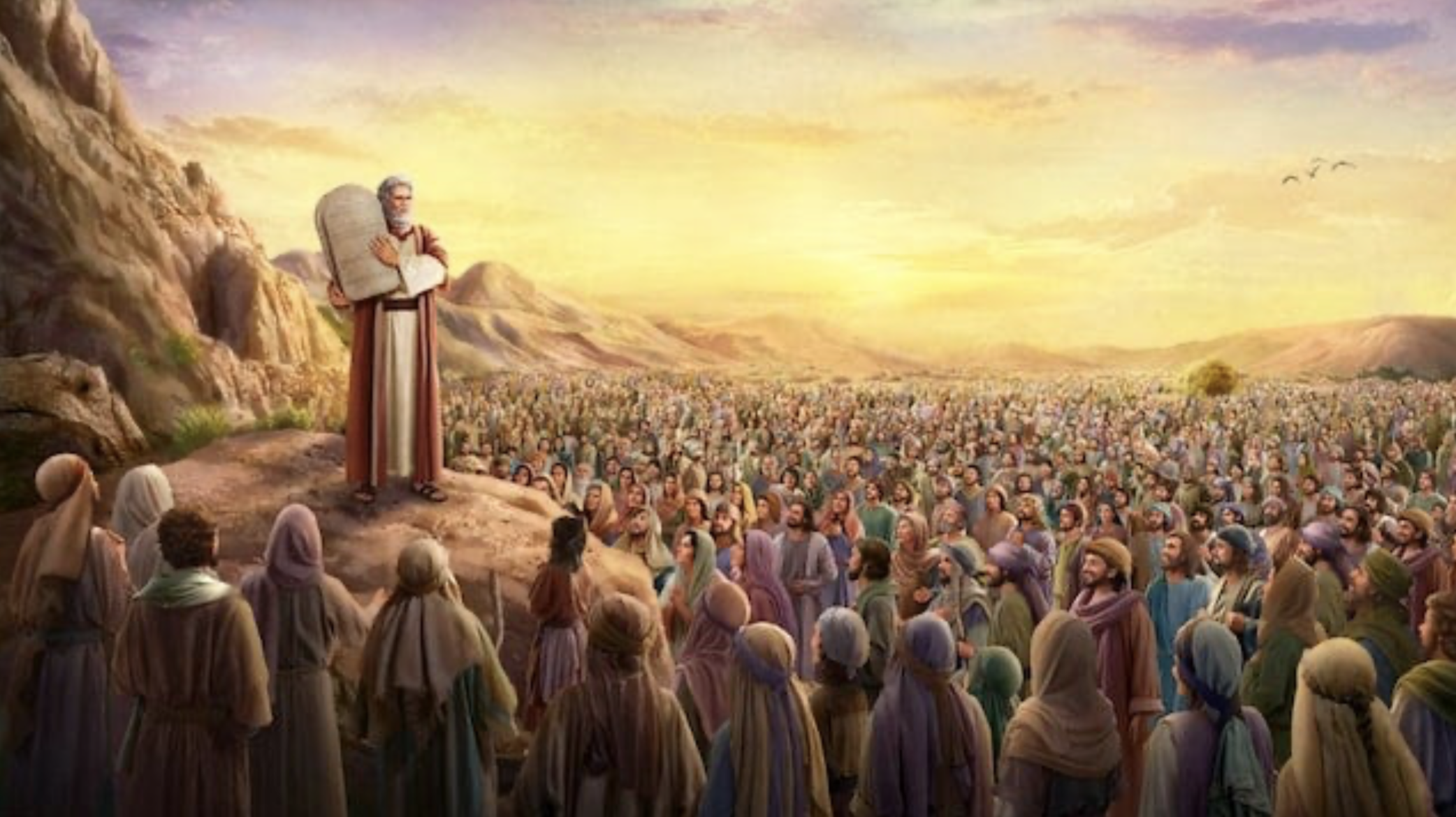
With a Moses with the tables of the ten commandments, who quietly explains to the people the rules for living well in society. And maybe that's how some of you imagined it too.
We agree, that is not at all what was read.
We can play the game of seven differences:
In the text, it is not Moses who is speaking to the people, it is God himself. Moses is at the bottom, with the people (perhaps a little closer to the mountain but still at the bottom).
There are no tables. That will come later, but for now, the ten commandments are the voice of God and that's it.
It's not nice. The weather in this text is more of a mix of eruption and storm.
And, above all, people are not calm at all! They are rather in a state of panic, close to syncope!
Well, four differences is already enough. Enough to see that the atmosphere was much more impressive, frightening, threatening.
If I invite you to imagine the scene, it is also because imagining it according to the description of the Bible helps us to dispel certain false impressions that we have of the Ten Commandments.
Sometimes we see them as a series of ethical principles for a dignified life, or a set of rules for a just society. We would almost put the Ten Commandments next to these books which present us with a limited number of rules for living well.
The 7 habits of effective people. The 12 rules for life. The 8 values of judo. We like lists of principles.
But without even talking about the content, just by paying attention to the setting of this chapter - the thunder, the fire, the people in panic - we see that the ten commandments are not a list of nice principles for living well .
Nor are they a treatise on political philosophy, or legislation defined in detail, or a list of tasks for being accepted by God.
And we could go on listing things that the Ten Commandments are not. But I would like to look with you today at the Ten Commandments from a perspective that, in my opinion, does justice to the nature of this text: the Ten Commandments in the context of God's Covenant with his people.
The beginning of the Covenant
We have already talked a little about the narrative side of this text: the ten commandments in the Bible are not an isolated list of principles, but they are stated by God at a given moment, in the middle of a story which is in the process of unfold.
This is a good time to give a short summary of this story so far: At the beginning of Exodus, God freed the people of Israel from slavery in Egypt (which he says in verse 2).
God leads them through the red sea, through the desert, through trials, until they arrive at Mount Sinai. And after having done all this, God proposes a Covenant to the Israelites:
You have seen what I did to Egypt and how I carried you on eagles' wings and brought you to me. Now if you will listen to my voice and keep my covenant, you will be mine personally among all people, for all the earth is mine. You will be for me a kingdom of priests and a holy nation. (Ex 19:4-6)
This is the proposed exchange: the people listen to the voice of God (that means, obey the voice of God), and God makes them a kingdom of priests that belongs to him personally.
This is not an arbitrary exchange. The two things are totally linked. It is by listening to the voice of God that Israel can be a kingdom of priests. The priest is the one who represents the divinity, who makes the link between one god and the others. It is therefore normal that the priest, to be a good representative, a good banner bearer, must behave in the image of the values of his god.
God therefore proposes that the people of Israel be a people of priests. And the people accept. Alright. To seal this Covenant, there will be a meeting between the two parties: God and the people.
God says he is going to manifest his presence on Mount Sinai, and the people are going to see it from the bottom of the mountain. Moses has the task of organizing this meeting, with instructions for the people to prepare and especially instructions for the people not to come too close to the mountain.
The presence of God arrives on the mountain. Fire, smoke, tremor, thunder. Moses goes down to the people. And there, for the first time, God speaks in a way where all the people hear - not just Moses!
It is the meeting of the people and their God. This is the high point of the Covenant.
It is therefore quite normal that God begins his speech with a presentation:
“I am YHWH your God, who brought you out of Egypt, out of the house of slavery.” (v1)
Then God will describe in a very summary manner the nature of this Covenant that he concluded with the people of Israel. And we can see the ten commandments like that: a summary of the covenant. Almost like a table of contents - each of the themes discussed here will be developed in detail later in the Torah.
An Exclusive Covenant
So, what do the Ten Commandments tell us about the covenant?
First, that it is a relationship of exclusivity - the first commandment.
To be a people of priests, they must have one god. Having others would be totally contradictory with their mission of representation. It's like a monogamous marriage.
The most natural way to try to circumvent this exclusivity is prohibited by the second commandment. To identify the Eternal, the true God, with something created, an idol, is ultimately to have another god and to try poorly to say that it is YHWH. Because if we create an image that does not correspond to God, then it is not God.
Besides, it's interesting to see that we can do this every time we are not faithful to the revelation that God makes about himself. From the moment we shape an image of God inspired by something other than God - an animal, a person, a political idea, an ideology, etc. - and make this image the object of my praise …It’s idolatry. Diverted idolatry, because we still tried to give the name of the true God to this thing we created.
The description of God as a "jealous God" may seem very bizarre. Especially for us today. But a god who is not jealous, especially in this context of Covenant, is an indifferent god. A god who does not act if his people move away from him. A god who doesn't want to make himself known.
It is not an indifferent god that we see in the ten commandments. He is committed to this Covenant, with his severity against idolatry, but also with his goodness and his faithfulness which do not run out. 1000 generations... that's much more than the number of generations between Moses and us.
As priests who represent God, the people therefore receive the privilege of being God's banner bearers. They bear the name of God, YHWH, and therefore are commanded to bear that name with honor – and not as if it were something mundane.
We also see that this people of priests must honor the acts of the Lord by keeping the holy days. Days are dedicated to commemorating God and his deeds. In the case of the Sabbath, which is presented here, God is commemorated as creator. When the ten commandments are repeated in Deuteronomy, we see instead the commemoration of God as the deliverer from slavery.
If the second commandment forbids Israel from identifying God with what He is not, the fourth commandment commands Israel to commemorate what God is.
A Collective Covenant
In the commandments that follow, which deal more with interpersonal behavior, we see that it is an exhaustively collective Covenant.
What I mean by exhaustively collective: the people, collectively, are committed to this Covenant - it is first of all a collective reality - but each individual of the people is committed to this Covenant.
They therefore owe each other mutual respect. Of honor itself, in the case of relations of authority.
An individual cannot arbitrarily harm the life, property, marriage or reputation of another, because that other person is also in the Covenant.
Often a distinction is made between the first four commandments which deal with duties towards God; and the other six commandments which deal with duties towards one's neighbor. We could even see this distinction in the structure of the text: the first four commandments are developed and explained. While the next six are stated very quickly. Probably because they are easier to understand.
But they are not necessarily easier to put into practice, since the last commandment goes to the inner root of our behaviors - the way our desires develop as latent aggression.
If the exclusive aspect of the Covenant shows us a God who is jealous - that is, not indifferent to our relationship with him - the collective aspect shows us a God who is not indifferent to any person of his people. The behavior of others concerns him.
Behavior that is not aligned with one's character misrepresents the true God. Or represent a false god. Which brings us back to idolatry.
Generally speaking, all these commandments are relatively brief. A table of contents of the Act. Through Moses, God will give more detailed instructions on how to put these commandments into practice.
They will also have prescriptions for what to do when someone breaks these commandments - sacrifices, punishments, etc. And that's important too: these commandments will highlight the gap between the holiness of God and the sin of human beings (not just the Israelites).
This gap, highlighted not only by the content of the ten commandments, but also (and perhaps above all) by the impact of the voice of God which spoke directly to the people, is what will bring them into a state of panic, almost despair.
Moses reassures them in a very paradoxical way: he tells them not to be afraid, but that this manifestation of God is done on purpose to inspire fear in them. In French, we tend to make the difference between fear and dread but… In reality, in Hebrew, the word used is the same (in verse 20). The feeling is very close.
I wonder if this is when they are already beginning to understand that being representatives of a holy God is a task far beyond their abilities. They implore Moses to be their mediator, so that when they hear God's commands, it will not provoke a similar level of fear.
The New Covenant
We've talked a lot about how the Ten Commandments fit into the mission of the people of Israel to be a kingdom of priests. And if we continue to read the Old Testament, we see that the people of Israel systematically failed to keep this Covenant.
And, as Christians, we believe that Jesus fully fulfilled this Covenant. He was faithful in his behavior, in his words, in his desires. He was the high priest, who was the only perfect human representative of God.
So that means it's okay, the Ten Commandments aren't really important to us anymore?
Not so fast...
The apostle Peter said to Jesus' disciples,
“You are a chosen people, royal priests, a holy nation, a redeemed people, to proclaim the praises of him who called you out of darkness into his marvelous light” (1 Pet 2:9).
Just as the people of Israel are called to be a kingdom of priests AFTER being saved from slavery in Egypt, we are called to be a kingdom of priests AFTER being saved from sin through the sacrifice of Jesus.
The First Covenant points to our New Covenant with God in Jesus.
The commandments of the First Covenant highlight the gap between God's holy character and man's sin. This gap finds its resolution in the work and sacrifice of Jesus, the New Covenant.
We can be these representatives of God among the people without the fear of judgment, because Jesus took the judgment of His people upon Himself. This is always our calling: to be a chosen people, royal priests, a holy nation.
And by being a kingdom of priests, we know and make God known by following his commandments.
I come back to my image from the beginning.
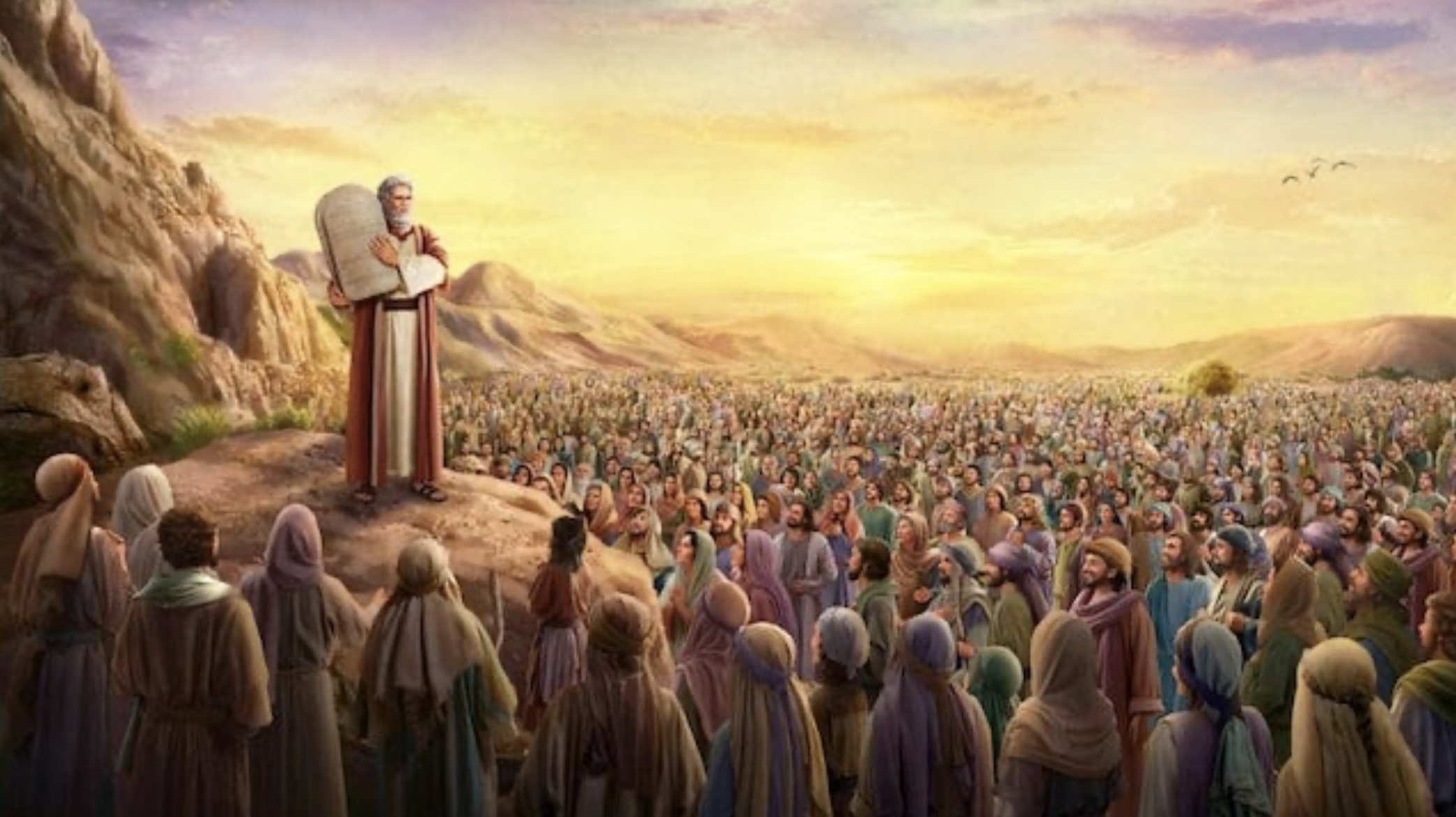
We have seen that this image does not correspond at all to Exodus 20. But if we remove the stone tables, this image can really remind us of the Sermon on the Mount. Where Jesus tells his disciples that they are the “salt of the earth”.
He said to his disciples:
“In the same way may your light shine before men so that they may see your beautiful way of acting and thus celebrate the glory of your heavenly Father.” (Mt 5:16)
On this occasion, Jesus will give a reading of the Ten Commandments in the original Spirit of the Ten Commandments - not as a checklist of tasks to do or not to do, but as an expression of the privilege of being a representative people of God's character.
No panic, paralyzing fear or trembling this time - Jesus teaches with the authority of God, but with the approachable voice of a mediator. And we are free to practice His commandments as members of the New Covenant.
What does it look like to live out His commandments as members of the New Covenant today?
I invite you to read the Sermon on the Mount, Matthew chapters 5, 6 and 7, because the examples given are very current, and they are not really difficult to transpose to our contemporary context.
Some examples :
Jesus highlights the exclusivity of the covenant we have with God, saying that we cannot serve God and riches. We cannot put all our effort and thought into amassing a large amount of money and, at the same time, put all our effort and thought into glorifying God. If we try to do that, we're going to be a kingdom of priests of money, not a kingdom of priests of God.
Jesus highlights the corporate aspect of the covenant, showing that our relationship with God has EVERYTHING to do with our relationship with others around us.
He says :
“So if you present your offering towards the altar and there you remember that your brother has something against you, leave your offering before the altar and go first to be reconciled to your brother, then come and present your offering. " (Mt 5:23-24)
So if you have a lingering dispute with a sibling or someone close to you, and you want to be faithful to the Covenant you have with the God who has already saved you, go quickly resolve it. Ask for forgiveness if necessary, give forgiveness if necessary, set things straight if necessary.
Jesus highlights the individual, comprehensive aspect of the covenant, showing that even your heart and your outlook is an area that must manifest the character of God:
"You have heard that it was said: You shall not commit adultery. But I say to you, Every man who looks at a woman to lust after her has already committed adultery with her in his heart." (Mt 5:27-28)
Perhaps as you read the Sermon on the Mount you begin to get a little of the panic of the people when they heard the voice of God. The holiness of God highlighted, the project of being part of a kingdom of priests and expressing this reality through our behavior... seems difficult.
If this is our case, rather than ignoring the call, may we remember the context of the Covenant, of a God who did in advance what was necessary for our salvation, and who he provided a mediator so that we can listen to his voice without fear.
The Miracle of the Spirit (Pentecost Sunday)
Acts 2.1-41
I’m excited, and a little nervous, to be taking a break from Exodus this week to talk about what today is, and what it represents. Today is Pentecost Sunday. For most people in France, the meaning of this day is vague at best. For most Christians in France…it might also be vague at best.
On Pentecost Sunday, we remember the day on which God sent the Holy Spirit to his people; we find this episode of the story in Acts chapter 2. But how you read this story today might vary greatly depending on how you grew up, what kind of church culture you came out of.
Let me give you a little background on myself before I go on, because I want to explain why I’m going to go about this the way I am.
I grew up in Pentecostal churches in the United States. These are churches that were born out of a movement in the early twentieth century, that placed a big emphasis on what we call the “sign gifts,” miraculous signs like speaking in tongues, prophecy, healing, and so on. And that is still the norm in most Pentecostal churches today; you’ll hear a lot about the Holy Spirit, and a lot of time will be dedicated to pursuing these miraculous gifts. (And as we’ll see in a minute, they have a reason for thinking this way.)
That’s what I grew up in. Often, the Sunday services (especially the evening services) could last for hours. There were people yelling, people falling down, people shaking. There was one guy who used to run literal laps around the sanctuary, running like his pants were on fire. I’ve been to healing services, exorcism services, one service where a pastor tried to punch cancer out of a man’s stomach in the name of Jesus…
I promise you, I’ve seen it all.
Now clearly, that’s not where I am today. But my goal today is not to defend one position or another. I’m going to have to talk about what I believe, but I’m going to do my best to show you, in the Bible, why I believe what I do.
This sermon was long in coming, because for years now we’ve had a good mix of people in Connexion. Some of you come from Pentecostal or charismatic backgrounds (I’m using those words interchangeably, by the way); some of you come from much more reserved, cessationist backgrounds; and some of you didn’t grow up in church so you come from neither one. So one of the questions we as the elders have had to ask ourselves is, how do we manage a church in which opinions or convictions might vary wildly on this subject? What common ground can we find? What on the subject of the Spirit’s activity in the world can we all affirm together?
That’s what I’d like to try to do this morning. It’s a tall order, because emotions get high when you talk about this stuff. But this is a subject we see all over the book of Acts, so we need to reckon with it. And, we’ll all be happy to know, there is quite a lot we can all agree on—and it’s really good news.
So let’s start by just looking at what happened on that day.
What Happened (Acts 2.1-13)
To give us some context: at this point in the story, Jesus has died and was raised, he appeared to his disciples and some four hundred other people, and in the previous chapter, the disciples (now called apostles, because Jesus was sending them out to preach the gospel—the word “apostle” means “sent”) saw Jesus ascend into heaven in his body. And now, they’re doing what he said: they’re waiting. We see in Acts 1.15 that about a hundred and twenty of them were gathered in the same place, praying and marveling at what had happened, and waiting for God to send the promised Holy Spirit.
Then they come to the day of Pentecost, which was the second of the annual harvest festivals for the Jews, that came fifty days after Passover (it was called the Feast of Weeks in the Old Testament). So this is about a month and a half after Jesus’s death and resurrection, and about a week after he ascended into heaven.
Let’s read from the beginning of Acts 2.
When the day of Pentecost arrived, they were all together in one place. 2 And suddenly there came from heaven a sound like a mighty rushing wind, and it filled the entire house where they were sitting. 3 And divided tongues as of fire appeared to them and rested on each one of them. 4 And they were all filled with the Holy Spirit and began to speak in other tongues as the Spirit gave them utterance.
Okay, so the first thing we need to notice here is that the Holy Spirit’s coming is very different from Jesus’s coming. The Bible teaches that there is one God, who has manifested himself for all eternity in three persons: the Father, the Son, and the Holy Spirit. One God, three persons. If that makes no sense to you, welcome to the club. No one understands it.
The Son was Jesus Christ: born of a human woman, but conceived by the Holy Spirit. So Jesus is fully God, but also fully man. He is a physical human being who is also the Son of God.
That’s not the case for the Spirit. The Holy Spirit is what his name implies: he’s a Spirit. He’s not a human being, he’s not physical. So if he’s a Spirit, and not a physical being, how would the apostles know he had come? If it was a purely internal, subjective experience—like a feeling they got—how could they prove that this had actually happened? And how would they know the same thing had happened in others?
The question is actually really important, because with Jesus gone, God had to provide continuity. He had to show the people watching the apostles that their ministry isn’t a new thing, but the continuation of what Jesus started.
So there needed to be something visible, to prove to the people around that this was really happening, that it wasn’t all in their heads.
And we get that here. First, there’s the sound of a wind in the room (already freaky); then, something like tongues of fire that comes and floats over their heads (even weirder). But those things, only those disciples who were present could see and hear, because they were inside a closed room.
The next thing is what seals the deal: they’re filled with the Holy Spirit. We see the Spirit doing a lot in the Old Testament too, giving people power for specific tasks. The language the Bible uses to talk about what happened back then is, “The Spirit of God rushed upon Saul, or rushed upon Samson, or rushed upon Shamgar (my personal favorite of the Judges).” But it’s always punctual; it’s always momentary. We see the Spirit rushing upon Saul at the beginning of his reign, and then we see the Spirit leaving Saul later on.
That’s not what it says here. It says that the Holy Spirit didn’t just come upon them; he filled them.
And that way we know this happened—the outside, objective proof that this was real—is that they began to speak in other tongues as the Spirit gave them utterance.
And after, it gets even better. V. 5:
5 Now there were dwelling in Jerusalem Jews, devout men from every nation under heaven. 6 And at this sound the multitude came together, and they were bewildered, because each one was hearing them speak in his own language. 7 And they were amazed and astonished, saying, “Are not all these who are speaking Galileans? 8 And how is it that we hear, each of us in his own native language? 9 Parthians and Medes and Elamites and residents of Mesopotamia, Judea and Cappadocia, Pontus and Asia, 10 Phrygia and Pamphylia, Egypt and the parts of Libya belonging to Cyrene, and visitors from Rome, 11 both Jews and proselytes, Cretans and Arabians—we hear them telling in our own tongues the mighty works of God.” 12 And all were amazed and perplexed, saying to one another, “What does this mean?” 13 But others mocking said, “They are filled with new wine.”
The details we see here are numerous, very specific, and very important.
These “other tongues” the apostles are speaking are actual, recognizable languages. That’s what the crowds say in v. 7-8: these guys are all from Galilee, and yet we can hear them all speaking in our native language. And these people listening came from all over the place. They were Jews from many different countries. And yet, they all hear the apostles speaking in their native languages.
And they’re saying very specific things; we see in v. 11, the apostles are telling in our own tongues the mighty works of God.
That’s what happened on this day of Pentecost. It wasn’t all that happened (we’ll talk about the rest in a little while), and it wasn’t the only incredible thing we see the Holy Spirit do. In the book of Acts, we see the apostles, through the Holy Spirit, healing people, prophesying, casting out demons, resurrecting people from the dead; and we see Christians all over the place speaking in other tongues just like the apostles did, which was the sign that the Holy Spirit wasn’t reserved for an elite few, but that all Christians had received the same gift from God the apostles had.
But if that’s what happened on the day of Pentecost, what didn’t happen?
What Didn’t Happen
I’m just going to tell you what I see when I read the Bible. And I’ll be honest: since I’m the elder who planted the church, and I was the only elder when these questions first started being asked, my view on the subject informed a lot of how we do things here. That might change as time goes on, as different elders come on board, and that’s fine. But this is how I approach it.
First of all, no matter where we land, we want to give a lot of grace to people who disagree with us on these subjects, because they’re not always easy. The Bible isn’t very specific about what some of these things looked like, so there’s definitely some room for interpretation. For that reason, I want to be careful when someone comes to me claiming they had an experience with the Holy Spirit that differs from what I see when I read the Bible. I don’t want to jump right away to saying, “No, that definitely wasn’t the Holy Spirit.” I want to listen, and consider that there may be some things about this I don’t understand.
That being said, there are a number of things that often happen in churches, particularly charismatic or Pentecostal churches, that I don’t believe we see in the book of Acts.
With the first, I know I’m going to make some people mad, but it’s what, in modern churches, people usually called speaking in tongues. But there’s another word for it, which is glossolalia. It’s what happens when someone repeats or intones random syllables or sounds that don’t seem to fit into any known language.
Glossolalia a word that exists outside of church circles, because it’s a phenomenon that exists outside the church. It happens in just about every part of the world, in many different religions, and in pagan practices as well.
Now I’m not suggesting this phenomenon is always bad, just that it’s not unique to Christianity, and that it’s not what we see in the book of Acts or elsewhere in the Bible. We already saw what was unique about that: they spoke in languages spoken by people who were listening. They were real languages, understandable by those who were present.
The other thing we often see in churches today, that we don’t see in the book of Acts or elsewhere in the Bible (at least not in a positive way), is whatever falls under the category of “loss of control.” Falling down; trembling uncontrollably. Nowhere in the Bible, nowhere in Acts, do we see God approving a loss of control.
Those are just a couple of examples. A lot of what we see happening in some churches today is not what was happening in the book of Acts or afterwards. And I don’t believe what we see in Acts was meant to continue in quite the same way after that time period.
That’s not to say I think it never happens—I’m not a cessationist. But the fact that I believe it’s possible doesn’t mean I think that’s how it should be everywhere, at all times. The time of the apostles was a completely unique period in history, in which the claims of the apostles were validated by the signs and wonders they performed.
There’s a lot more I could say about this, but that’s why, at Eglise Connexion, we tend to be more reserved than demonstrative. That’s why we don’t speak in tongues (that is, we don’t hear glossolalia) in the service; that’s why we want to maintain a certain order during the service. We do still pray for people: we pray that God would heal people, and we believe that God does heal. But we want to maintain a certain order; we want to adhere to what Paul says in 1 Corinthians 12-14, which is one long warning against disorder in the church’s gatherings.
I do think we could stand to loosen up a bit, to be a little more vocal and celebratory when we worship God—like I said, I grew up in a very different context, and seeing extremely reserved worship is weird for me: these are massive, joyful truths we’re singing about. So I think we could show that more than we do.
But we want to worship in a way that is ordered, that seeks to serve everyone here, that’s not just trying to make me feel good.
What It Means (Acts 2.22-41)
Now, if you disagree with me on the things I just said, that’s fine. This is a secondary issue, and not even all of the elders have agreed on this subject in the past. We are all brothers and sisters in Christ, and as long as we all accept to do things in a certain way when we meet, we can disagree on these things, and it makes very little difference.
And it’s not a problem because of what this event means—what unites us. It’s really easy to get distracted by what we see in Acts 2. It was spectacular, but it had a very specific goal.
And that’s one thing we see over and over again in the Bible. Every time God does something, whether it’s minor or spectacular, he always has a reason. Whenever Jesus healed someone, he had a reason. And it wasn’t only that he had compassion on those who were sick, although his compassion was real. It was in order to show the people who he was—that he was no ordinary man. But at the same time, it was also to show the people that seeing isn’t necessarily believing.
In order to believe, something else needed to happen.
Go back to Acts 2. After the text we read earlier, when the apostles were speaking in tongues and the people outside were hearing their own languages spoken, some people are amazed, while others say the apostles are drunk.
So Peter gets up and speaks to the whole crowd. And he delivers an incredible, impromptu sermon that is not at all what we’d call “seeker sensitive.” He says in v. 22:
22 “Men of Israel, hear these words: Jesus of Nazareth, a man attested to you by God with mighty works and wonders and signs that God did through him in your midst, as you yourselves know— 23 this Jesus, delivered up according to the definite plan and foreknowledge of God, you crucified and killed by the hands of lawless men. 24 God raised him up, loosing the pangs of death, because it was not possible for him to be held by it.
In other words, he tells them that they, Jewish men and women, people who up to that point thought they were saved because they were Jewish, have sinned against God, and need his forgiveness. In v. 36 he pronounces the final, climactic sentence of his sermon:
36 Let all the house of Israel therefore know for certain that God has made him both Lord and Christ, this Jesus whom you crucified.”
The Lord and Christ, whom you crucified. What incredible courage: he might have been stoned to death right then.
But how did the crowd respond?
37 Now when they heard this they were cut to the heart, and said to Peter and the rest of the apostles, “Brothers, what shall we do?” 38 And Peter said to them, “Repent and be baptized every one of you in the name of Jesus Christ for the forgiveness of your sins, and you will receive the gift of the Holy Spirit. 39 For the promise is for you and for your children and for all who are far off, everyone whom the Lord our God calls to himself.” 40 And with many other words he bore witness and continued to exhort them, saying, “Save yourselves from this crooked generation.” 41 So those who received his word were baptized, and there were added that day about three thousand souls.
These miraculous signs the apostles were able to do were spectacular. Absolutely. Part of the reason why they were able to do these things was to show that Jesus was continuing his ministry through them.
But that’s only part of it. We talked about this in Exodus: very often, we see one thing happen in the Bible, for a specific reason at a specific time, but that actually points to something even bigger, something even better, still to come. The same thing is happening here. The miraculous signs we see in the apostles, particularly the speaking in tongues we see in Acts 2, is pointing to something far better still to come.
And that is the reversal of a curse.
If you’ve read the book of Genesis, you’ll remember a particular scene early on in the book, in chapter 11: the tower of Babel. At that time, everyone on earth spoke the same language—which makes sense, because they were all descended from the same family. So they settle in a certain place and they founded a city. And they’re pretty pleased with themselves. So they decide, in v. 4:
“Come, let us build ourselves a city and a tower with its top in the heavens, and let us make a name for ourselves, lest we be dispersed over the face of the whole earth.”
So they start, and they get really high up. God sees what they’re doing, and he is not happy. He says in v. 6:
“Behold, they are one people, and they have all one language, and this is only the beginning of what they will do. And nothing that they propose to do will now be impossible for them. 7 Come, let us go down and there confuse their language, so that they may not understand one another’s speech.”
Now it might seem like God sees the people as a threat, like a petty tyrant: if they keep going, they’ll be able to do anything they want, and we can’t let that happen.
But these people aren’t a threat to God. They’re a threat to themselves. They’re starting to think they don’t need God, because they’re able to do impressive things on their own. They’re lost in their pride, and in their arrogance they imagine they can live without God.
In their arrogance, they desire to take the place of the God for whom nothing is impossible. It is idolatry in its simplest form.
So God, as a consequence, confuses their language. Suddenly, they can’t understand each other. They’re all speaking different languages, all at once. And without the ability to communicate…there’s nothing they can do together.
They quit their project, and they disperse. And from then on, we have multiple groups of people, speaking multiple languages in multiple locations.
That’s the situation for millennia. People live dispersed from one another, separated by language and culture and, quite often, animosity.
That’s the situation, until the day of Pentecost.
On this day, what do we see? We see many different people, from many different cultures, with many different languages, suddenly all able to hear the same revolutionary message, this incredible good news, spoken in their own language.
There are a couple of really important things we need to see here. These people who were in the crowd on the day of Pentecost likely didn’t need to hear these things spoken in their own language. They were from several different places, but they were all Jews, Paul says in v. 5 of Acts 2—so they all would have had at least a passing knowledge of Hebrew (and probably Greek as well). And when Peter gets up and preaches in v. 14, he’s not speaking a dozen languages at once. He’s speaking one language, and it seems like everyone in the crowd understands his sermon.
So I don’t think the apostles spoke in tongues so that the people would understand. I think they did it so that the people might be moved. Everyone who’s lived in a different country knows that it’s one thing to hear or read the Bible in the new language you’ve learned, and it’s quite another to hear it in your native language. Even if we’re perfectly bilingual, our native tongue does something to us that other languages just can’t. It hits our minds and our hearts in a particular way.
This speaking in tongues isn’t strictly necessary, but it is profoundly symbolic and meaningful. It was the signal for them that the Spirit wasn’t only coming to an elite in Jerusalem, but for everyone. And this “live translation” of the wonders of God in all these other languages was a foretaste of what was coming: the gospel, going out in power, not only to the Jews in all these various regions, but to the Gentiles there as well: many peoples, united by one single Spirit.
The second important thing to note is that God doesn’t totally reverse the curse of Babel; he doesn’t make all the people suddenly speak one language. Because, once again, the speaking in tongues isn’t an end in itself. It’s a gift that’s pointing to something greater.
And that greater thing is the Holy Spirit, taking people from various backgrounds and languages and cultures, and uniting them through the miracle he performs in their hearts. Peter gets up and preaches this really accusatory sermon, in which he says to them all, “This Son of God, whom God sent with mighty works and signs and wonders that you all saw with your own eyes—you crucified him. You killed him.”
And instead of getting defensive, what do we see in v. 37?
Now when they heard this they were cut to the heart, and said to Peter and the rest of the apostles, “Brothers, what shall we do?”
Right there—that’s the real miracle. It’s not the speaking in tongues. It’s not prophecy. It’s not healing. It’s hearing this crazy message of what Jesus Christ did, that he lived and died and was raised to save us…and being cut to the heart. That is miraculous, because it makes no sense. Paul says that “the word of the cross is folly to those who are perishing” (1 Corinthians 1.18). We can only see the gospel as not folly when the Holy Spirit gives us new hearts, and new minds, and new ears to hear and believe in him, so that we might not perish but have eternal life.
That is what it means to be “baptized in the Holy Spirit” (cf. Ephesians 4.1-6); THAT’S the point. That’s why the apostles spoke in tongues, that’s why they were able to heal, that’s why these miraculous things were happening at this time. Every miracle occurring at this time is pointing to the greater miracle: the work of the Holy Spirit to regenerate and renew people from every tribe, tongue and nation and unite them into one body, one family, under one Father—all of this leading toward the day in which God presents the church to his Son as a bride, without spot or wrinkle or blemish, to enjoy their unity with him forever.
Three thousand people met Christ that day, and that was just the beginning.
How We Move Forward
To close, let’s ask one more question—where do we go from here? How do we respond to what we see in this passage?
The answer is simple. Either we lean in to the signs, or we lean in to the message.
It’s easy to read Acts 2, and the following chapters, and wonder why we don’t still see this sort of thing today, or at least not as often. It’s easy to think that if these signs and miracles were happening all over the place today, in such a visible way, the preaching of the gospel would be much more effective.
But that’s simply not true. Even in the book of Acts, and even in Jesus’s ministry, seeing a miracle doesn’t convince everyone—because again, that’s not the point. These miracles were pointing toward the greater miracle, and that greater miracle has spent the last two thousand years taking shape.
What’s different about our situation today, and that of the apostles? A lot of things, of course, but one main thing: we have the Bible. The whole Bible: Old and New Testaments. We have the letters the apostles wrote. We have the whole of Scripture, which the Holy Spirit inspired so that we might know everything we need to know, and see everything we need to see, in order to believe.
Paul says in 2 Timothy 3.16-17:
16 All Scripture is breathed out by God and profitable for teaching, for reproof, for correction, and for training in righteousness—
To which we might say, “Sure, Scripture is profitable, but it would help an awful lot if we had the miracles too.”
Sorry, no. Paul says that God gave us Scripture for teaching, reproof, correction, training in righteousness—why?
17 ...that the man of God may be complete, equipped for every good work.
In other words: we don’t need anything else.
So do miracles still happen? Absolutely, because God is still a compassionate God. Does speaking in tongues still happen? I believe it does—not necessarily the way a lot of Christians would say it does, but I do believe these things still happen, in the right context, and if God judges them necessary.
But we don’t see these things as often here because we don’t need them here. We have something the early church didn’t have, and that is the whole of Scripture, breathed out by the Spirit, and which the Spirit uses to give us everything we need, to equip us for every good work.
So rather than lean in to the miracles, we want to lean in to the message. The message of the gospel, not miracles, is what saves us. It’s what makes us complete. It’s what equips us.
The message of the gospel is the true miracle. Even if we never see a single outward miracle in our whole life, we already have the miracle we need.
The Presence and the Fear of God
Exodus 19.10-25
I have a confession to make that will definitely prove I’m getting older: I hate emojis.
I hate emojis.
I love technology, but I hate some of things that come with it. Emojis and social media are perhaps the two things I hate the most about the technology that has come to the foreground in the last twenty years or so.
I hate emojis because I love words. You can already see it: reliance on emojis are making us incapable of using actual language. We’ll write 😁 instead of constructing our sentences to express that we’re happy. We’ll write 🙏 instead of just praying with someone. We’ll use 💩—if someone can tell me in what context this is necessary, I’d be thankful.
But I have a theory as to why emojis took off the way they did. Sometimes, visualization is helpful. I think it’s rarely helpful in a text message, but I get why it’s appealing: you can see something and intuitively understand—it’s a much more immediate means of communication than words. It’s why graphs and charts are helpful; it’s why facial expressions are helpful; it’s why illustrations are helpful. Sometimes we need to see something to capture the full measure of it: you can describe the Grand Canyon to someone, but it’s a totally different thing to actually be there and see it.
I bring this up because what we see in today’s text is essentially God giving the people of Israel one huge illustration. It’s enabling them to visualize something they would only otherwise understand in part.
Last week we saw the people arrive at the foot of Mount Sinai, and God told Moses what he was going to do. He was going to establish a covenant with the people of Israel—and in case you weren’t here last week, here are the terms of that covenant. He said in Exodus 19.5-6:
Now therefore, if you will indeed obey my voice and keep my covenant, you shall be my treasured possession among all peoples, for all the earth is mine; 6 and you shall be to me a kingdom of priests and a holy nation.
So he gave a condition—obey my voice and keep my covenant—and he gave them a promise—if they respected that condition, they would be he treasured possession, a kingdom of priests and a holy nation.
But they still don’t completely understand how serious this covenant is; God’s going to give Moses a list of laws the Israelites would have to follow, and the Israelites will need to be entirely convinced that they need to follow these laws, because they are to be God’s representatives among the nations, which means they have to be like him.
This is a big deal; it entails a total transformation of who they are as a nation and as a people. T. Desmond Alexander writes: "The ratification of the covenant at Mount Sinai transforms the Israelites from being oppressed slaves of the king of Egypt to being exalted servants of the King of kings.”
In other words, they will need to be holy—they will be a kingdom of priests and a holy nation.
But what does that mean, exactly? When we think “holy”, we often think of moral righteousness. And that is certainly true: God’s people would be holy in that they would be set apart by God to reflect his character to the world.
But it would be an incomplete reflection, because God is holy in ways ordinary human beings can never be. And he’s going to show that—he’s going to show just how wide the gap is between our holiness and his own—at Mount Sinai.
Preparing for the Presence of God (v. 10-15)
We see this first in the way God prepares the people for what he’s about to do. They’re about to come close to God, which is no small thing.
V. 9:
When Moses told the words of the people to the Lord, 10 the Lord said to Moses, “Go to the people and consecrate them today and tomorrow, and let them wash their garments 11 and be ready for the third day. For on the third day the Lord will come down on Mount Sinai in the sight of all the people.
So already this is something different than anything they’ve encountered before. God tells Moses that he is to “consecrate” the people. The word “consecrate” literally means to set apart as holy—Moses is to prepare the people to present themselves before a holy God.
He tells Moses to have the people “wash their garments” and be ready for the third day. In other words, that third day wouldn’t be like every other day.
Three couples got married this past week: Frank and Suzanne, Timothée and Laura, and Vincent and Sophie. I’m sure all of them have their favorite clothes they like to wear on a regular basis, certain ways they like to style their hair, certain ways they get ready in the morning. But they didn’t wear those clothes this week, and they didn’t get ready in the same way.
They got ready for their wedding.
Coming before God is serious, so the people were to prepare for that day in a different way than every other day. They were to wash their clothes, to come before God clean. They were to set themselves apart for this one thing: to go to the mountain fully aware that they were entering into the presence of holiness.
That’s not all—if this washing wasn’t enough to make them aware of the seriousness of the situation, what God said next would do it. V. 12:
12 And you shall set limits for the people all around, saying, ‘Take care not to go up into the mountain or touch the edge of it. Whoever touches the mountain shall be put to death. 13 No hand shall touch him, but he shall be stoned or shot; whether beast or man, he shall not live.’ When the trumpet sounds a long blast, they shall come up to the mountain.”
So in addition to the consecration and the cleansing they have to go through before the third day, Moses has to set limits around the mountain that the people can’t cross. If they go up too far, if they touch the mountain, the penalty is death.
That might seem a bit harsh, but it’s not. It’s what we saw last week: the holiness of God is unfit for sinful human beings. That’s why the person who comes too close to the mountain is to be stoned or shot (with an arrow, of course); they are not to be touched, because if they’ve been too close to the presence of the Holy God, they are now dangerous to come into contact with.
We can think of it almost like radiation. Think of the sun. The sun is a good thing—it’s a good creation of God. It gives us warmth, just the right conditions for a habitable planet, and it keeps our solar system in its orbit. Now let’s take an object in space, like a meteor or a satellite. Assuming it’s made of really strong stuff and doesn’t get burned up, if an object gets too close to the sun, it soaks up solar radiation and becomes radioactive. Not only can we not get close to the sun; we can’t get close to anything else that’s been close to the sun, because that would be dangerous for us too.
The sun is a good thing, but it is dangerous.
God’s holiness is an absolute good. It is what makes him God—he is totally set apart, totally above, totally perfect. His holiness is so good, in fact, that it is dangerous for anyone who isn’t as holy as God is.
So limits are set around the mountain, which the people absolutely must not pass.
Moses does what God commands in v. 14:
14 So Moses went down from the mountain to the people and consecrated the people; and they washed their garments. 15 And he said to the people, “Be ready for the third day; do not go near a woman.”
Obviously, he doesn’t mean don’t go physically near a woman; women were present in front of the mountain. What he means is, don’t have sex. Not because sex is bad or dirty (God created sex), but because he wants them totally set apart, in body and in mind, for this moment when he would come down. They are to be consecrated—dedicated to nothing else on that day.
Witnessing the Presence of God (v. 16-19)
So, as verse 2 of this chapter tells us, Israel is encamped in front of the mountain. And as Tim Chester noted, that’s a strange thing to say—mountains don’t have “fronts”.
But thrones do.
That really is what we see here: it’s like they’re entering into the throne room of the God of everything—and if they weren’t yet aware of why that was a big deal, they soon would be.
V. 16:
16 On the morning of the third day there were thunders and lightnings and a thick cloud on the mountain and a very loud trumpet blast, so that all the people in the camp trembled. 17 Then Moses brought the people out of the camp to meet God, and they took their stand at the foot of the mountain.
So on the third day, it’s almost like the mountain starts to wake up. There’s thunder, there’s lightning, a huge cloud that envelops the mountain and a “very loud trumpet blast.” That’s not a guy in the camp playing the trumpet to celebrate; that’s heaven, announcing God’s arrival.
We see at the end of v. 16 that “all the people in the camp trembled.” They are terrified.
Now if you’ve read the Bible, you’ll remember that often God will send an angel to someone, and every time that happens, the person who sees the angel is terrified, and usually the angel will tell them, “Don’t be afraid.” It’s interesting that Moses doesn’t do that here—not yet anyway. He will say it later on, as we’ll see in a couple weeks, but he will say it in a specific way that’s actually in keeping with what happens here.
For now, he doesn’t discourage their fear, because their fear is right—that’s the appropriate response to the presence of God.
A couple of years ago, we were back in Florida visiting my family, and we were there in peak storm season. Almost every day during the hot summer months, a little after noon, there’s a massive storm, with thunder and lightning and torrential rain. So every day the kids got a show. We were watching from inside most of the time, so we were sheltered and completely safe, but even from the safety of shelter, the kids were a little freaked out at first, because the thunder and lightning were incredible.
That’s how we should feel in the presence of something this powerful. That fear is the right response.
So Moses doesn’t tell the people not to fear. Instead, he tells them to come out anyway. Come out of their tents, come out of the camp to meet God.
Can you imagine? You leave your camp and you come up to the foot of this mountain, which is wrapped in clouds and thunder and lightning, and from which these shattering trumpet blasts are coming.
And once they’re there, it gets even more intense.
A lot of us went to see Christopher Nolan’s film Oppenheimer, which came out last year. I don’t think I’m spoiling anything by telling you that J. Robert Oppenheimer headed up the team that created the first atomic bomb, which they tested in the desert in New Mexico. The scene in the film where they test the bomb is incredible, because it’s not what you’d expect. You don’t see a lot of wide shots of the whole explosion, because we’ve seen those pictures before. We know what that looks like. Nolan wanted to get in close. They photographed shots of a small nuclear reaction in extreme close-up, so you have these long shots of just fire, rolling in and over itself.
I can’t help but think of that when I read v. 18:
18 Now Mount Sinai was wrapped in smoke because the Lord had descended on it in fire. The smoke of it went up like the smoke of a kiln, and the whole mountain trembled greatly. 19 And as the sound of the trumpet grew louder and louder, Moses spoke, and God answered him in thunder.
So there is thunder. Lightning. A loud trumpet blast. Then fire, and smoke billowing up like out of a smokestack from the mountain. Trembling. Then the trumpet blast gets louder and louder, and Moses speaks (or he has to scream, I’d imagine, over the noise), and when God answers, he answers in thunder.
Can you imagine it?
It’s one sign after another. God called the people to come to him. He wants to be in a relationship with his people.
But God is dangerous. His presence is not to be taken lightly. Coming to God is not like going to visit your grandpa. It’s not even like going to visit someone you greatly admire.
It’s like going to visit a thunderstorm. It’s like going to visit an atomic blast. He wants us to come, and he will keep us safe—remember, he set limits around the mountain so that the people wouldn’t die—but even from a distance, his presence is awesome, and dangerous, and terrifying.
Mediating the Presence of God (v. 20-25)
Why is he terrifying? We saw it before. God’s presence is terrifying because God is holy, and we are not. Just like we can’t withstand an atomic blast, because we’re not made of lead, we can’t withstand the presence of a holy God, because we aren’t holy.
In order for the people to truly come into the presence of God, they would need a barrier; they would need a kind of filter. And that filter, that barrier, as it turns out, would be a person.
That’s what we see next, in v. 20:
20 The Lord came down on Mount Sinai, to the top of the mountain. And the Lord called Moses to the top of the mountain, and Moses went up.
God allowed only one man to come up to the top of the mountain. Moses could come up, and no one else, at least not for now. (Later on he’ll bring Aaron up with him, because Aaron will soon be named high priest.) For now, it’s just Moses.
So what does God tell Moses when he gets up to the mountain? He gives him more safeguards, more limits; he tells him to go back down again, and reiterate for the people one more time just how serious this is.
V. 21:
21 And the Lord said to Moses, “Go down and warn the people, lest they break through to the Lord to look and many of them perish. 22 Also let the priests who come near to the Lord consecrate themselves, lest the Lord break out against them.” 23 And Moses said to the Lord, “The people cannot come up to Mount Sinai, for you yourself warned us, saying, ‘Set limits around the mountain and consecrate it.’ ” 24 And the Lord said to him, “Go down, and come up bringing Aaron with you. But do not let the priests and the people break through to come up to the Lord, lest he break out against them.” 25 So Moses went down to the people and told them.
You see, once God’s glory is visibly present on the mountain, there isn’t just one limit the people mustn’t cross. God sets up three separate zones of increasing holiness, the further up the mountain they go. (And later on, the tabernacle would be configured in exactly the same way.) Only Moses can come all the way to the top for now. Aaron and the priests can go up to the slopes, but no further (v. 22). And the people have to stay on the ground, at the foot of the mountain.
The closer to God you get, the more serious the danger is.
Only Moses can actually come into God’s presence for now, because God wants Moses to act as a mediator between God and the people. He wants there to be a barrier for now.
But why would he want that? Again, this is God—he can do whatever he wants. Clearly he can make it possible for Moses to come into his presence without dying, at least in a limited way. Why can’t he just do that for all the people?
There are a few reasons.
The first, I think, is logical, and that is that people can get used to almost anything, even things that are incredible. That’s why tourists who go into the mountains on vacation stand around taking pictures, looking at the peaks in awe, while the people who live there walk around like it’s no big deal. It’s why parents, when their kids get sick, will rush to them to clean it up, rather than running away like a sane person. It’s why Tom Cruise jumps out of airplanes, when everyone else straps in.
We can get used to almost anything.
And when we get used to fire, we tend to want to play with it.
It’s what we’ll see in about twelve chapters—despite everything they’ve seen, the people will eventually get bored with the incredible presence of God, and want a new god to do something new for them. They’ll get used to God’s presence, and stop taking it seriously.
We cannot come to God on our own; we need a mediator, who will represent us well before God.
That’s what we see in Moses: he is a good mediator between the people and God. He will hear God’s instructions, and transmit them faithfully to the people; he’ll also listen to the people, and pass on their requests to God. He’s a good mediator.
But he’s still not a perfect mediator. Later on, Moses will fail in his mediatorial task, and as a result will be prohibited from entering the Promised Land of Canaan.
Moses shows us a mediator is necessary, and he shows us that no merely human mediator is enough.
Here’s why I think this chapter is so incredibly important for us today. We’ve heard so many times that God is love, that the Father sent Christ to die for our sins—that he lived our life and died our death to reconcile us to God. And of course that is true: it’s what we say every week, it’s what we celebrate every week when we take Communion together.
But often we end up adopting a kind of Westernized idea of what the love of God the Father looks like. We liken God’s paternal love to our own. And our love, quite often, is more influenced by commercials than the Bible.
On the screen, you see a dad playing with his new baby. They’re on the floor, wrestling a little, the dad is rubbing his face into the skin of the baby’s belly, tickling it and making it laugh. Then someone says off screen, “Who wants a scratchy face when they’re cuddling with their baby?” And they show the dad carefully applying shaving cream, then shaving his face nice and close. Then one last shot of the dad holding the baby after a great day playing: the baby’s asleep on his chest, and he leans down and kisses the baby, nuzzling his his smooth, freshly shaved cheeks into the baby’s forehead.
A lot of the time, that’s what we think of when we think of the love of a father. And it’s not bad—not at all. Dads, play with your babies. Wrestle with them, kiss them, cuddle with them. They need you, and that’s good.
But that’s not what the love of God looks like, because his love is holy. He’s not after our comfort; he’s not there to tickle us and make us laugh. He’s there for our joy—which is a very different thing—and he’s there for our holiness.
My fear, even and almost especially for myself, is what happens when we get used to God. Because what we see described in Exodus 19 is not at odds with what we see described in the gospels. God has not changed. He is still the same holy God he was on the mountain, surrounding it in fire, smoke billowing up from the mountain, showing himself in lightning and speaking in thunder.
We cannot come to God the way a baby comes to her dad. Our God is a consuming fire (Deut. 4.24), as we see on the mountain. We can see his love in that he invites us to enter into his presence, but we cannot come to him as if he’s a normal dad. He’s not.
To come to God, we need a mediator. We need the Mediator.
That’s the second reason why God wanted a barrier between himself and the people, all the way back at the time of Moses. Moses’s acting as mediator for the people pointed forward to the day when the perfect Mediator would come.
Jesus said that “no one comes to the Father except through me” (John 14.6). We can’t, because we could never withstand the power of pure, unleashed holiness.
The only way we can come to God is through our Mediator, Jesus Christ. For all eternity, the only reason we will not be burned up by the holy presence of God is because we are protected by our Mediator. He has covered us in his holiness, and stands between us and the Father as our protection. Because he is both fully God and fully man, he bridges the infinite gap between our holiness and God’s holiness. He makes it possible for us to stand in God’s holy presence.
So we can come to God with joy, and thankfulness, and celebration. We can know that we are truly united to God, and we don’t have to be afraid of him.
But we also shouldn’t be afraid of fearing him, because that is the right response.
Cultivating the Fear of the Lord
You might be listening to this, and like me, feeling horribly convicted. Because you know you tend to come before God lightly, like you’d come to your dad. You know you don’t fear him as you should.
So how do we cultivate this fear?
Firstly—and this is far from the main thing, but I’m throwing it out there—read books that help. There’s a great one that was recently released by Michael Reeves called Rejoice and Tremble (“Réjouissez-vous et tremblez,” https://maisonbible.fr/fr/79283-rejouissez-vous-et-tremblez-pourquoi-la-crainte-du-seigneur-est-une-benediction-pour-le-peuple-de-dieu-9782925131335.html). It’s an excellent book, and the entire work is centered around this question.
But ultimately, the things you could read outside of the Bible are accessory—helpful, but not the foundation. So live in his Word. Read the Bible cover to cover, on a regular basis (if you can, once a year), because it’s impossible for someone who has been saved by grace, born again through the work of the Holy Spirit, to be exposed to the Bible that much and walk away with a small view of God.
Because the Bible does not present a small view of God. Not once. Even when Jesus does things we find easier to swallow—like healing the sick out of compassion for them—we’re still talking about the God of all creation who commands errant molecules with his word. Even Jesus is the one who appears in the book of Revelation shining like the sun, eyes like fire, a voice like a waterfall, with a sword coming out of his mouth.
Read the Bible. Read the whole Bible, as often as you can. Let it shape your view of God.
Secondly, pray often. Read Psalm 103, and see how often David says that God’s love and compassion is for those who fear him, and ask God to love you like that—to develop in you a view of him that moves you to awe and drives you to your knees, bowing your head before him. No one ever fears God enough, no one fears him as much as he deserves. So our prayers should reflect that. We repent that we do not fear you, Lord, and we beg you to show us mercy, to give us a right view of you, and to help us approach you with joy and trembling.
Lastly—and this might be simple but it’s not easy to do—take God seriously.
We notice this a lot in kids. We’re reading the Bible, or we’re praying together as a family, and one of the kids is goofing around, interrupting, hitting his brother or sister. As parents, we want to be understanding with our children, but we also want to impress upon them that these moments are serious. This is us, as a family, speaking to the all-powerful God of the universe, who is there in the room with us at that moment. It’s not a small thing. It’s not a light thing.
Now, I’m terrible at this. It’s like I was saying earlier: you spend enough time around something, and you get used to it. So we should jump on every opportunity we have to make an ordinary moment holy—because the reality is that there is not a single moment of a single day in which God is not present with us. Right there, in the room, there he is. How would we act differently if we could see him physically present there?
My prayer is that the Holy Spirit would help us meditate on this incredible passage, and feel that fear. That he would help us to always be in awe of the fact that we get to come protected into God’s holy presence. And that we would respond to this fear with obedience—because that is the point, as we’ll see in the next chapter. We fear the Lord, that we might listen to him, and obey him.
The Covenant, the Condition and the Witness
Exodus 19.1-9
The notion of covenant is absolutely crucial to understanding the story of the Bible. The funny thing is, people find this notion difficult sometimes, but it’s an idea we actually understand quite well, and encounter almost every day.
There are many different types of covenant, but we’re going to focus on two different types today.
The first is what’s called a promissory covenant, or what I’ll call an unconditional covenant (which I find clearer). Take, for example, take a marriage. Loanne and I celebrated our twenty-first wedding anniversary last week—last Sunday, actually. On April 28, 2003, we stood face-to-face on a beach in Florida, and as we held hands and looked into each other’s eyes, we both made promises to one another. There were absolutely no conditions to these promises—we didn’t say, “I will love you, cherish you, honor you, and remain faithful to you…until I get tired of you, in which case I’m out.” No—we said, “For as long as we both shall live.” That’s it. No conditions. I’ll be your husband, for the rest of my life or the rest of yours.
This is the kind of covenant God gave to Abraham. He told him that he would make him the father of many nations, that through his descendants all the nations of the earth would be blessed, and that he would give the land of Canaan to his descendants as their land. He didn’t say to Abraham, “If you do X, then I’ll do Y.” He just said, “This is what I’m going to do.”
That’s one kind of covenant: an unconditional covenant.
The second kind is of course a conditional covenant. This is the kind of covenant you have with your employer. When you started working for your employer, you signed a contract with them, stating that you would fulfill the tasks for which they mandated you, and if you do that, the employer in return will pay you a salary. I do this, you do this in return. If one of us doesn’t do it, well then, the covenant’s off. If you don’t show up to work for weeks on end, the contract is void and you lose your job. If your employer doesn’t pay you, same thing—you may need to take them to court to make it official, but that’s what happens.
So we have a conditional covenant and an unconditional covenant.
The Covenant
In today’s text, God spells out the covenant he is going to establish with his people. He’s delivered them out of slavery in Egypt, he’s provided for them and protected them in the desert, and today they arrive at Mount Sinai, the mountain on which God will give them instructions on how they should live. He’s going to tell Moses (who will then communicate it to the people) what kind of agreement, what kind of covenant, God is going to establish with them, and it’s a conditional covenant, like the work contract we talked about a minute ago.
But, as these things often go, it’s actually more complex, and more beautiful, than that.
V. 1:
On the third new moon after the people of Israel had gone out of the land of Egypt, on that day they came into the wilderness of Sinai. 2 They set out from Rephidim and came into the wilderness of Sinai, and they encamped in the wilderness. There Israel encamped before the mountain, 3 while Moses went up to God. The Lord called to him out of the mountain, saying, “Thus you shall say to the house of Jacob, and tell the people of Israel: 4 ‘You yourselves have seen what I did to the Egyptians, and how I bore you on eagles’ wings and brought you to myself. 5 Now therefore, if you will indeed obey my voice and keep my covenant, you shall be my treasured possession among all peoples, for all the earth is mine; 6 and you shall be to me a kingdom of priests and a holy nation.’ These are the words that you shall speak to the people of Israel.”
So let’s just look at the covenant itself real quickly. First we see a condition God gives to Israel—v. 5: if you will indeed obey my voice and keep my covenant… That’s the condition: obey God’s voice, keep his covenant.
What exactly are they supposed to obey? The laws that God will soon give to Moses.
Next, we see a commitment from God—a promise of what he will do if Israel fulfills their commitment. V. 5 again: Now therefore, if you will indeed obey my voice and keep my covenant, you shall be my treasured possession among all peoples, for all the earth is mine; 6 and you shall be to me a kingdom of priests and a holy nation.’
So God promises to give them two things if they respect the covenant. The first is love—you shall be my treasured possession among all peoples, for all the earth is mine.
In other words, you already belong to me. Everything does. The entire world belongs to me. But if you obey my voice and keep my covenant, I will attach to you a particular sort of love: God’s affections will be directed to Israel in a different way.
The second thing God promises to give them is a mission. He says in v. 6: you shall be to me a kingdom of priests and a holy nation. Remember what we saw a couple of weeks ago: God’s goal for his people is that they be representatives to the world, who show the foreign nations around them the nature of God’s character and will. They will be holy as he is holy, and the world will see what his holiness looks like.
So we have a condition for Israel—obey my voice, keep my covenant—and a promise from God: you will be my treasured possession on earth, a kingdom of priests and a holy nation.
Now of course this is still early; they don’t yet have the law, so they’re not entirely sure what they’re getting in to. Even so, the people respond with a commitment of their own, that they will do what God has told them to do. V. 7:
7 So Moses came and called the elders of the people and set before them all these words that the Lord had commanded him. 8 All the people answered together and said, “All that the Lord has spoken we will do.”
The Condition
That’s basically what this covenant looks like. But there’s a problem. Not a problem for God or for his plan, but rather for the people.
A few minutes ago, I mentioned God’s covenant with Abraham—how it was an unconditional covenant. Now, God is going to speak to Abraham’s descendants, the people of Israel, about the covenant he’s going to make with them. It would be easy to assume that since God had made this unconditional covenant with Abraham, he’d do the same thing with his descendants. But that’s not what he does.
He puts a condition on the covenant. They will be his treasured possession, if they obey his voice and keep his covenant.
On the one hand, this condition is necessary. It’s necessary because of the mission God gives them, to be a kingdom of priests and a holy nation. God’s people are meant to be, in a sense, the guarantors of God’s reputation on earth. That meant that whenever a foreign nation would observe the people of Israel, it was God they would be seeing.
One thing we see throughout the Bible is that God’s ultimate goal in everything he does is his glory: it is to show the world what he is really like. (That’s what the word “glory” means in the Bible: it is everything God is, made visible for all to see.) God’s desire that the world see his glory is not arrogant or selfish: it is a gift he gives to his creation, because seeing his glory, contemplating it, observing it, living in it, is the only thing that will satisfy us throughout eternity.
So this mission God gives to Israel, to carry his reputation to the nations, is huge. It is a massive gift—again, nothing will make God’s people happier than being like God—but it’s daunting as well. If they are going to represent him in the world, they have to be like him.
The problem is, they won’t be able to do it. God’s about to give them a lot of laws that will go into great detail about things as mundane as the type of fabrics they had to use in certain circumstances, how to deal with mold in their tents. The point of all this super-strict mundanity is that God’s character is exacting—he is perfect…and if he is perfect, and his people are to represent him on earth, his people should be perfect as well. (Jesus reiterated that same point a long time later, when he told his disciples, “You therefore must be perfect, as your heavenly Father is perfect”, Matthew 5.48.)
It’s almost funny, what we see in v. 8, when Moses tells the people what God said and they respond, “All that the Lord has spoken we will do.”
I want to say, Yeah, right—just wait a while and see how it goes.
The Witness
So here’s the question I can’t get away from: why did God do it this way? The mission God gives to his people makes the condition necessary—they have to be like him if they’re going to represent him—but in that case, what’s the point of any of this? God knew perfectly well they weren’t up to the task. So what good is the covenant if the people would always be unable to fulfill it?
I think the key to answering that question is found in two verses that might be easy to overlook.
The first is at the beginning of God’s discourse. God is speaking to Moses and he tells him what he should say to the people. But before he gives the terms of the covenant, this is what he says (v. 4):
You yourselves have seen what I did to the Egyptians, and how I bore you on eagles’ wings and brought you to myself.
He calls attention to what he did—how he brought them out of Egypt, and everything he did in order to get them out—and he says, “You yourselves have seen what I did.” You saw this. You remember. It’s not like someone else told you about it; you saw it for yourself.
The second verse is at the end of today’s passage, in v. 9.
9 And the Lord said to Moses, “Behold, I am coming to you in a thick cloud, that the people may hear when I speak with you, and may also believe you forever.”
(When God wants the people to “believe Moses forever”, he means he will do these things so that the people will believe that the words Moses communicates to them in the law are indeed God’s words, not his own. The cloud on the mountain, and the voice they hear from the mountain, will validate the law Moses will transmit to them.)
So you see, it’s something similar. Here, God doesn’t call attention to something he has done, but to something he will do. He’s going to come to Moses in a thick cloud that the people can see, and they will hear when God is speaking to Moses. Just as they witnessed God’s power in delivering them from Egypt, they will also witness God’s power when God gives the law through Moses, and because of this, they will believe that the words he brings down from the mountain are really and truly the words of God, his law, his will.
What’s the point of this double mention of God’s power that Israel can see and hear?
These two verses serve almost as bookends to the covenant: they hold this passage together. God wants the people to remember his power in the past, to witness his power in the present, and to expect his power in the future, precisely because the task facing the Israelites is too great for them to handle. They can’t do it—but God doesn’t want them to believe in what they can do; he wants them to believe in what he can do.
This has always been the case, even with Abraham. All the way back in Genesis 15, Abraham was declared righteous because he believed that God could do the impossible.
This is one area of biblical theology that always boggled my mind; we need to think about it. God’s covenant with Israel, that comes with conditions, doesn’t cancel out his covenant with Abraham. It’s not like God made this promise to Abraham, then saw how Abraham’s descendants turned out, and said, “Actually… I’d probably better take out some insurance on this covenant, because they are not what I was expecting.” God doesn’t need an escape plan.
God’s conditional covenant with Israel doesn’t cancel out his unconditional covenant with Abraham. Rather, it reveals an aspect of God’s covenant with Abraham that perhaps wasn’t apparent until that point. And that is that this unconditional covenant with Abraham shouldn’t be possible. Not because God isn’t powerful, but rather because God is holy, and Abraham wasn’t. That’s the problem.
A covenant is a real, binding union between two parties. It really and truly unites them to one another. And the perfectly holy God making a binding, unifying covenant with an unholy person… Such a thing shouldn’t be possible.
God’s covenant with Israel underlines that reality, because very soon, as Israel starts trying to keep the covenant, they will show again and again that they can’t do it. They are sinful people, and he is a holy God: they’re not up to his level. Neither was Abraham.
And yet—what does God constantly say? I am the God who brought you out of Egypt. I am the God who brought you out of Egypt. You know what I can do. I can do this too.
The question is, how?
Israel would receive the first part of the answer in the law, because they would receive the rites and the sacrifices that would purify them, that would cleanse them of their sin. Their sin would be figuratively placed on an animal, and that animal would receive the penalty for that sin; the animal would be killed instead of the person.
Already, this was massive, because the condition of the covenant is that Israel obey God’s commands and keep his covenant—and in these rites and sacrifices, he makes provisions for Israel to remain united to him in the covenant even when they don’t obey him. Already, God proves himself more gracious than he needs to be.
This is why I hate the dichotomy people make sometimes—saying that the God of the Old Testament is a God of wrath, and the God of the New Testament is a God of love; or, the old covenant (the Mosaic covenant) is a covenant of works, and the new covenant in Christ is a covenant of grace. It’s not true: the law God gives to the people at this point in time is a law of grace. God makes provisions for those times when Israel would not meet the conditions of the covenant, so that even in that case, the covenant might not be broken. This is unbelievable, undeserved grace.
So it’s easy to see how the people of Israel might look at these sacrifices God allows them to make, and to think that is the whole answer to the problem. God is holy, they aren’t, so they can make sacrifices to purify themselves when they sin, and the covenant is upheld. It’s easy to see how they might stop looking for something better still to come.
But needing to make sacrifices to be purified from sin is like putting a patch on a flat tire: it will hold for a while, but pretty soon you’ll need another one, and eventually you’ll need to replace the tire altogether. It’s the same thing here: God tells the people what to do when they sin—he gives them sacrifices to make in order to be forgiven. But they’re imperfect human beings; they’re going to sin again. Which means they’ll need to make another sacrifice.
And again, and again, and again, for the rest of their lives. It’s a solution, but it’s a temporary solution.
And pretty soon, God would begin reminding the people of that reality. He would send his prophets to tell the people of something better coming, that the sacrifices, rather than being the definitive solution to the problem, were more like training tools, to get the people ready for the permanent solution—a solution that was so unexpected that no one saw it coming.
Israel could never keep their side of the covenant. And no one could have predicted that God’s solution to this problem would be to keep Israel’s side of the covenant for them.
You saw what I did, he said, how I brought you out of Egypt; you heard what I said, you saw my presence on the mountain when I gave the law through Moses. This covenant was God’s doing; it was his plan, it was at his initiative, and he made the provision for it to be possible. So when it came time for the covenant to be perfectly fulfilled, that too would be God’s doing. You can’t keep my covenant, and I know that—I’ll keep it for you.
The Covenant Fulfilled
So let’s try to synthesize real quick.
We see three separate elements in this passage, three separate layers to the covenant.
We see God’s commitment to his people (v. 5b-6): “you shall be my treasured possession among all peoples, for all the earth is mine; and you shall be to me a kingdom of priests and a holy nation.”
We see God’s condition for meeting that commitment (v. 5a): if you will indeed obey my voice and keep my covenant… (And later, as we saw earlier, he will provide the means for the people to remain united to him even when they don’t meet that condition, the sacrifices they’ll need to make.)
And we see God’s call to witness his power to bring the covenant to pass (v. 4, 9) “you yourselves have SEEN what I did to the Egyptians… I am coming to you in a thick cloud, that the people may HEAR when I speak with you, and may also BELIEVE you—believe that the words you communicate to them are my words—forever.”
Every one of these elements is yet another brick laid in the road that would lead to Jesus Christ.
Actually, it’s bigger than that: every one of these elements is what we see when we look at Jesus Christ.
Jesus meets the condition of the covenant for God’s people. He obeys God’s voice and keeps his covenant, like the people could never do. He lives a perfectly sinless life in the place of God’s people.
And Jesus is the sacrifice for not meeting the condition. As God provided the sacrifices for his people to be temporarily cleansed of their sin, he provided the perfect, once-for-all sacrifice in Christ, who suffered the punishment we deserve for our sin, so that we might not be punished.
Next, Jesus is the means by which God keeps his commitment to his people. Through his sacrifice for us, and his perfect life given to us, he fulfilled the covenant for us—the “if you obey my voice” condition of the covenant is perfectly met, because Christ did it. And because Christ fulfilled the covenant for his people, God has made us his treasured possession, a kingdom of priests and a holy nation.
Peter says in 1 Peter 2.9 (speaking to Christians):
9 But you are a chosen race, a royal priesthood, a holy nation, a people for his own possession, that you may proclaim the excellencies of him who called you out of darkness into his marvelous light.
God has made good on his commitment to his people in the covenant, because Christ fulfilled the condition of the covenant.
And lastly, Jesus is what his people witness in order that they might believe. After his resurrection, he appeared to his disciples. He didn’t appear in a vision; he appeared physically. He said, “Touch my hands. Touch my side. See that it’s really me.” They witnessed him physically, and they transmitted their witness to us, in order that we might believe. And we have witnessed his presence in our own lives, from the moment he saved us, and every day since.
Conclusion: The Old and the New
Now I know there are some people here this morning who have come in limping. You’ve come in feeling weighed down with all the ways you’ve failed—the ways you’ve failed your friends or your family, the ways you’ve failed yourself, the ways you’ve failed God. You’ve come in barely able to concentrate on anything I’ve been saying this morning, much less think about what difference all of these things make in practice.
One thing people who feel like they’ve failed have in common is that they have this picture in their minds of what things would be like if they hadn’t failed. Maybe it’s vague, maybe it’s very clear, but one thing’s for sure: everything would be rosy if you had just managed to get it right.
So what ends up happening? You try to get it right. You work hard, under immense pressure, trying to do the right thing that will maybe repair some of the damage you’ve done, the right thing that will ease the pain you’ve caused someone else, the right thing that will bring you out of failure into success, the right thing that will finally get rid of that imaginary tattoo on your forehead you see every time you look in the mirror, the one that says, “You’re not good enough.”
And one hundred percent of the time, that thinking spills over into your relationship with God. You read the Bible and see his commandments and think, “Okay, I’ve got to do this, I’ve got to do this, I’ve got to do this,” because otherwise, one day God is surely going to wise up and realize you’re defective, and drop you.
But God doesn’t drop his people. From the beginning, he made the way for the Covenant to be kept.
The New Covenant isn’t a destruction of the Old; it’s a completion of the Old. Under the Old Covenant, God already provided the means to stay united to him when the people didn’t meet the condition to keep the covenant. The main difference between the Old Covenant and the New is that the New Covenant starts off already kept, because Christ kept God’s commands for us. The conditions of the covenant are met before it ever gets to us. Because of Christ’s finished work, we are, from the beginning, God’s treasured possession, a kingdom of priests and a holy nation, and nothing can take that away from us. Not our mistakes, not our inadequacies, not our failures.
And that is what brings about our obedience. Because of who we are now—his beloved people—we believe, and we obey. Not the other way around. We believe, and we obey, because God is faithful. We don’t obey so that he will be faithful—we obey because he is. We don’t obey to get everything he’s promised us in Christ; we obey because we already have it.
Now of course, a lot of the time we forget this; we will often need to obey simply because it’s what God has commanded. We need discipline to persevere in obedience, because we forget the gospel really easily.
But in those moments when we don’t forget, in those moments when we are mindful of what Christ has done for us, and obey for that reason—in those moments, obedience isn’t like work; it’s like singing. It’s recognizing something that is true, and being so overwhelmed by it that it bubbles over into action. It’s doing what you want to do, because what you want is to act like the One who is good.
So he is calling us all this morning: see, and believe in, Christ’s finished work; remember we are a chosen people, that we may proclaim the excellencies of him who called us out of darkness into his marvelous light; and obey because Christ has already listened to God’s voice, and kept his covenant.
God, my daily bread and my anxieties
Matthew 6.7-13, 6.25-34
Introduction
We are currently in a series of sermons on the book of Exodus, and today's message is not really a break from that series, but rather a focus on a particular topic that came up during these messages on the Exodus.
In this series on the Exodus, we have seen how God freed the people of Israel from slavery in Egypt, and a few weeks ago we saw, in Exodus 16 and 17, how God revealed his providence in the people of Israel - how God revealed that He provides for the needs of His people.
In fact, the people had been freed from slavery in Egypt but afterwards they would have to cross a desert, and in this desert certain fairly basic needs manifested themselves. Like having something to eat and having something to drink.
When they encountered these needs, the people's first reaction was to murmur, to complain.
God therefore showed them that he was actively and constantly engaged in providing for their necessities. He provided them with a source of food in the desert, Manna, a rather amazing kind of seed that was nicknamed the “bread of heaven.”
But it is not only a food that God gave them, but above all a lesson, a way to know their God better.
In Exodus 16 we read:
The Lord said to Moses, “I will rain bread for you from heaven. The people will go out and collect the necessary quantity each day. So I will test him and see whether he will follow my law or not. On the sixth day they will prepare what they have brought, that is, twice the portion collected each day.”
(Ex 16:4-5)
Through these episodes, where they had to depend on a miracle - or several miracles - from God, God taught them that he is the one who provides. And, consistent with Jason's message a few weeks ago, he showed that his provision is:
Necessary: the people needed their provision;
Limited: the people had what they needed daily, not all at once;
Abundant: God provides even beyond their requests;
And assured : its supply lasts as long as the need lasts.
Today's text comes much later. Jesus is teaching a large number of gathered disciples, and he is also going to teach about God's provision.
Just as the people of Israel should learn about God's provision, and then shape their behavior according to it, the disciples of Jesus should learn about God's provision, and shape their behavior and thoughts according to it. .
It is a text where the application is quite explicit: Jesus says three times "do not worry", or "do not be anxious". This is the application, I tell you in advance - and you have probably already understood it.
Don't worry. We will especially see the arguments that Jesus gives for this commandment. We will look at three points together:
My anxieties about God's provision
The alternative to following this commandment
God's Provision and his Kingdom
God's provision and my anxieties
Why don't zebras have ulcers?
This may seem like an absurd question, but it's the title of a book by Professor Robert Sapolsky, professor of biology and neurology at Stanford University. In this book - which I haven't read, but I read the summary - Professor Sapolsky answers why zebras don't have ulcers: because zebras don't have anxiety.
Be careful: they don't have anxiety, but they do have stress. The life of a zebra is not easy: there are lions that represent a real danger. But the zebra doesn't think about the lion all the time when he's not there. The future possibility of danger is something that does not cause insomnia in zebras... So we can say that they are not anxious. And that's why zebras don't have ulcers - or at least very rarely.
On the contrary, anxiety seems to be a universal human experience, and more present each time. We have an incredible capacity to imagine everything that can happen to us and everything that we can lack. And even if this danger is not present there, now, we still stress because we are aware of the possibility of danger. And that’s anxiety. Some people have more difficulty with it, others less, but I think it's safe to say that it's a universal experience.
And that’s precisely what Jesus tells us not to do: be anxious. “Don’t worry” – this could be translated as “don’t be anxious”.
At first glance, one might imagine that Jesus encourages us in this text to be like zebras. “Don’t think about it.” Be like birds, or flowers, who do not think about danger... Happiness in ignorance... Is this what Jesus recommends?
No, Jesus does not encourage us to imitate birds or wild flowers. He does not encourage us to ignore our needs, to be idle, or not to think. On the contrary, he says: look, study!
He invites us to study how God takes care of these unconscious, perhaps even ephemeral, beings. It’s a “who can do more, can do less” argument.
If God provides for birds, for flowers, which, compared to human beings, have less value, then he will take care of his children who are more important.
If God provides for birds and flowers who do not have a particularly organized job of getting their food, then God will provide for his children, who are capable of working in an organized way.
This is not an invitation to imitate birds and flowers, but to reflect on God's ability to care for his creation and, in particular, for us.
God can do it And God will do it - because we are more valuable to Him than birds, and surprisingly, we are more important than daisies.
The question we often want to ask after hearing this is… “and what can we say about people (or even Christians) who suffer from hunger, poverty, persecution?”
Jesus is not talking about this subject here. And I remind you that Jesus is not someone naive about human suffering. He spoke at a time when hunger, poverty and persecution were much closer and more concrete realities than for us.
Later in the New Testament we still see a "who can do more can do less" argument about this. When Paul speaks in his letter to the Romans that God uses even suffering to provide for our needs, he says:
He who did not spare his own Son but gave him for us all, how could he not also grant us everything with him?
(Rm 8:32)
This God who gave us his Son to give us eternal life, why would he deny us a simpler need? He bought us at a price, only to lose us because of some need? No, the Bible tells us that even after physical death, God provides life for his children.
It is a difficult reality that God provides for us also through lack and suffering, but it is a reality that we will have to struggle with at certain times in our Christian life. And God promises us that in those times he will give us the strength we need to cope.
What is certain is that we cannot avoid these moments of trial through our concerns, through our anxieties.“Who among you, by his worries, can add a moment to the length of his life?” (v. 27)
We cannot escape death through our anxieties. We cannot escape future trials through our anxieties.
Instead of ruminating about our future needs and trials, Jesus encourages us to look to God, the creator, Our Father, and surrender our present needs to Him in prayer.
I invite you to think: Do you feel like there is an area of your life that is really important, even necessary, about which you have the habit of thinking "how am I going to do this"?
“What am I going to do about this health problem that is starting to appear and is likely to get complicated?”
“What am I going to do for the rest of my career, now that my CV has more holes than a block of Emmental cheese?”
“How am I going to deal with this debt which will handicap my family’s finances for several years?”
“How am I going to not be alone, seeing as I’m single and getting older every year?”
I'm not saying these aren't legitimate concerns. But when we think in this way, with a "how am I going to do it", we try to find in ourselves the capacity to manage an entire hypothetical future of our problem, instead of finding in God the capacity to manage the current, present size, of the problem.
Pagans and their anxieties
Okay, Jesus tells us that our anxieties, in short, aren't very helpful, so he encourages us to turn our eyes to God, who cares for all creation, and turn our needs over to Him in prayer.
But what is the alternative? The alternative to this, Jesus tells us, is to be like a pagan. Like someone who serves an idol, another god.
Already by the context of this speech of Jesus on anxiety: it is connected to verse 24, which says that:“No one can serve two masters (...) You cannot serve God and Mammon”. Mammon is the god of money - the personification of the power of money.
If we do not have faith that our Heavenly Father will care for our future needs, then we must find another power that promises to care for our future. A god.
We do this when we think that an area of our life does not belong to God. Regarding my material needs, I go to the god of money, who has his own laws, his own rules. Regarding my emotional needs, I go to the god of attraction, who has his own laws, his own rules. And so on.
The problem is that those gods don't love us. They're not going to provide for us because we're their children, or something like that. No. They can bargain with us. They will offer us exchanges.
For example: you orient your life so as to have the job that pays the most, you dedicate a maximum of time to this job, you invest your money well and you optimize your taxes as much as possible; do this and, if you succeed, perhaps, you will have your future guaranteed.
I'm not saying that these things are bad in themselves, but if they are the ones that direct your life, that systematically shape your choices, then it has become the idol that you have chosen to take care of your needs.
And what is typical with an idol: you depend on it, but it also depends on you, on your actions. And so it doesn't help much to reduce anxieties, it concentrates them in a particular area. If it is the money god who will take care of everything, your anxieties will be concentrated in the financial area.
Jesus shows a dependent relationship with the Father that functions in a completely different way. It is not a commercial relationship. It is not a relationship of symmetrical dependence, because God does not depend on you and God's faithfulness does not depend on ours.
Even in prayer, Jesus tells us to avoid this commercial logic where more prayers or longer prayers would yield more results. The answer does not depend on our ability to pray well, or to pray exactly the right things because, as he says, “your Father knows what you need” (v. 8).
So Jesus invites us not to be like pagans, to trust God fully instead of trying to secure our future needs through our strengths, through our worries or through our idols - it amounts to the same thing.
And freed from these concerns, we can aspire to more...
God's Provision and His Kingdom
(...) Isn't life more than food and the body more than clothing? (v. 25)- Jesus asks.
Don't you have other things to occupy your mind? You have no other needs?
This is a theme that appears often in Scripture: God, in his provision for a need that we know well, shows that he also provides for a need that we did not know, or that we knew wrong.
When Moses, at the end of his stay in the desert, reflected on this episode where the people were hungry and God gave Manna, he said the following:
He humbled you, made you hungry and fed you with manna, which you did not know and which your ancestors did not know either, in order to teach you that man does not live by bread alone, but by everything that proceeds from the mouth of the LORD.
(Dt 8:3)
In the same way, Jesus invites us to trust God with our material needs, to remove worries, to make room in our schedule today and, first of all, to seek the Kingdom of God.
You may know this verse, it is well known: “Seek first the kingdom of God and his righteousness, and all these things will be added to you.”
It is often misunderstood, and in different ways. Well, there are some who attribute a little too much to the "all these things" of this verse, when it refers to our primary needs - the necessities, not great wealth.
Another error, perhaps more subtle, is to think that it is an exchange: we serve the Kingdom of God and its justice, and as a reward, we have our needs met (which is what we really wanted).
There are several problems with this interpretation...
The first is that the Kingdom of God and its justice is always, or at least often, presented as a desire, an aspiration. “Thy kingdom come” (v. 10), in Jesus’ prayer, and Jesus speaks of those who “hunger and thirst for Righteousness” (Mt 5:6).
Secondly, Jesus tells us that our material needs will be given to us "in addition" - it is not in return. That's a bonus.
It’s a need that we have, and of which we are not always aware. And Jesus tells us that if we give priority to this need, the others will come with it.
So, what exactly is this “Kingdom of God and His righteousness,” and how can we seek it? Throughout the Sermon on the Mount Jesus describes the culture of the Kingdom of God. He gives commandments that are a picture of his character. As he is the Son, he reveals God as Father, and attached to him we can know God as Father too.
To seek the Kingdom of God is to proclaim this Kingdom that Jesus proclaimed to us. It is to proclaim the work of Jesus, his victory over sin and death on the cross. And to decide to live for him, as citizens of this Kingdom.
As human beings, this is our true path to fulfillment. As Christians, this is what our new nature calls us to do.
So, this verse means that we have to leave everything, stop working at our respective jobs, be all full time for the church, and God will manage to find us something to eat?
No. This means that we must work on what is given to us each day as citizens of the Kingdom who seek the will of the Father first.
And we must especially watch out for adversarial thoughts – an external or internal thought, concern, or speech that says the opposite of what Jesus is telling us here. Thoughts that say that if I seek the Kingdom of God today, then I will be missing something essential in the future.
Let's say,
If I talk about Jesus today, then the people around me will look down on me and I won't have the social support I need.
If I am generous with my money today, as Jesus encourages me to do, I will not be rewarded for it when I need it in the future.
If today I decide to follow what God teaches me about relationships, then I will lack experience in the future.
If I'm honest with my tax return today - quick reminder - then I'm going to fail financially in the future.
In these adversarial thoughts, the Father's provision is doubted, or forgotten, so anxieties come, and the future paralyzes what I could do today.
In the face of these opposing thoughts, we must remember what Jesus said: that we do not need to choose between the Kingdom of God and our true needs, that we have the freedom to choose the Kingdom of God today in the confidence that God our Father takes care of our future.
He knows what we need. And our main need is to live his Kingdom with him, daily, every day.
So… in summary:
Don't worry ;
Do not be like pagans;
Seek His Kingdom today, and the rest will come.