

Luke 22.7-20
The last Supper (1) - The lord’s supper
(Luke 22.7-20)
Today we have come to one of the most well-known episodes in the life of Jesus: his last supper with his disciples before his crucifixion.
If you haven’t grown up in church, you may not know what that’s referencing, but chances are you’ve seen Leonardo da Vinci’s painting.
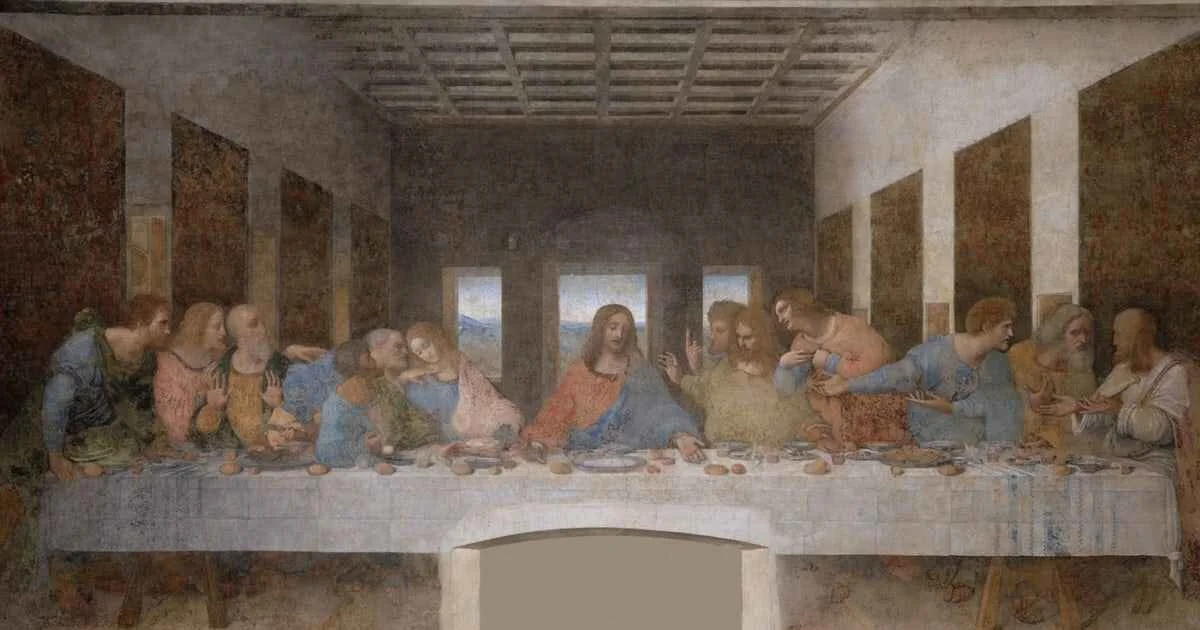
This is the point in Jesus’s life, just before his death, where he instituted the Lord’s Supper (known in Catholicism as the Eucharist)—it’s the part of the service where we take the bread and the cup and say, “This is the body of Christ, this is the blood of Christ.”
Few subjects have stirred up more controversy in the Christian church than this one. There’s the classic dispute between Catholics and Protestants over what it means; and even among the Reformers, we have correspondance between Martin Luther and John Calvin in which they violently disagree with each other about this topic.
It seems like no matter what branch of Christianity you find yourself in, there is someone in your camp who will disagree with you on this. We bring a lot of baggage to the table when it comes to the Lord’s Supper.
There’s baggage around how it’s presented. How many people here grew up hearing the Lord’s Supper presented (implicitly or explicitly) as a private time—a moment to personally reflect on our sins, and on what Christ did for us on the cross? We’d take it at the same time, but we’d do it with eyes closed, silently prayerful. We’d see it as a moment between me and God. But the way it’s presented in the Bible, the Lord’s Supper is not a private moment—personal, but not private.
There’s baggage around the language we use to talk about it. The Lord’s Supper is one of the ordinances, or sacraments, that Christ himself instituted. I want to maintain the use of that word, because it accurately communicates the seriousness of what we’re doing; but it’s tricky, because when Catholics use that word, they mean something very different than what we (Protestants) mean when we say it.
One way of articulating the Catholic view of the sacraments came from Thomas Aquinas. He said that on the cross, Jesus Christ built up a “storehouse of merit”, and the sacraments are the means by which Christians access that merit. To put it simply, on the cross, Christ provided all the grace we’d ever need, but we don’t get it automatically; we access that grace through the sacraments. So according to this view, the sacraments are a way of making sure we keep on getting saving grace from God.
That’s not what we believe. For Protestants, the sacraments are particular means by which Christ helps his people become more like him, in a unique way. They’re not the only way he helps us, of course—he does it through the Bible and prayer and preaching and the community of believers, etc.—but the sacraments are a particular tool God uses in a unique way to help us grow more like him.
Another difference is in simple number: Catholics believe in seven sacraments—baptism, the Eucharist, confirmation, confession, marriage, anointing of the sick, and the holy orders.
Protestants only hold to two: baptism and the Lord’s Supper.
The other big difference is what we think happens when we take the Lord’s Supper. The classic Catholic view is called “transsubstantiation,” and it means that the bread and the wine literally become the body and blood of Christ when you receive it, without losing their physical properties.
Again, that’s not what we believe. The bread is just bread, the juice is just juice. They do not become anything else. But we would hold that through this ordinary bread and juice, Christ is present in a particular way to help his people grow in holiness when we take the sacraments—the Lord’s Supper and baptism. This is what we mean when we call these two institutions the “means of grace.”
I know all that sounds vaguely mystical, but don’t think I’m going weird on you. As we go on, one of my goals will be to explain why it makes sense that the sacraments help us grow in Christ in a particular way.
So to do that, let’s go to out text—Luke 22.7-20, and see what the Bible has to say about it.
The Passover (v. 7-18)
If you remember from last week, the Jewish religious authorities want to kill Jesus because he is challenging their authority. In our previous text (Luke 22.1-6), we see Satan entice one of Jesus’s disciples, Judas, to make a deal with the religious leaders to let them know the next time they are in a secluded place, so that they can arrest him far away from the eyes of the crowd.
But something needs to happen first. Jesus needs to take one final meal with his disciples.
Let’s read, starting at v. 7:
7 Then came the day of Unleavened Bread, on which the Passover lamb had to be sacrificed. 8 So Jesus sent Peter and John, saying, “Go and prepare the Passover for us, that we may eat it.” 9 They said to him, “Where will you have us prepare it?” 10 He said to them, “Behold, when you have entered the city, a man carrying a jar of water will meet you. Follow him into the house that he enters 11 and tell the master of the house, ‘The Teacher says to you, Where is the guest room, where I may eat the Passover with my disciples?’ 12 And he will show you a large upper room furnished; prepare it there.” 13 And they went and found it just as he had told them, and they prepared the Passover.
14 And when the hour came, he reclined at table, and the apostles with him. 15 And he said to them, “I have earnestly desired to eat this Passover with you before I suffer. 16 For I tell you I will not eat it until it is fulfilled in the kingdom of God.” 17 And he took a cup, and when he had given thanks he said, “Take this, and divide it among yourselves. 18 For I tell you that from now on I will not drink of the fruit of the vine until the kingdom of God comes.”
The time of the Passover has arrived. Jerusalem is now swarming with people, which would have made it very difficult for Jesus’s group to get a room for the night to celebrate.
So Jesus sends two of his closest disciples, Peter and John, on a secret mission. He tells them what to look for, and they find everything ready, exactly as Jesus said it would be.
We saw this last week, but this little prologue serves as a reminder: Jesus was in complete control of what was about to happen to him. He wasn’t being tricked by Satan’s schemes—Jesus, and no one else, would decide where and when he would be arrested.
So he made sure that this final meal with his disciples would take place in an unknown location where they wouldn’t be interrupted, where Judas couldn’t warn the authorities of their presence.
In v. 14, Jesus and his disciples arrive at the upper room, all prepared and ready. They sit down at the table to celebrate the feast of the Passover. And Jesus says that he has earnestly desired to eat this Passover with his disciples, before going to the cross.
Why was this so important to him? What was it about the Passover that made it the perfect occasion to have this particular conversation with his disciples?
The Passover was one of the climactic moments in Jewish life. If you really want to understand what was going on during the Passover, the best place to start would be Exodus chapter 12.
We don’t have time to read the whole passage, but in Exodus 12 we see the story of Moses’s intervention to free the Hebrews come to its climax. The people of Israel have been in slavery in Egypt for many years; they have been crying out to God to free them.
And God responds by sending them Moses, a Hebrew who was raised as the adopted son of the Pharaoh’s daughter. He is sent by God to convince the Pharaoh to let the people go free.
Through Moses, God convinces Pharaoh to let the people go by sending a series of plagues against Pharaoh—but ultimately it is the only last plague which convinces him.
God sends an angel to kill all the firstborn—animals and humans—in Egypt. He gives the people of Israel a visible sign to show, so the angel would not come into their houses and kill their firstborn. They are to slaughter a lamb, and wipe its blood on the doorposts of the house. When the angel sees the blood of the lamb, it will pass over their houses, and spare their firstborn.
And that is what happens. The Egyptians suffer devastating loss, but the Hebrews lose no one. The Pharaoh is so distraught after losing his own child that he lets the people of Israel go free.
Here’s what we need to remember: God showed his faithfulness to his people, by saving them through the sacrificial blood of a lamb, shed in their place.
That’s what the Jews are celebrating when they celebrate the Passover.
So Jesus, at this final Passover meal with his disciples, reappropriates the Passover for his own purposes. The feast of the Passover was never meant to be an end in itself—it was to be a picture of a better Passover which would come later, in the form of Jesus Christ.
So what Jesus is going to do in this meal is show his disciples that just as God saved his people in the past, he continues to save his people in the present.
And although they surely wouldn’t understand its fullest meaning right then, they would certainly understand it in a few days.
The Lord’s Supper (v. 19-20)
19 And he took bread, and when he had given thanks, he broke it and gave it to them, saying, “This is my body, which is given for you. Do this in remembrance of me.” 20 And likewise the cup after they had eaten, saying, “This cup that is poured out for you is the new covenant in my blood.”
Let’s work backwards here—let’s talk about the cup first.
If you know your Bible well, you’ll probably get what he’s doing here. But I don’t want to assume anything, so let’s ask the question: When he says, “This cup that is poured out for you is the new covenant in my blood,” what is the “new covenant” he’s talking about? And what does it have to do with blood?
To understand that, we once again have to go back.
In the book of Genesis, the first book of the Bible, we see that God created the world; he created man; and man rebelled against God—that’s what we mean when we talk about “sin”. Sin is rebellion against God, our Creator. Every man, woman and child who has come into the world since then is born in sin—we are all, by our nature, sinners. Since that point when sin entered the world, man has been separated from God’s presence.
And from the earliest pages of the Bible, we see the beginnings of God’s plan to bring his presence back to the people he created. That is, essentially, the story of the Bible—it is the story of how God brings his presence and his reign back to his people.
He chose a people for himself, the people of Israel, and he made a covenant with them. If the people obeyed God’s law and followed his good rules for them, they would be his people, and he would dwell with them as their God.
And in Exodus 24, we see the inauguration of this covenant.
It’s a startling scene. They slaughtered oxen, put the oxen’s blood in basins, then poured half the blood against the altar, and threw the rest of the blood on the people.
Can you imagine? It was a gory mess.
But that gory mess was filled with symbolism and meaning.
The blood reminded the people of how serious sin is—it showed them that the only appropriate punishment for sin is death.
That’s a problem, because the people deserved death for their sin, and God is just, so he will always give the appropriate punishment for sin. But if God killed his people as they deserved, they wouldn’t be his people anymore, because they’d be dead.
So God provided a ritual of sacrifice for them: animals would be killed in their place, essentially taking the punishment for their sins, so that they could be declared righteous.
These blood sacrifices had to be repeated on a regular basis, because the people—as you quickly see if you read the Old Testament—were constantly breaking God’s law. They never managed to obey him. Their sin repeated endlessly, so the sacrifices had to be repeated as well.
Now. Fast-forward to several thousand years later, in the upper room in Jerusalem, where Jesus is sitting with his disciples.
Jesus gives his disciples the cup to drink, and says, This cup is the new covenant in my blood. So you can see that he is clearly referencing this first covenant with its blood sacrifices, but he’s doing so in a particular way. He is contrasting what he is about to do with what the first covenant did.
In just a few hours, Jesus would be arrested. He would be falsely accused and convicted. He would be tortured, and he would be crucified.
At his crucifixion, he would take on himself the sins of his people, and he would be punished in their place, for their sins—exactly like the animals of the Old Covenant sacrifices.
But his sacrifice would be different, because he was not only not an animal; he was also more than a mere man.
Jesus Christ is the Son of God—he is God made man. He lived the perfect life God’s people were commanded to live. He is the first and only man who perfectly obeyed every law of the Old Covenant. He fulfilled the Old Covenant for his people.
So his death for the people would not be like the death of animals, which had to be repeated without end.
Through Christ’s death on the cross for his people, the sacrifice was made—once and for all. He took our place, as our sacrifice…but he was the perfect sacrifice an animal could never be.
With Christ’s death, he established a new covenant with his people, and he fulfilled the terms of that covenant for them.
The cup Jesus gave his disciples in this moment was the symbol, the physical picture, of that covenant.
Now, what about the bread?
V. 19:
And he took bread, and when he had given thanks, he broke it and gave it to them, saying, “This is my body, which is given for you. Do this in remembrance of me.”
Now, here we can clearly see why we don’t believe that in the Lord’s Supper, the bread literally becomes the body of Christ, and the juice literally becomes his blood. When Jesus held out the bread for his disciples and said, “This is my body,” none of them would logically think that bread was literally his body, because his body was there in the room with them.
He’s speaking figuratively, saying, “This is a picture, or a symbol, of my body, which is given for you.” He’s setting up a symbolic ritual here, and clearly the disciples understood that, because they kept on receiving it in this way, and so have we all, ever since.
So the bread is a symbol of Christ’s body. We get that.
But what does Jesus mean when he gives them the bread, and tells them to eat it (cf. Matt. 26.26), and then says, “Do this in remembrance of me”?
I had a really hard time with this when I was younger; I couldn’t see how this would be an appropriate memorial to Christ—how eating a piece of bread and drinking a sip of wine or juice would help Jesus’s disciples remember him.
But we actually understand this better than we think we do, and very naturally.
When it comes time to give his disciples “something to remember him by,” he doesn’t give them a magic formula to memorize, or a poem, or a photograph. He gives them something physical and tangible. You can feel it; you can see it; you can taste it.
Everyone knows that physical stimuli, over time, builds up memory. We see it most easily in the context of family.
Think about your mother’s kitchen (or your father’s, if your dad is the cook of the family). Every time I go visit my parents, it doesn’t matter where they live or what house they’re in, the second my mom starts cooking dinner, I am immediately transported to my childhood. They still use the same plates, and the same silverware, we used when I was a kid. The feel of those particular forks in my hand, or of the plates as I’m setting the table, bring back very distinct and powerful memories in my mind.
Or think about it—why do we hug our kids? Because we love them, sure—it feels great to hug your kids.
But that’s not all there is to it.
My dad is an affectionate guy. He hugged me a lot when I was little, and he regularly told me he loved me. (Usually, he did both at the same time.)
Obviously, that doesn’t happen as often now, because I live far away and don’t see him as often. But even now that I’m an adult, every time my dad hugs me, I remember his love for me in a really particular way. I’m thirty-eight years old, and still today, if I’m hurting, a hug from my dad is one of the most comforting things in the world.
Let’s be clear: this is not an intellectual exercise. I have never once gone through the process of actually thinking, This hug is the means by which my father expresses his love for me.
It’s sense memory, in action. Dad hugs me, and I remember his affection for me—not in my head, but in my guts.
Without even having to think about it, when my dad hugs me, I feel his love for me in a particular way.
And without having to think about it, I feel my love for him in response.
God’s people are in constant danger of forgetting the grace of Christ. We are constantly bombarded with other things scrambling for our attention, other stimuli trying to get us to desire them and love them. We need help remembering.
So Christ gave us something physical, something tangible, something that help us remember his grace to us in a particular way. Something that would reform our hearts and minds, that would call us back to what we know is true, and help our hearts remember him, and respond in kind.
The Lord’s Supper and the Church
So let’s take a step back for a minute. The Lord’s Supper helps us remember Christ’s sacrifice for us in a particular way.
But everything I’ve just said could be reduced to an individual experience. And while it has to be an individual experience (because we’re individuals), it can’t be just that.
The sacraments Christ instituted—baptism and the Lord’s Supper—are both signs pointing to the New Covenant that Christ has established with his people. Baptism is the sign of our entrance into the New Covenant, and the Lord’s Supper is the sign of the perpetual renewal of the New Covenant.
One theologian put it this way: “The sacraments—baptism and the Lord’s Supper—are the means by which the people of God rehearse the story of God communally.”
When a Christian is baptized as Christ commanded, that Christian publicly declares that he or she has entered into the New Covenant through faith in Christ; and the church publicly declares that we affirm and welcome the Christian into the New Covenant community.
And when we, the church, receive the Lord’s Supper together, we publicly affirm that all of us are continually receiving all the benefits Christ purchased for us through his death. Paul said in 1 Corinthians 11.26,
For as often as you eat this bread and drink the cup, you proclaim the Lord’s death until he comes.
We “proclaim the Lord’s death”…to whom? To each other.
That’s why, when we take the Lord’s Supper here, we ask you to get up out of your seats, and to take the bread and the cup from someone else’s hands. We want you to look a brother or a sister in the eyes when you do it, as a reminder to both of you that the covenant that Christ established with his people is PERMANENT, and ongoing, and we are continually benefitting from it.
That’s what Paul meant when he talked about taking the Lord’s Supper unworthily, without discerning the body (1 Corinthians 11.27-29). In the context of 1 Corinthians 11, it’s clear that he’s talking about the body of Christ, the church. We cannot take Communion together and forget that we are taking it together.
Now I know a lot of you may be hearing all this and thinking, Yeah, that sounds nice and all, but REALLY, what difference does it make?
So let me get really practical for a minute. There are weeks when you’ll come in here, and you’ll just be totally in the clouds. You're thinking about other things, the sermon was boring, whatever (don’t worry, my feelings aren’t hurt).
Or there are weeks when you feel broken. Broken by the songs that we’ve sung, the Scripture we’ve read. During the preaching of the Word, your heart was convicted, you’ve recognized sin in your own life, and you just feel crushed under the weight of it all.
In either case, the Lord’s Supper is there to remind us that our feelings have absolutely nothing to do with what is true. No matter what we’re feeling, Christ’s sacrifice is still enough, and his covenant with his people has not moved.
Or maybe it has nothing to do with sin or spiritual things. Maybe you just came in completely destroyed by loss. I’ve told the story about several years ago, when Loanne and I suffered a series of miscarriages, before Zadie was born. I remember the first time we were back with you guys after that first miscarriage; we were still reeling.
And I can tell you that when I received the Lord’s Supper with you, I felt the presence and the goodness of Christ in a unique way, because I was reminded that his goodness toward me is his goodness toward all of us, and wasn’t affected in the slightest by the pain I was feeling. He was still there, and his covenant with his people had not changed.
And I felt the same thing the first time I received the Lord’s Supper after Zadie’s birth. In the joy I felt on that day, I took the bread, and I took the cup, and I was just overwhelmed with gratitude that, for all the goodness he had shown to us that week in giving us a healthy, beautiful baby girl, that was nothing in comparison to the goodness he showed us when he established a new covenant with us in his blood.
The Lord’s Supper is a weekly, tangible reminder of what is actually true about us: we are his, and he is Lord and King, offered once and for all for our sins.
So it is a weighty moment, absolutely; but it’s not a mournful moment. When we take the Lord’s Supper, we aren’t celebrating death or loss; we’re remembering the faithfulness of our God, who has provided salvation for his people.
It’s hard for us to see how something can be weighty and solemn, but joyful at the same time. At least it’s hard to see in this context, but in other contexts, we understand it just fine. Think of a wedding. We’ve celebrated two weddings in our church over the last two weeks.
Weddings are a big deal. This is no light affair. The things we gather to observe and reflect on when we gather for a wedding are massive.
But at the same time, what is more joyful than a wedding? (Or a wedding anniversary, which carry that same weight, and that same joy.)
Like a wedding anniversary, the Lord’s Supper is a weekly reminder of God’s grace to us—a reminder which is solemn, and weighty, but at the same time, joyful in the extreme.
Conclusion
So we’re going to receive the Lord’s Supper together now. And while we do it, I’d like you to think about a couple of things.
Firstly, look back. Think about the past. Think about your baptism—the sign of your entrance into the community. (We don’t require baptism to take Communion here, but only because we don’t have a baptistry and don’t want to force Christians who have faith in Christ to wait several weeks to be baptized. If you’re not baptized, but you’ve asked to be, you’re free to come. But if you have no intention of being baptized, then don’t take Communion—the two go together.)
So think of God’s faithfulness to you in your baptism. And go back even further than that. The Lord’s Supper is a reminder of God’s delivrance of the people of Israel in Egypt; it is a reminder of God’s continued faithfulness in delivering them from their enemies and establishing them in their land; and it is a reminder of his ultimate faithfulness to us in Jesus Christ. Think about the past faithfulness of God toward his people.
Secondly, look forward. Think about the future. I skipped over it before, but when he begins his meal with the disciples, Jesus gives them a cup and tells them to pass it around; and he says to them in v. 18: “For I tell you that from now on I will not drink of the fruit of the vine until the kingdom of God comes.”
Jesus is enjoying this meal with his disciples; it is a moment full of meaning for him.
But he is clear that as good as this meal is, it’s not the meal he’s really looking forward to. He is anticipating the joy of a future meal, which we see in Revelation 19.6-9—the meal he will have when he welcomes his church home with him in paradise.
The Lord’s Supper is Advent, every week—a look forward to the return of our King, to the ultimate Passover feast, where we will celebrate God’s salvation together with all his people, and with the One who saved us.
And lastly, look around. When we receive the bread and the cup together, we are reminding one another that we are not alone in this. This is a personal moment, but it is anything but a private moment. This is a family meal, in which the people of God rehearse the story of God together.
So if you have faith in Christ, and you follow him, and you love him, come and receive the Lord’s Supper with us, and trust that in this moment—through means both ordinary and mysterious—Christ is here with us, in a particular way, helping us to grow in him.