

God Is Immutable
God Is Immutable
(Psalm 102.25-28)
Jason Procopio
I’m old enough now to have had the surreal experience of going through old photo albums with my kids and seeing pictures of my dad when he was younger than me. My dad was twenty-four years old when I was born, so I have very clear memories of what my dad was like when he was my age or younger. Looking through those old pictures, the memories of what he was like back then came screaming back to me. (Jack couldn’t believe it either; he kept saying, “Wow, he looked just like you.”)
It’s an almost melancholy experience, because although my dad is still pretty young, I have seen him change. When I was a child, he was right in the peak of his physical form. He still looks great, but his hair has gotten gray; he’s just a bit thicker than he was when he was my age. (So I guess I know what to expect.) When I was young my dad was a ball of energy; now he gets tired. When I was young he was almost hopelessly optimistic; now I see him worried.
I know some of that is probably due to the fact that I’m older too, so he lets me see aspects of himself he didn’t let me see when I was little.
But that’s not all there is. My dad, who in my mind was stable as a rock, has changed, and is still changing. In many ways he’s changed for the better; in some ways he’s suffered the changes that come from being an older man. But in either case, he’s not the same now as he was back then.
That reality is at the heart of some of our greatest fears about ourselves, and some of our greatest assurances from God.
We are in the second week of our annual series on the attributes of God. Last week we saw that God is independent—meaning that he exists completely in himself, and has no need of anything outside of himself to be or to act.
Today we’re going to be looking at a natural extension of that attribute: namely, that God is immutable. That is, he is unchanging. To see this, we’re going to hop around a good bit today, but we’ll start in Psalm 102.
God Never Changes
We’ll be mostly focusing on v. 25-28, but let’s just get a little context. The beginning of this psalm is a solid lament. We don’t know exactly what’s going on, and that’s not the point—the point is how the psalmist feels about what’s going on.
The heading for Psalm 102 reads, A Prayer of one afflicted, when he is faint and pours out his complaint before the Lord.
This man is so desperate and weak that he forgets to eat (v. 4). He weeps in despair over God’s judgment (v. 9-10).
But after telling God how he feels about his situation, he comforts himself by reminding himself of God’s continual faithfulness. He reminds himself of God’s faithfulness to the weak and the needy (v. 18-22).
But how can the psalmist know that God will continue to be faithful? He gives the foundation of his trust in v. 25-28.
25 Of old you laid the foundation of the earth,
and the heavens are the work of your hands.
26 They will perish, but you will remain;
they will all wear out like a garment.
You will change them like a robe, and they will pass away,
27 but you are the same, and your years have no end.
28 The children of your servants shall dwell secure;
their offspring shall be established before you.
So the psalmist is honest about his pain; but he reminds himself of God’s faithfulness. And he knows that God will continue to be faithful, because God never changes.
The earth will perish, but you will remain. The heavens will wear out, but you are the same.
Last week we saw that God is completely independent—he alone has aseity, meaning, he alone is self-existing and self-sufficient. And by definition, if he has being in and of himself, his being doesn’t depend on anything outside of himself.
Which means that nothing can happen that has the possibility to change him. As the song goes, As thou hast been, thou forever wilt be.
Or as we read in James 1.17:
Every good gift and every perfect gift is from above, coming down from the Father of lights, with whom there is no variation or shadow due to change.
We hear this and we nod our heads—in the context of this limited conversation, we can get behind that idea.
But if we’re honest, we have to admit that at other times, it’s harder for us to believe that.
Most Christians, if they read their Bibles (and unfortunately that’s a big “if”), will tend to gravitate towards the New Testament, the second part of the Bible, which talks about Jesus and the beginning of the church. It’s astonishing, the number of Christians who never read the first part, the Old Testament, which tells the story of God’s people before Christ. (Or if they do, they’ll only read the Psalms and Proverbs.)
But let’s not be too hard on them. Even if I disagree in the strongest possible way, and will encourage you night and day to read all of the Bible—Old Testament and New—at least once a year if you can… I do understand why some people have a hard time with it.
And one of the reasons is that God, as we see him in the Old Testament, can seem quite a bit different from God as he appears in the New Testament.
People sometimes say things like, the God of the Old Testament is the God of judgment. The God of the New Testament is the God of grace.
The God of the Old Testament is the God of wrath. The God of the New Testament is the God of compassion.
The God of the Old Testament is the God of punishment. The God of the New Testament is the God of forgiveness.
On and on you could go.
I could go on a rant now about how this is patently untrue—and it is. The God of the Old Testament is not a different God from the God of the New Testament. He’s the same God. Yahweh and Jesus Christ are not at odds with one another. This is a ridiculous false dichotomy people have created.
But even so, let’s cut people who say such things some slack.
For those of you who have read the whole Bible, have you never had the experience of reading a passage from the Old Testament, and feeling really heavy and burdened, really conscious of the wrath of God, and then wanting to hurry over to the New Testament so that you can feel reassured of God’s grace? If that’s never happened to you, then you’re probably not reading your Bible.
That is how it feels sometimes. When we read the Bible too quickly, that is what we might come away with.
So if that is you, don’t feel bad, and don’t be afraid. If you have a tendency to view God differently at different times in the Bible, there are two concepts that can help you make peace with what this seeming (but untrue) disparity.
Let’s look at the harder one first. It’s called the “inseparable operations of the Trinity.” (As always, you don’t need to know the term, but the idea behind it is really important.)
That word “Trinity” simply means what the Bible means when it talks about God. The Bible says that there is one God, and that this one God has eternally existed in three distinct persons: the Father, the Son and the Holy Spirit. (We don’t have time to go into how that works, so I’ll give you the simple explanation: I have no idea, and no one else does either.)
So often people will unconsciously separate the work of the three persons of the Trinity. They’ll think that the Father is at work in the Old Testament, and the Son and the Spirit are at work in the New Testament.
This concept of inseparable operations of the Trinity simply says, "It doesn’t work like that.” Any time you see God doing anything, all three persons of the Trinity are at work.
You can’t separate the work of the Father from the work of the Son. You can’t separate the work of the Son from the work of the Spirit. And so on. In the Old Testament, the Father, the Son and the Spirit are always working together. And in the New Testament, the Father, the Son and the Spirit are always working together.
Everything God does, he does it in all the persons of the Trinity. Everything they do, they do together, as God.
This reality should do away with these ideas we have of God being different in the Old Testament and in the New Testament.
Guess what? As hard as it is to imagine or accept it, when the Father poured out the plagues on Egypt, guess who was there, doing it with him? The Son and the Spirit. When Jesus healed the multitudes, guess who was right there, doing it with him? The Father—the same Father who judged idolatrous nations in the Old Testament.
When we see God doing things in the Old Testament which we wouldn’t naturally ascribe to Jesus, we should always remind ourselves that the Son was right there with the Father, working with him to do that very thing.
The second helpful concept is a little easier, and in theology it’s called “progressive revelation.”
Progressive revelation says that although God is always the same, he doesn’t tell his people everything there is to know, all at once. He reveals himself and his plan progressively, little by little.
At creation, he shows that he is the Creator.
To Moses he gives his name—Yahweh, the great “I AM.”
After the exodus in Egypt, he gives his people his law—the standard of righteousness that reveals his own perfect character.
Through the law, he shows his people that they could never be perfect on their own (because they can never obey it).
Through the prophets, he reveals why that’s a problem, and promises to send a Savior to solve that problem.
And in Christ, he shows his people just how mind-blowing his solution is: God himself will take on the imperfection of his people, and suffer the punishment for their rebellion in their place. God himself will suffer his own wrath for the people he loves.
In other words, there are steps to God’s plan, which allow us to see many different facets of his character and plan—his perfection, his power, his justice, his wrath, his love, his grace—at different times. But God himself is the same at every step; it’s just that he didn’t reveal all these different facets of his character at the same time.
All of this reminds us that from the beginning of the Bible to the end, we learn about God progressively, but God himself does not change. The God of the Old Testament is the God of the New Testament; he did not change between the book of Malachi and the book of Matthew. He does not change. He is immutable.
How We See God
So that’s the theology of God’s immutability. And we needed to see that to understand why it matters.
Why does it matter? What does the knowledge of God’s immutability change for us?
First of all, it changes the way we see God.
God’s immutability is the guarantee of his faithfulness. This is what we see in Psalm 102—the psalmist speaks of God’s continued faithfulness, and then rests in the fact that this faithful God never changes.
There are all kinds of promises in the Bible of things that God will do for his people. Some of those promises have already been fulfilled. For those promises, as we read the Bible from beginning to end, we can actually see how he did it. We can see that he was faithful to do what he said he would do.
Some of the promises we find in the Bible haven’t been fulfilled yet. We’re still waiting on these things. But we can have absolute assurance that he will do it.
Why? Because he never changes. As we saw last week, nothing can make God want something he doesn’t want; nothing can make him change his mind. His immutability guarantees that if he says he will do something, he will do it.
Secondly, his immutability is the guarantee of his knowability.
Because God never changes, we can know him. He has revealed himself in his Word, so we can go to the Bible and know that the way God describes himself in these pages is still true of him today.
He hasn’t told us everything there is to know about himself—we’ll never exhaust the riches of his person—but everything he has told us about himself in the Bible is still true of him today. He has not changed in the thousands of years between the writing of Scripture and today. Because God never changes, we can know him.
Similarly, his immutability reminds us of the unchanging truth of Scripture.
In Matthew 7.24-27, Jesus says,
24 “Everyone then who hears these words of mine and does them will be like a wise man who built his house on the rock. 25 And the rain fell, and the floods came, and the winds blew and beat on that house, but it did not fall, because it had been founded on the rock. 26 And everyone who hears these words of mine and does not do them will be like a foolish man who built his house on the sand. 27 And the rain fell, and the floods came, and the winds blew and beat against that house, and it fell, and great was the fall of it.”
The sand constantly shifts under a house, but a rock is steady, unmoving. Christ’s words are a sturdy foundation for our lives because they are God’s words, and God never changes.
The God who inspired the book of Genesis is the God who lives in us today. The God who preserved his Holy Word through the millenia preserves us.
We can go to the Bible, and know that the Bible doesn’t change depending on time or place or context, because it is God’s Word, and God never changes. No matter where we are, or what we are dealing with, these promises are sure and steady; they do not depend on any external factors.
His immutability gives us comfort.
Why would the fact that God never changes be comforting? Well, we understand why even on a basic, human level.
My parents moved a lot when I was a kid, so we don’t have a “family house”, so to speak. But no matter where they have lived, there are things in the house that are always present.
The collage of baby pictures which hangs on my parents’ wall has been there since I was a child.
The silverware and the dishes they use today are the same ones we used when I was little.
This slightly unsettling sculpture of Santa worshiping the baby Jesus. (We’ve had it since I was little, and I love it.)
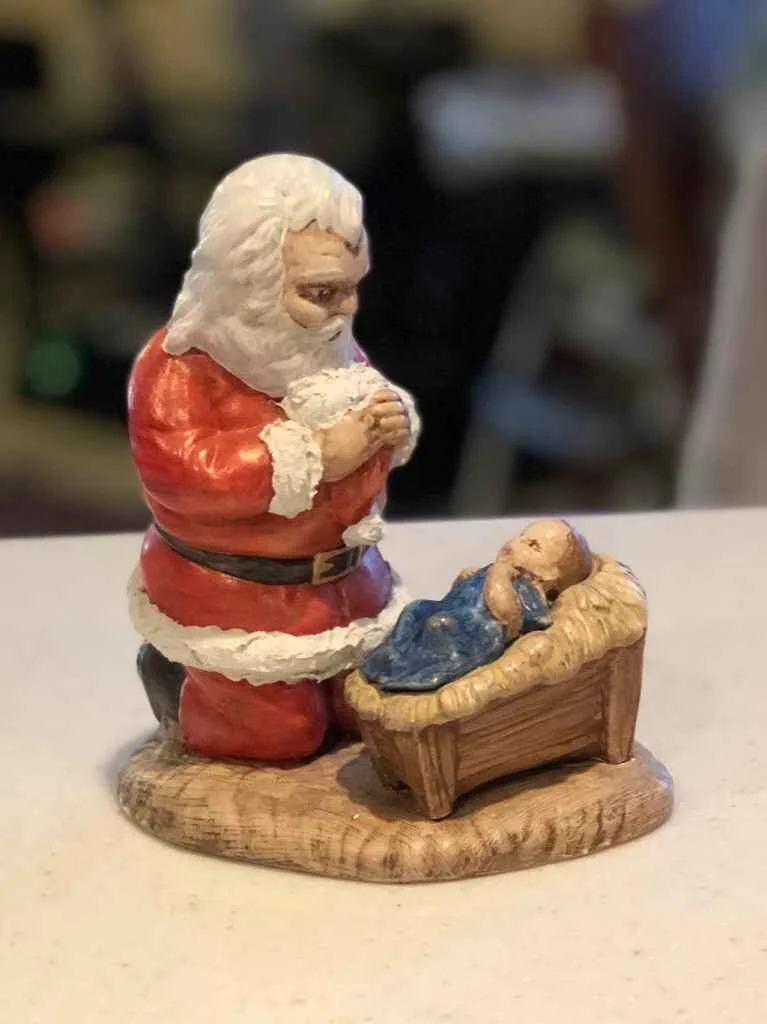
They have many of the same blankets they’ve had since I was little.
No matter where they live, my parents’ house has the same smell.
I'm thirty-eight years old now, and I have a family of my own. I don’t need my parents now the way I did when I was young. But even so, there’s something strangely comforting about coming home and seeing those permanent fixtures of my childhood, smelling the smells I grew up with.
God’s immutability is our ultimate source of comfort. One of the defining characteristics of God we see in Revelation 4.8, after his holiness, is that he is the Lord God Almighty, who WAS and IS and IS TO COME.
We take comfort in our God’s power, and holiness, and wisdom, and goodness, because we read about him in the Bible, and we know that the amazing God we see in these pages is the same God who lives in us, and cares for us, and serves us.
The truth of God’s immutability changes the way we see God.
And it also changes the way we see ourselves.
How We See Ourselves
God never changes. We, on the other hand, are constantly changing.
We are never constant. We are never consistent. We say we’ll do one thing, and we do another. We change our minds. We go back on commitments.
The fact of our perpetual change is true on every possible level. Our skin cells—all our skin cells—die and are replaced approximately every 27 days. Each of us loses 50 to 100 strands of hair every day. (Obviously, there are many other examples I could give.)
We don’t just see it physically; we see it in our behavior, even over very short periods of time. This is why we love the psalms, right? One minute David’s saying, “Oh God you are always with me, my soul is satisfied in your presence,” and literally three lines later he’s saying, “God, where ARE you?! Why have you forsaken me?!”
Is this not us? We feel confident, we feel happy, and one tiny piece of bad news—say, the news of a transport strike in Paris—can change all of that really quickly.
And if it’s true on a small scale, in regards to things like our mood, how much more true is it of larger-scale issues?
We have lots of couples in the church who got married recently. When we do pre-marital counseling with new couples, we ask them many questions about where they see themselves in several years’ time: what they plan on doing in terms of life at church and raising kids and vacation and handling finances and sex and hospitality and many other things. It’s good to talk about these things.
We’re always very careful to say that these things are subject to change. But no matter how often we say that, couples are always surprised when they actually do change. “You said you wanted two kids, and now you want six?!” “But we talked about this! We had a plan!”
Yes we did. But people change.
(And isn’t it interesting that in these situations, we ironically use the language of immutability to point out imperfections in the other—“You always do this!” “You never do what you say you will!”)
Human beings are inherently disappointing—not because we’re all as bad as we could be, but simply because when dealing with other people you rarely get what you expect to get. We are constantly changing.
But there is good news in that as well. The good news behind the fact that we are constantly changing is the simple truth that we can change.
One of the most frequent and destructive lies you see in relationships is the one which says, “This is just who I am. You can’t ask me to be something I’m not.” It’s destructive because it is a lie.
We can change, and we know it, because we change all the time. We can change for the worst, but we can also change for the better. Now, those changes for the better will all be accessory if the Holy Spirit doesn’t do the work of changing our hearts, but how often do we look at our lives and doubt that the Spirit can actually do that?
We look at what the Bible calls us to be, what God calls us to do, the type of person he wants to make us into, and we are horribly daunted. We look at even something as simple as the Ten Commandments, and we think, Well, I’m in trouble. I’ll never be able to live like that.
But people change for the better all the time. People learn to create different habits, to see things differently, to eat better, to live more generously, to be less self-serving.
So imagine how much further we can take that potential for change if we have the unchanging God of the universe in our corner, changing us as he has promised to? Imagine how much more we could change if we weren’t the ones doing the changing, but if God did the changing in us?
That is exactly what he says he will do.
In Ezekiel 36.26-27, God says to his people:
26 And I will give you a new heart, and a new spirit I will put within you. And I will remove the heart of stone from your flesh and give you a heart of flesh. 27 And I will put my Spirit within you, and cause you to walk in my statutes and be careful to obey my rules.
And in Philippians 2.12-13, Paul explains how God does it:
12 Therefore, my beloved, as you have always obeyed, so now, not only as in my presence but much more in my absence, work out your own salvation with fear and trembling, 13 for it is God who works in you, both to will and to work for his good pleasure.
We work—we resist sin and we grow in spiritual discipline and we serve one another—and in our work, we become more like him. And we actually do become more like him, because it is God—the unchanging God of Abraham, the immutable God of Jacob, the ever-same God of Moses—who is working in us to conform us to the image of his Son, applying the finished work of Christ to our hearts and lives, declaring us righteous and then making us righteous.
We can change, because God never does. The God who transformed the saints of the Old Testament and the New, the God who took a murderer and turned him into the Apostle Paul, the God who took the ultimate sin—the murder of his own Son—and through that sin brought about salvation for all his people, works in us today.
He never changes. Which means we can change.
Conclusion
The reality of God’s immutability places two great calls on our lives.
Firstly, it calls us to obedience.
The God who doesn’t change tells us what he is like, and invites us to become like him.
He sends his Son to live our life and suffer our death, so that we no longer have the threat of condemnation hanging over us. And once he reconciles us to himself and declares us righteous, he continually works in us by his Spirit and says, “Work with me. Let me change you.”
Brothers and sisters, what we were, what we always have been, is not what we have to be.
For those of us who have been saved by the Holy Spirit of God, sin is no longer the default position of our hearts. He has freed us from sin. So we no longer have to say yes to sin.
If there is one truth I pray you grasp almost more than any other, it is this: because of the finished work of Christ for us, sin is no longer inevitable.
We can choose to speak fairly and humbly about our boss instead of complaining about him behind his back.
We can choose to look away from sin rather than giving in to it.
We can choose to be generous, to make sacrifices for the kingdom of God, rather than amassing a wealth of useless toys for ourselves.
We can choose to not sleep with our girlfriend, to not be casual about her sexuality, but to protect it for the day we can enjoy it as God intended.
YES, WE CAN.
Because the unchanging God has made good on his promise to save us from sin, we can learn to love what he loves. We can learn to desire what he says is truly desirable. We can learn to trust that he knows better than us.
The reality of our unchanging God calls us to change, through his Spirit, to be like him.
And most importantly, the truth of God’s immutability exposes our own idolatry, and invites us to place our only hope in God alone.
How often are we driven to place our trust in unstable things? in things which could never support the weight of our trust? Like the proverbial house on the sand, we build our lives and our hopes and our identities on things which are constantly changing, constantly shifting, constantly subject to change.
Consequently, our false gods always disappoint us.
If we want a good example of that, think of the way we often speak of marriage.
People often quote 1 Corinthians 13 at weddings. Most people—even most unbelievers—have heard this passage, but I’ve always hesitated to use it at weddings.
We read in this passage:
4 Love is patient and kind; love does not envy or boast; it is not arrogant 5 or rude. It does not insist on its own way; it is not irritable or resentful; 6 it does not rejoice at wrongdoing, but rejoices with the truth. 7 Love bears all things, believes all things, hopes all things, endures all things.
I’ve heard this text used at weddings before, and my cynical reaction is always the same: “Yeah, good luck with that!” Not a single marriage in human history has made good on the promise of this kind of love.
Marriage (or any close friendship, for that matter) is a wonderful diagnostic tool—it lets us see, very quickly, how unloving we actually are. We are not always patient or kind. We often envy. We are often rude. How easy is it to insist on our own way, to be irritable or resentful? How impossible is it to bear all things and endure all things when “all things” include the sin of another human being, pointed at us?
But this passage makes more sense if we realize that it’s not describing the love we have, but the love of God, which he is building in us?
Jen Wilkin said of this text: “What better passage to read at a wedding than one that describes the kind of love we can never hope to receive perfectly from anyone but our heavenly Father? How much more willing might we be to replace the always and never language of our human arguments for the language of grace and forgiveness if we could just recognize that we cannot ask another human to be our God?”
There is only one who is unchanging, and he alone is God. He alone can stand the weight of our expectations, of our hopes, our fears and our identities. And he alone has provided his Son, the only means we have to build our house on the rock.
So as we realize how inconstant we (and everyone else) are, we are invited to place our trust in the only constant in this universe: God himself, whom we can trust, because he never changes.